TRANSMISSION // 2611.29856v1
Could AI World Models Help Plan Mars Terraforming?
Source published
A position paper proposes physics-constrained AI world models for testing Mars-atmosphere interventions, but its architecture and benchmark have not yet been demonstrated.
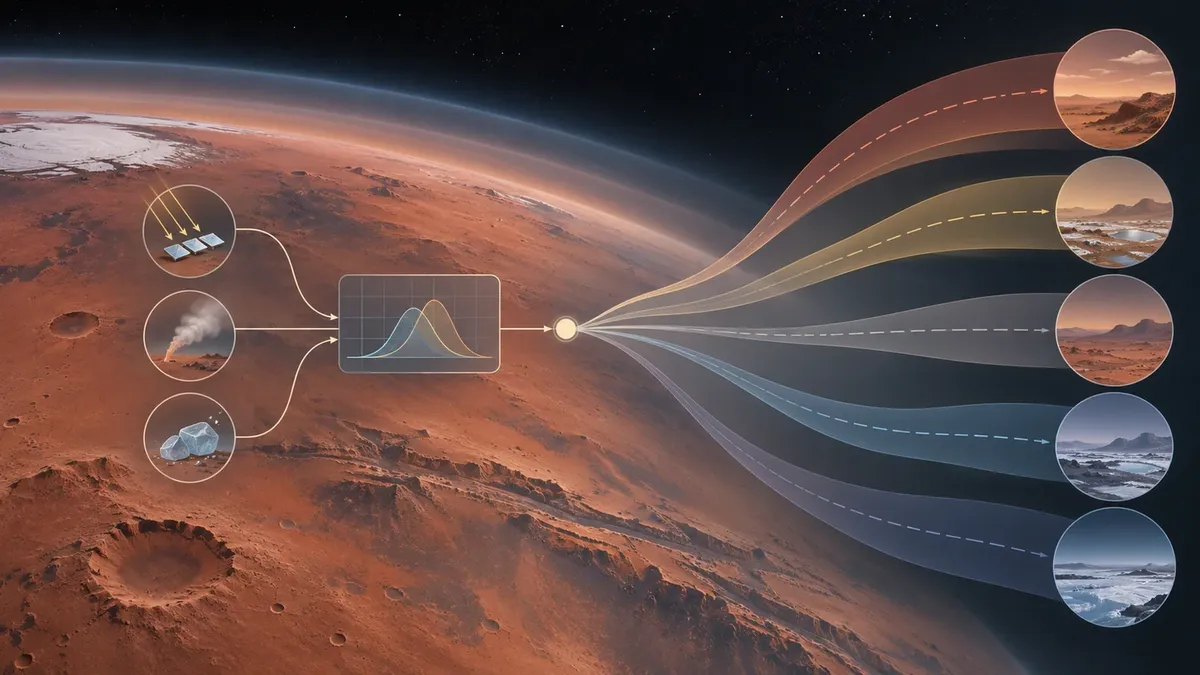
Terraforming Mars would mean guiding atmospheric change over timescales far beyond ordinary forecasting. This paper argues that a particular kind of AI simulator could help compare possible interventions—but it presents a research proposal, not a working system or evidence that terraforming plans would succeed.
The challenge: predicting a planet under intervention
A climate model can estimate how an atmosphere may evolve, but planning a deliberate change poses a tougher question: what happens if someone takes a particular action, and then another, over many years? For Mars, the proposed interventions include adding greenhouse gases, darkening polar regions to absorb more sunlight, and using orbital mirrors to increase incoming light. A useful planning tool would need to predict how those choices affect the atmosphere as their effects accumulate.
The authors describe this as a long-horizon control problem. Existing Mars general circulation models (GCMs) represent atmospheric physics, but the paper argues that running them repeatedly to explore many intervention sequences is too computationally demanding. Conversely, learned climate models and AI world models may be faster, but, in the authors’ assessment, existing versions do not combine Martian atmospheric physics, action-conditioned predictions and reliable long-term behavior.
The paper is a position paper: it makes the case for a research direction rather than reporting a completed model comparison or a successful terraforming simulation.
A proposed model, not an experimental result
The authors sketch a system that would compress atmospheric conditions—such as temperature, pressure, dust and winds—into a compact internal representation. A recurrent state-space model would update this representation over time, taking intervention choices into account. In plain terms, it would retain a summary of the atmosphere’s history while imagining how different actions might change what comes next.
The proposal combines ideas from several areas of machine learning. A JEPA-inspired encoder would predict in a learned representation rather than trying to reproduce every detail of an atmospheric map. A Dreamer-style planning component would compare possible action sequences inside the learned model. Physics-informed constraints and universal differential equations would, in principle, keep the predictions closer to known atmospheric rules while allowing learned components to represent processes that are poorly characterized.
The authors favor a recurrent state-space architecture over a transformer-based alternative for this application. Their rationale is that its stochastic latent state could represent multiple plausible futures, while its recurrent memory could track earlier conditions and actions. They also argue that this structured approach may be better suited to a sparse Martian observational record. These are arguments for the design, not findings from tests showing that it is more accurate, stable or data-efficient than transformers.
What MarsWorld would test
The paper proposes MarsWorld as an open benchmark specification. It would evaluate models on atmospheric forecasts under intervention sequences, using observations and reanalysis products such as EMARS and OpenMARS, with synthetic data from the Mars Climate Database proposed as an additional training source. The benchmark’s reference trajectories and full evaluation are left for future work.
The proposed tests cover several distinct questions: how closely predictions match held-out GCM trajectories; whether rollouts respect selected physical constraints; how long simulations remain within a range supported by physics-based models; and whether a policy chosen by the learned model performs when tested in a separate GCM. That last step matters because a policy can look promising inside its own simulator yet fail in another model.
The benchmark would therefore assess performance against simulated reference data—not observations of a terraformed Mars. The authors also acknowledge that results could reflect similarities between the training and evaluation simulators, rather than generalization to the real planet. Testing across different GCM families could reduce this concern, but the paper says full simulator independence cannot be claimed without intervention data from Mars.
What remains uncertain
The central claims—that the proposed architecture can support stable, physically credible, multi-century rollouts and make policy search practical—remain untested in this paper. The authors explicitly say that physics constraints’ ability to reduce the data needed for learning has not been demonstrated here. They also note that different interventions may produce overlapping atmospheric effects, complicating efforts to identify which action caused a predicted change.
Long-range forecasts are especially demanding when the system moves beyond the conditions represented in training data. Physics constraints may rule out some impossible predictions, but they do not by themselves establish that the model will accurately capture unfamiliar atmospheric processes. The paper itself presents benchmark evaluation and comparisons against data-only and physics-only alternatives as necessary future tests.
In short, this is a case for building and testing an AI planning tool for planetary atmospheres—not evidence that such a tool already works, or that Mars can be made habitable. The source is an arXiv preprint marked “Preprint”; the claims should be read as the authors’ proposal rather than as a demonstrated result or established scientific consensus.
- Mars terraforming
- world models
- planetary climate
- artificial intelligence
- climate simulation
- MarsWorld
Related reading
Automatically matched by shared topic keywords. These links do not imply that the sources agree or establish a consensus.
A warmer Mars could support plants long before people could breathe its air
Source published
Shared keywords: planetary climate
Could AI Learn Better by Looking Back?
Source published
Shared keywords: artificial intelligence, world models
A Safety Check for Video World Models at Walls
Source published
Shared keywords: artificial intelligence
Why one action may not teach an AI how actions work
Source published
Shared keywords: artificial intelligence, world models
Why more accurate world models may not plan better
Source published
Shared keywords: artificial intelligence