TRANSMISSION // 2611.29794v1
Could the Sutlej Stream Come from Tucana III?
Source published
Deep DECam observations reveal extra structure in the Sutlej stellar stream. Its similarities to Tucana III make a shared origin plausible, but unconfirmed.
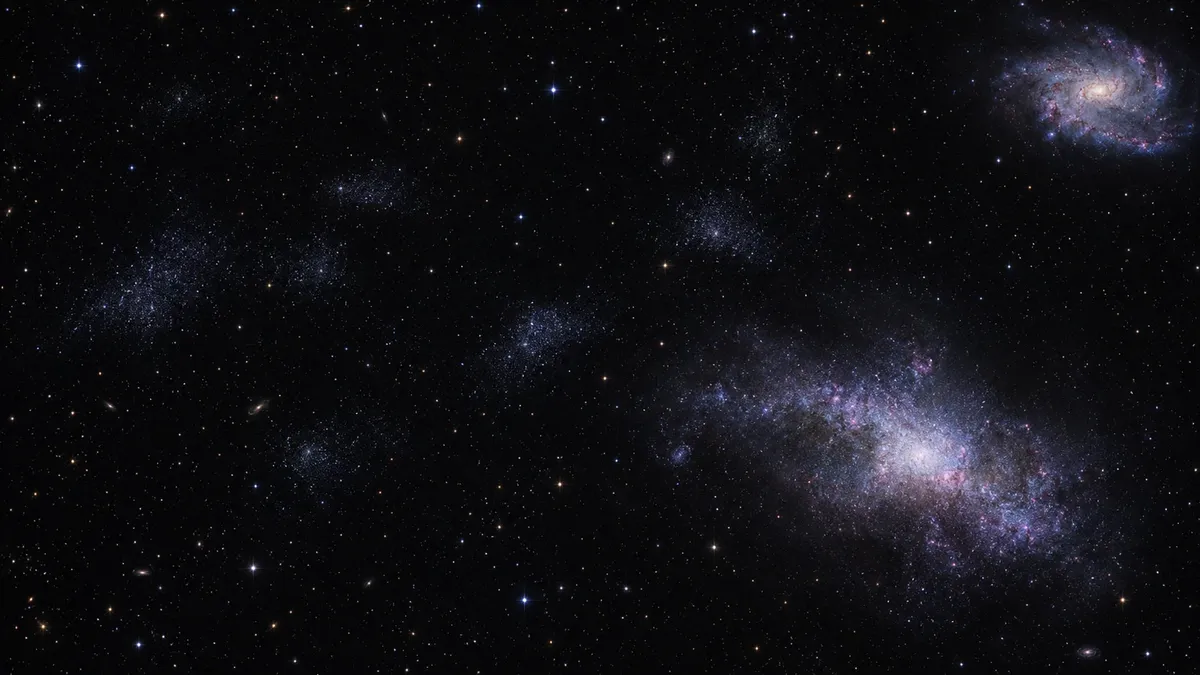
Deeper images show that the Sutlej stellar stream may be more complex than its two known branches. Researchers propose that some of its stars could come from Tucana III, but the evidence does not yet establish that connection.
Stellar streams are groups of stars spread out when gravity pulls them from a smaller system, such as a dwarf galaxy or star cluster. Their positions and motions can help researchers study the Milky Way’s gravitational field and the history of its satellites. The Sutlej stream, found near the Small Magellanic Cloud (SMC), was first identified as two parallel branches of old, metal-poor stars. A new study uses deeper images to look for fainter parts of the structure and asks whether it could be related to the nearby system Tucana III.
Searching for fainter stars
At Sutlej’s distance, about 32 kiloparsecs, Gaia mainly detects the brightest stars. The researchers instead used photometry from DELVE DR3, a catalogue that includes images taken with the Dark Energy Camera. Its observations reach about 2.5–3.5 magnitudes below the stream’s main-sequence turnoff, a point on a star’s brightness–colour pattern that helps indicate its age and distance.
The team made a matched filter: a selection method that gives more weight to stars whose colours and brightnesses fit a model of Sutlej’s old, metal-poor population. The filter recovered the two previously reported branches and revealed an overdensity between them, along with additional features around the stream’s edges. The researchers divided this more complex pattern into four segments, spanning roughly 11 by 7 degrees on the sky. These are observed concentrations, not proof that the stars form one smooth, continuous structure.
To estimate distances, the team compared each segment’s colour–brightness diagram with a model of the stellar population. They also examined blue horizontal-branch stars and RR Lyrae variable stars, which can be used as distance indicators. Proper motions from Gaia helped select likely candidates. Fifteen stars passed the motion selection; most had distances broadly consistent with their segment’s photometric estimate. The sample is small, so these stars provide a check rather than a definitive map of the whole structure.
A possible link to Tucana III
The stellar-population model used for Sutlej also fits the main sequence and turnoff of Tucana III (Tuc III), a nearby system with tidal debris. The clearest reported overlap is near Tuc III’s trailing arm: there, the systems are close on the sky and their distances and reflex-corrected proper motions—motions adjusted for the apparent effect of the Sun’s movement—are similar. The study says those measurements cannot distinguish Sutlej members from Tuc III debris in that area. This does not establish that the structures share an origin.
To explore the possibility, the researchers ran restricted N-body simulations, computer models that follow particles representing a satellite and its debris under gravity. In the models, a close passage through the Milky Way’s inner regions can strip much of a Tuc III-like progenitor. A later encounter with the Large Magellanic Cloud (LMC) can spread the debris across the region attributed to Sutlej. For models selected because they produce overdensities in all four Sutlej segments, the simulated stars occupy a narrow range of proper motions that includes most of the candidate stars; its spread is comparable to Gaia’s measurement uncertainties. This is a compatibility check, not a direct confirmation of the stream’s motions or origin.
The simulations do not reproduce the distinct, separated segments seen in the observations; they generally produce a broader distribution. The study also compares uncertain estimates of stellar mass: about 9,400 times the Sun’s mass for Sutlej, based on a small set of horizontal-branch stars, versus about 3,400 solar masses for Tuc III’s core and known tails. If the systems share a progenitor, extensive stellar loss would be required. These rough estimates do not settle whether that history is plausible.
What remains uncertain
A key next step is spectroscopy of stars in Sutlej. It could measure their radial velocities—their motion toward or away from Earth—and chemical composition. The paper’s simulations predict approximate radial-velocity ranges for the different segments, and a shared origin would be expected to fit Tuc III’s known metallicity. But this study has not measured Sutlej’s metallicity or confirmed its radial velocities; these are proposed tests, not findings.
The distance estimates for the segments were made by eye from photometric diagrams and are described by the authors as preliminary, with significant uncertainty. The simulations also rely on simplifying assumptions: the Milky Way and LMC are represented by rigid gravitational potentials, and the models treat Tuc III as a dark-matter-dominated dwarf rather than testing a star-cluster progenitor. Tuc III’s nature remains debated.
The authors conclude that a Tuc III origin is compatible with the available evidence, not proven. This article is based on the authors’ November 2026 arXiv preprint. A preprint is a research manuscript shared before, or without confirmation of, peer review; its conclusions should therefore be treated as provisional.
- Sutlej stellar stream
- Tucana III
- DECam
- DELVE DR3
- stellar streams
- Large Magellanic Cloud
- Milky Way halo
Reviewed cross-references
These connections were reviewed by a model, not independently fact-checked by a human. Similarity does not imply agreement; consult the original papers and the evidence below.
Euclid images reveal fainter stars in a remote Milky Way cluster
Shared method: Both studies compare stellar color–magnitude data with isochrones: the Sutlej study uses an isochrone-based matched filter and fits distances for stream segments, while the AM-1 study fits isochrones to color–magnitude diagrams to characterize the cluster population. This is a shared photometric method, not evidence of a shared origin or population. The Sutlej study is a preprint; the AM-1 paper states it was accepted to PASP.
Model review: · openai-codex/gpt-6-luna
Evidence and provenance
Selected excerpts, not complete papers. PDF extraction can omit figures or damage equations, tables and reading order; sources may be preprints.
2611.29794v1 — Original paper
Excerpt reference:
static/papers/2611.29794v1.md:375-446
Basis: Paper text
Source SHA-256:dad9970718c9d937e512fd66bb605aed4e1ba16f60048b0834825741b7d0fa502611.29794v1 — Original paper
Excerpt reference:
static/papers/2611.29794v1.md:447-509
Basis: Paper text
Source SHA-256:dad9970718c9d937e512fd66bb605aed4e1ba16f60048b0834825741b7d0fa502611.10127v1 — Original paper
Excerpt reference:
static/papers/2611.10127v1.md:1257-1391
Basis: Paper text
Source SHA-256:09a8392a682f0f9cbc42143cf724c0518d0d3534fe59ed8da0bb0c63557508b42611.10127v1 — Original paper
Excerpt reference:
static/papers/2611.10127v1.md:12-59
Basis: Paper text
Source SHA-256:09a8392a682f0f9cbc42143cf724c0518d0d3534fe59ed8da0bb0c63557508b4
Related reading
Automatically matched by shared topic keywords. These links do not imply that the sources agree or establish a consensus.
A Proposed Infrared Instrument Could Trace the Milky Way’s History
Source published
Shared keywords: stellar streams
A Faster Way to Follow Stars Escaping a Globular Cluster
Source published
Shared keywords: stellar streams
A billion-star search maps the Milky Way’s nested structures
Source published
Shared keywords: stellar streams
FAST Reveals Filaments in a Magellanic Stream Field
Source published
Shared keywords: milky way halo
Euclid images reveal fainter stars in a remote Milky Way cluster
Source published
Shared keywords: milky way halo