TRANSMISSION // 2611.29776v1
Can one simpler simulation stand in for many dark-energy models?
Source published
A new matching method uses constant-w simulations to approximate structure in more complex dark-energy models, with close agreement in tests—but important limits remain.
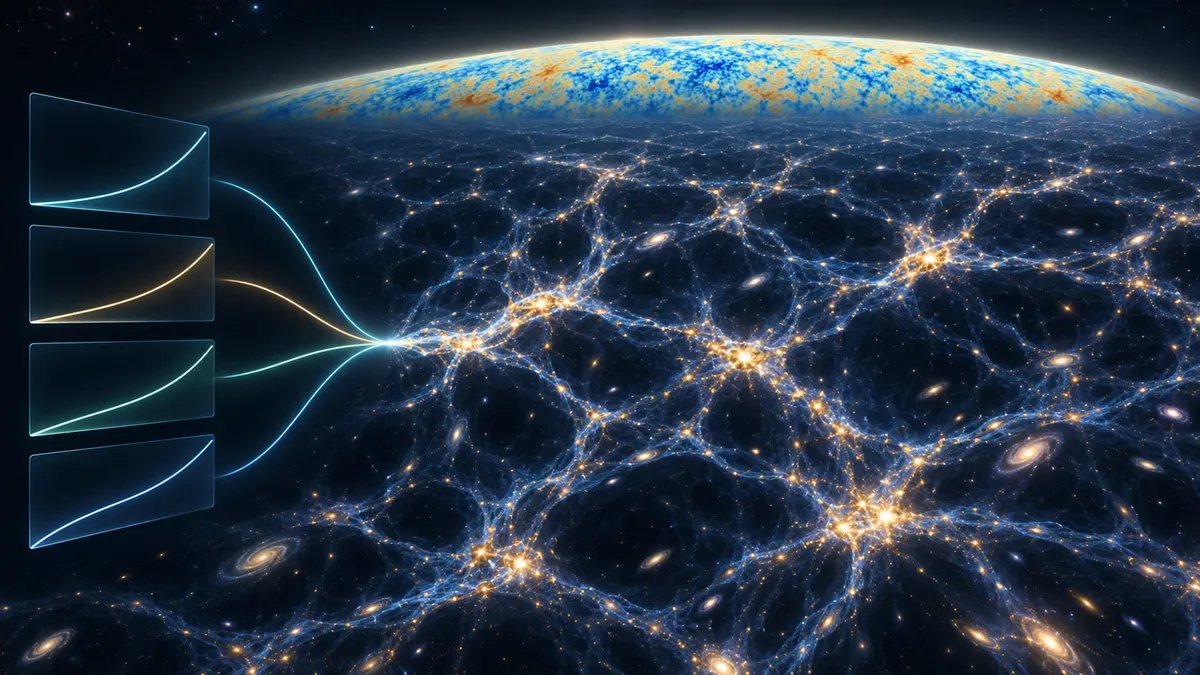
Dark energy may change over cosmic time, but simulating every possible history is costly. Researchers test whether matching a model’s distance to the early Universe and its growth of structure lets one constant-dark-energy simulation approximate many alternatives.
Cosmologists often describe dark energy with an equation of state, written as w(z), that can vary over time. A popular two-parameter description is the Chevallier–Polarski–Linder (CPL) model. But other histories are possible, and testing each one with a new suite of computationally expensive simulations would be difficult. Pavel Demidov, Carolina Cuesta-Lazaro and Peter L. Taylor ask whether existing simulations of simpler, constant-w cosmologies can instead act as stand-ins for a broader range of models.
Their method, called spectral equivalence, matches a changing-dark-energy model to a constant-w model in two steps. First, the models are given the same comoving distance from the present to the cosmic microwave background’s last-scattering surface. This distance condition corresponds to matching a weighted average of their recent expansion histories. Second, the primordial fluctuation amplitude in the stand-in model is adjusted so that both models have the same linear clustering amplitude at the time being studied.
The researchers tested the idea with N-body simulations, which follow how dark matter moves and clumps under gravity. They compared one CPL model and two spline-based dark-energy histories—including one deliberately designed to challenge the matching—with a single constant-w predictor. The simulations used the same starting random seed, helping them compare corresponding structures while reducing differences caused simply by random initial conditions. The main simulation comparisons were made at the present day (z = 0).
Across the matched runs, the matter power spectrum—a measure of how strongly matter clusters on different scales—agreed with the predictor to within 0.2% up to wavenumber k = 0.5 h Mpc⁻¹, and within 0.6% up to k = 1 h Mpc⁻¹. The bispectrum, which captures information beyond pairwise clustering, differed by at most 0.26% up to k = 0.5 h Mpc⁻¹ and 1.75% up to k = 1 h Mpc⁻¹. The tested wavelet-scattering coefficients were within 0.05% of the predictor.
The comparison also extended beyond these summary statistics. With the simulations’ shared initial phases, the authors found very strong agreement between matched matter-density fields: their measure of decorrelation stayed below 0.006% up to k = 1 h Mpc⁻¹. They also report close agreement in tests involving halos, cosmic voids and simulated galaxy clustering. Velocities require extra care: the researchers found that a simple correction based on linear theory improved the match, but it did not capture all small-scale effects.
A separate, controlled analysis used a power-spectrum emulator to compare parameter estimates from the full CPL model with estimates made through constant-w models and spectral equivalence. The resulting posteriors were very similar. This is a demonstration within a toy setup, not a new constraint on dark energy from observed survey data.
The results are promising, but they do not establish that every possible dark-energy history can be matched this way. The authors assume dark energy affects the simulated structure through the background expansion and is smooth on the scales studied. They tested a limited set of histories, at one simulation output redshift, and explicitly describe the method as empirical: there is not yet a first-principles guarantee that bounds the errors for all models. Their deliberately challenging example performed well, but that does not prove universal accuracy. The paper also notes that individual halos can differ even when population-level statistics agree, partly because small changes can grow through the chaotic evolution of gravitational systems.
The work therefore offers a possible way to reuse existing constant-w simulation suites rather than build a new suite for every dark-energy model. The authors suggest checking future analyses with a small number of full simulations. Applying the approach to real survey data—and assessing its reliability across broader model choices—remains a next step. This account is based on an arXiv preprint; a preprint is a research manuscript that may not have completed peer review.
- dark energy
- cosmology
- N-body simulations
- large-scale structure
- spectral equivalence
- matter clustering
Reviewed cross-references
These connections were reviewed by a model, not independently fact-checked by a human. Similarity does not imply agreement; consult the original papers and the evidence below.
One simulation, many dark-energy histories
Supporting evidence: Both studies report that a constant-w simulation can reproduce aspects of evolving-dark-energy simulations at the field level in their tested cases. Demidov et al. match comoving distance to last scattering and test beyond-CPL models at z=0; Meng et al. match expansion histories in superconformal time and test CPL models across 0≤z≤3. Their matching prescriptions and test ranges differ, so the findings support only this bounded feasibility claim, not equivalence of the methods or broader performance.
Model review: · openai-codex/gpt-6-luna
Evidence and provenance
Selected excerpts, not complete papers. PDF extraction can omit figures or damage equations, tables and reading order; sources may be preprints.
2611.29776v1 — Original paper
Excerpt reference:
static/papers/2611.29776v1.md:1832-1901
Basis: Paper text
Source SHA-256:13e63750f5c30788a2752796b756f61e90ea067782abe28492b0b9be2f47a0362611.29597v1 — Original paper
Excerpt reference:
static/papers/2611.29597v1.md:15-66
Basis: Paper text
Source SHA-256:b5f662b92c1e4e92d5d64520fd2daa1210a65781d1ba3dc2973f3b3d5b79d5cb2611.29597v1 — Original paper
Excerpt reference:
static/papers/2611.29597v1.md:1954-2005
Basis: Paper text
Source SHA-256:b5f662b92c1e4e92d5d64520fd2daa1210a65781d1ba3dc2973f3b3d5b79d5cb
Related reading
Automatically matched by shared topic keywords. These links do not imply that the sources agree or establish a consensus.
One simulation, many dark-energy histories
Source published
Shared keywords: dark energy, large scale structure, n body simulations
DES Year 6 tests the cosmic picture
Source published
Shared keywords: dark energy
Combining Cosmic Probes to Test Dark Energy
Source published
Shared keywords: dark energy, large scale structure
Galaxy Motions Help Untangle Models of Dynamical Dark Energy
Source published
Shared keywords: dark energy
Choosing galaxies could shape the science of a future giant telescope
Source published
Shared keywords: dark energy