TRANSMISSION // 2611.29773v1
Where Do Fast Multimodal Decision Models Work Best?
Source published
S1Arena-MM compares probability-returning models with multimodal language models across static image, video and audio tasks and interactive games.
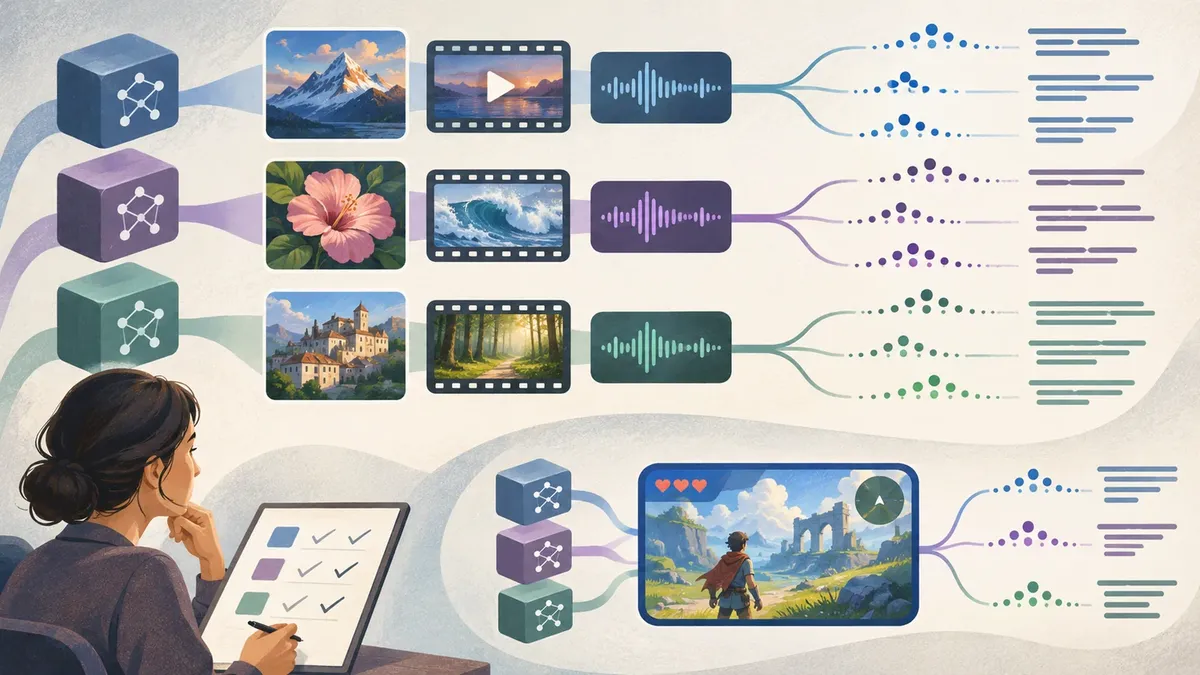
Some AI models return probabilities for a fixed set of answers in one pass; multimodal large language models generate text. S1Arena-MM tests how these approaches compare across different kinds of decisions, including game-playing tasks.
A model choosing between a few options may not need to produce a paragraph. Some “System-1” models take media as input and return probabilities for predefined answers in a single forward pass. Multimodal large language models (MLLMs) generate text. The S1Arena-MM benchmark asks how these model groups compare on a range of multimodal decisions—and whether results differ when tasks involve interaction.
The benchmark contains 51,060 questions across 94 tasks involving images, video and audio. The questions draw on 94 public datasets and three program-generated datasets. It also includes 102 game environments in which models play from screenshots; in real-time mode, the game continues while a model decides. The researchers evaluated 33 open models: 12 System-1 models and 21 MLLMs. They scored the probabilities returned by the models, including MLLMs evaluated at the answer token.
On static decisions, the abstract reports that the best System-1 model led the best MLLM by 4.9 percentage points on images. On video and audio, the leading models were within one percentage point of each other. These comparisons describe performance on the benchmark; they do not show that one model group will perform best on every task involving these media.
The authors assessed probability quality as well as answer accuracy. They report that, on video, a System-1 model had a lower Brier score than the MLLM it was post-trained from in 10 of 12 pairs. A Brier score evaluates predicted probabilities against observed outcomes, with lower scores indicating better performance by that measure. The abstract says decision-focused post-training mainly improved probabilities. It does not provide enough detail to explain the score’s calculation or the size of these changes, so the comparison should be read as a reported benchmark result rather than a complete account of probability calibration.
Extra generated reasoning did not produce a clear, across-the-board advantage in these tests. With up to 2,048 thought tokens per question, the most accurate MLLMs surpassed the strongest System-1 models only slightly. The abstract also reports that thinking raised the Brier score of most MLLMs. These findings concern the tested models and setup; they do not establish that reasoning is generally unhelpful.
The interactive results differed from the static-task comparisons. In BALROG, three System-1 models built on a 27-billion-parameter MLLM achieved 22.0–33.3% progression. With thinking off, no other model exceeded 9.7%, according to the abstract. In real-time GameWorld, the authors report that decision latencies of up to 1.1 seconds caused no measurable loss of progress for System-1 models. That result is specific to the reported GameWorld experiment and should not be taken to mean similar delays are harmless in other real-time applications.
Taken together, the abstract suggests that performance depends on the task: the model groups were close on video and audio, while the reported differences were larger for images and some interactive games. The evidence available here is the paper’s abstract, not its full methods, task-by-task results, statistical analysis or limitations. It therefore cannot show how much individual datasets or evaluation choices shaped the comparisons, or how well the findings generalize beyond the tested models and environments. The source is an arXiv preprint; the supplied information does not establish its review status. These results are best understood as findings from one benchmark, not as a general verdict about which models should make consequential decisions.
- multimodal AI
- AI benchmarks
- System-1 models
- multimodal language models
- probability evaluation
- interactive games
Reviewed cross-references
These connections were reviewed by a model, not independently fact-checked by a human. Similarity does not imply agreement; consult the original papers and the evidence below.
What a visual AI benchmark reveals about confidence
Shared method: Both preprints evaluate typed decision models using accuracy and probabilities or confidence: S1Arena-MM reports accuracy and Brier scores, while OmniDecisionBench scores accuracy and candidate-probability calibration. Their interfaces, datasets, modalities, and calibration measures differ, so results are not directly comparable; OmniDecisionBench is limited to static images, whereas S1Arena-MM also evaluates video and audio.
Model review: · openai-codex/gpt-6-luna
Evidence and provenance
Selected excerpts, not complete papers. PDF extraction can omit figures or damage equations, tables and reading order; sources may be preprints.
2611.29773v1 — Original paper
Excerpt reference:
static/papers/2611.29773v1.md:221-290
Basis: Paper text
Source SHA-256:6acde875eaddd5284025c0628e765329634d5431eb38012b95725b9b372e54492611.28924v1 — Original paper
Excerpt reference:
static/papers/2611.28924v1.md:224-364
Basis: Paper text
Source SHA-256:88bfc504e6bfb696e918a04a5eee0eb080a0b2da0e1d9806cdc40b4757053878
Why Video AI Misses Brief, Crucial Moments
Supporting evidence: These preprints offer compatible but non-identical evidence that sampling limitations are only part of the challenge of brief video events. S1Arena-MM notes that a fixed frame budget can miss brief evidence in long videos; Moment-Video reports that denser sampling helps some models, while errors persist in an audited subset where human review judged sampled evidence sufficient. The benchmarks and model populations differ, so this is not a direct replication.
Model review: · openai-codex/gpt-6-luna
Evidence and provenance
Selected excerpts, not complete papers. PDF extraction can omit figures or damage equations, tables and reading order; sources may be preprints.
2611.29773v1 — Original paper
Excerpt reference:
static/papers/2611.29773v1.md:2485-2553
Basis: Paper text
Source SHA-256:6acde875eaddd5284025c0628e765329634d5431eb38012b95725b9b372e54492606.02522v3 — Original paper
Excerpt reference:
static/papers/2606.02522v3.md:72-130
Basis: Paper text
Source SHA-256:5837b1d511f2bcba2925ee70d05614d5b45994edd3880727b2e87ff522915228
Related reading
Automatically matched by shared topic keywords. These links do not imply that the sources agree or establish a consensus.
A multimodal model built for online shopping
Source published
Shared keywords: ai benchmarks, multimodal ai
Why Video AI Misses Brief, Crucial Moments
Source published
Shared keywords: ai benchmarks, multimodal language models
A Reconstruction-Based Test for AI Image Descriptions
Source published
Shared keywords: ai benchmarks, multimodal ai
Can AI read artistic intent in audiovisual art?
Source published
Shared keywords: ai benchmarks, multimodal ai
Why a personal AI assistant needs to find the right person first
Source published
Shared keywords: ai benchmarks, multimodal ai