TRANSMISSION // 2611.29771v1
How Guided Learning Trained a Robot for Transfers
Source published
Researchers trained a humanoid robot policy in simulation, then replayed its trajectory to transfer a mannequin into a wheelchair. The open-loop demonstration had failures and does not establish safe use with people.
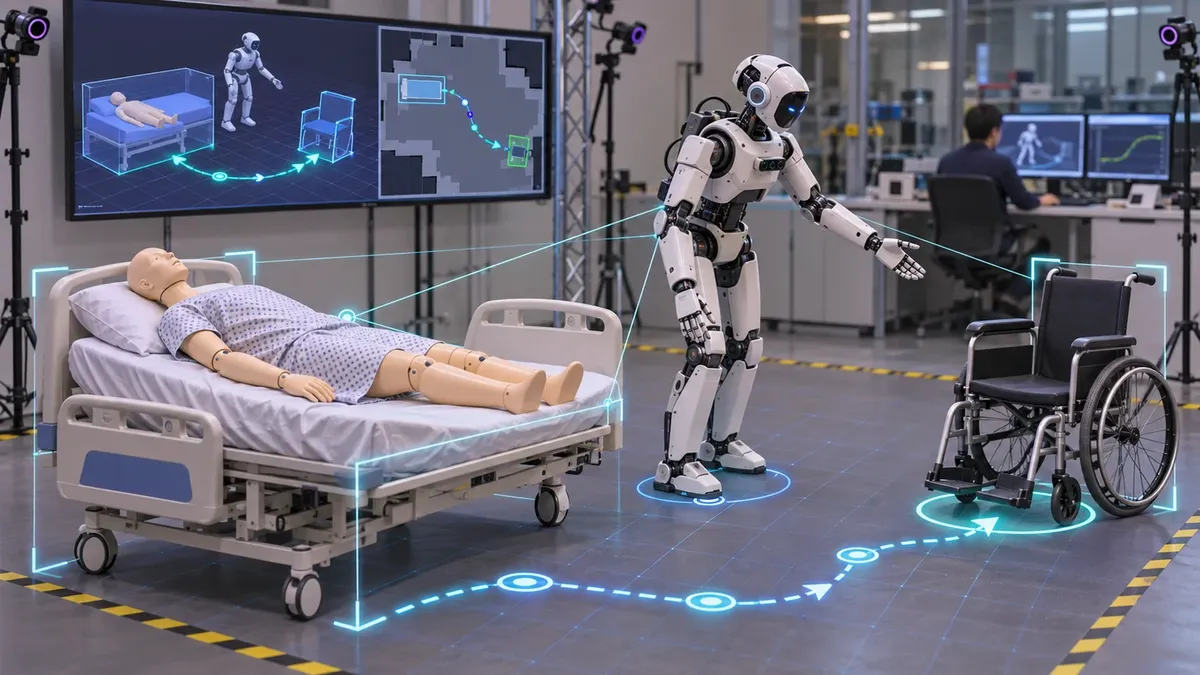
A bed-to-wheelchair transfer challenges a humanoid robot to coordinate many joints, manage contact and complete a long sequence of actions. In a preprint, researchers describe three forms of guidance for reinforcement learning and test them in simulation. They also replay a learned trajectory on a physical robot—but the trial was open-loop, not a test of the robot adapting to a person in real time.
A bed-to-wheelchair transfer asks a robot to coordinate its body, handle contact and complete distinct steps such as lifting, carrying and placing. These demands make it a difficult reinforcement-learning (RL) problem: the robot learns through repeated attempts and feedback, but must explore a large range of movements without losing useful contact or balance.
In Into My Arms, researchers introduce three kinds of guidance for training a humanoid robot policy in simulation. They then replay a learned trajectory on a physical robot carrying a medical mannequin. The authors say this shows the strategy is physically realisable, while also reporting failures. The hardware demonstration was open-loop: the robot replayed a planned trajectory rather than continuously adapting to what happened.
Three kinds of guidance
The authors focus on three challenges: coordinating many robot and object movements, learning in contact-rich situations where interactions can be difficult to predict, and assigning feedback across a long task with multiple phases.
Sparse Interaction Edges (SIE) represent selected spatial relationships between points on the robot and the object. The reward encourages reducing the distances along specified robot–object edges. In the human-transfer task, the researchers chose keypoints intended to bias behavior toward a more comfortable transfer; proximity by itself does not guarantee a safe or appropriate hold.
Interaction Gated Transport (IGT) makes the transport reward depend on continued proximity between the robot and the object. This is intended to discourage strategies such as pushing or throwing the object toward its destination. Hinted Object Path (HOP) provides a rough route for the object, not just a final destination, to guide exploration around obstacles. It is a hint rather than a fixed motion script: the policy can depart from it as it learns.
The team trained policies using proximal policy optimization in simulated environments. These included moving a ball into a raised box and transferring an articulated human model from a bed to a wheelchair; the farther human-transfer task included an obstacle. Training used 4,096 parallel environments for the ball task and 2,048 for each human task, on a single GPU. The comparison was an ablated RL baseline with changes to observations and rewards, and the paper also reports sequential ablations to examine the effects of the components.
Results in simulation—and on hardware
In the ball task, the baseline did not lift and carry the ball across the reported training seeds. Adding SIE changed the robot’s behavior: it used both arms to encircle and lift the ball, though this alone did not complete the task. With IGT, it maintained its grasp while carrying. HOP then guided the ball up and over the raised box toward its destination.
In the simulated human tasks, the authors report more consistent transfer strategies with their method than with the baseline. They also report that a trained policy handled variation in the human model’s height and mass at evaluation without further training. In separate simulations, random forces were applied to the object at each timestep with probability 0.1; force magnitudes were sampled uniformly from 300 to 500 newtons. The policy developed tighter holding strategies under those training conditions. These findings describe specific simulations, not a guarantee of response to real or unpredictable human movement.
For the hardware demonstration, the team used AIREC, a 35-degree-of-freedom humanoid, and a 155-centimetre, 15-kilogram mannequin. The robot lifted the mannequin from a bed, carried it to a wheelchair and disengaged, with no caregiver intervening during execution. The team tested two wheelchair orientations. Execution used open-loop trajectory replay at a reduced frequency, and the mannequin’s wrists and knees were loosely tied to reduce complexity and mismatch with simulation. The paper reports both successful and failed replays; it explicitly says this was not a closed-loop hardware validation study.
What remains uncertain
The hardware trial does not show reliable transfer with a person or establish that the robot can adapt safely to a person’s movements. The authors identify motor capacity and safe physical interaction as barriers to human trials. They discuss tactile sensing, compliant control and methods for certifying neural-network policies as possible directions for addressing these challenges—not as capabilities established by this experiment.
The method also requires design choices: selecting robot and object keypoints, specifying interaction relationships and a coarse object path, and setting completion tolerances. The policy has freedom to discover the detailed movement, but its learning is not structure-free.
This account draws on the arXiv version 1 preprint’s abstract, methods and results. The authors’ claim that this is the first such mannequin transfer is qualified as being to their knowledge. The reported outcomes should be understood within the particular simulations and carefully prepared hardware setup described in the manuscript; they do not establish readiness for caregiving use.
- humanoid robots
- reinforcement learning
- robot manipulation
- assistive robotics
- simulation-to-real
Reviewed cross-references
These connections were reviewed by a model, not independently fact-checked by a human. Similarity does not imply agreement; consult the original papers and the evidence below.
HALO trains a humanoid in simulated rooms before testing it in unfamiliar spaces
Supporting evidence: Both papers report humanoid policies trained in simulation and then run on physical robots: Miller et al. report an autonomous mannequin bed-to-wheelchair transfer, while Hu et al. report 91% success across 360 trials in six unseen environments. These task-specific results support only the bounded claim that simulation-trained humanoid policies can transfer to hardware; they do not establish comparable performance across tasks or general transfer reliability.
Model review: · openai-codex/gpt-6-luna
Evidence and provenance
Selected excerpts, not complete papers. PDF extraction can omit figures or damage equations, tables and reading order; sources may be preprints.
2611.29771v1 — Original paper
Excerpt reference:
static/papers/2611.29771v1.md:118-170
Basis: Paper text
Source SHA-256:e45a9e0bb9de6305541f11e31a10085ebb8d38a1f38bcfbe69252f86b7392b892611.06908v1 — Original paper
Excerpt reference:
static/papers/2611.06908v1.md:138-204
Basis: Paper text
Source SHA-256:0a3e6f2f5e45ee2170f7f9113f8d48d011c8d81fe4b408266c23bcb57af51ec5
Related reading
Automatically matched by shared topic keywords. These links do not imply that the sources agree or establish a consensus.
How BARE Helps Humanoid Robots Evade Obstacles
Source published
Shared keywords: humanoid robots, reinforcement learning
A quadruped that estimates disturbances as it walks
Source published
Shared keywords: reinforcement learning, simulation to real
Traffic-VL learns to recommend traffic-light phases from camera views
Source published
Shared keywords: reinforcement learning
How to combine robot skills without making them clash
Source published
Shared keywords: humanoid robots
How a robot can learn from its own attempts
Source published
Shared keywords: reinforcement learning, robot manipulation