TRANSMISSION // 2611.29693v1
HandiVid builds a 200,000-clip dataset for interactive video
Source published
HandiVid combines egocentric videos with hand, camera and interaction annotations. In tests, a model trained on the dataset outperformed an ARCTIC-trained baseline on reported video-generation metrics.
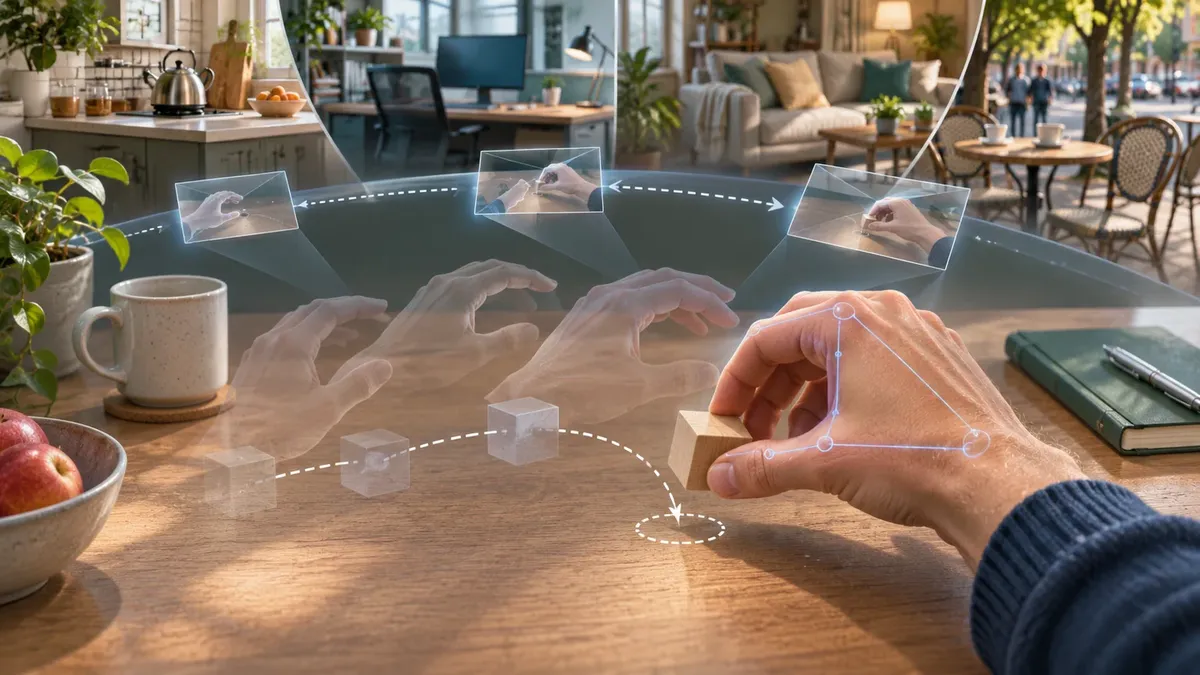
For an AI-generated first-person scene to respond convincingly when a hand picks up or moves something, the model needs examples that connect hand motion to what happens next. HandiVid is a dataset designed to supply those examples, alongside estimates of how the camera moves.
A hand reaches for a cup. To generate a convincing continuation, a video model must do more than draw a plausible hand: it should show the grasp, keep the viewpoint coherent and depict an appropriate response from the cup. Training systems to do this requires videos paired with information about hand motion, camera movement and the interaction taking place. The authors of HandiVid argue that existing egocentric video datasets often do not provide all three together at broad scale.
Their proposed resource contains about 200,000 short, first-person interaction clips. Each clip is paired with estimated 3D hand parameters and renderings, camera trajectories, and descriptions of the visible interaction. The dataset draws on public collections, online videos and AI-generated video. According to the paper, 80% of the final clips come from public datasets, 10% from online videos and 10% from synthetic videos.
How the dataset was assembled
The team built a pipeline to turn those varied sources into clips with a common format. It detects shot boundaries, extracts fixed-length segments and filters out some technically or perceptually low-quality video. It also removes subtitle regions. For hand annotations, the researchers use a hand detector and 3D reconstruction system; they add interpolation and SAM 3, an image-segmentation model, to fill some gaps in detected hand regions. Camera paths are estimated with a separate video-based system.
Descriptions are generated from sampled frames in each cropped clip, with the aim of keeping the text tied to the actions actually visible in that segment. A vision-language model checks whether a clip shows an egocentric view, only the wearer’s hands, and meaningful hand–object interaction. The paper gives examples of qualifying actions such as grasping, placing objects and using tools; hovering hands and empty gestures are excluded. Clips are also sampled to give less common scene and activity labels more representation.
These steps matter because an annotation can look plausible without accurately representing the video. A hand visible in a frame does not necessarily mean an object is being manipulated, and a description covering a longer recording may mention events outside the selected clip. The pipeline is intended to address such mismatches, but it cannot guarantee that every estimated pose, camera path or description is correct.
What the tests found
The authors manually inspected a random sample of 500 clips. They report that more than 92% passed a joint check of scene and activity labels, and that 95% passed their assessment of the 3D hand annotations. All 500 were judged to contain valid interactions under the study’s definition. These results describe that sample and those checks; they should not be read as a guarantee of error-free annotations across the entire dataset.
The team also tested whether the data could help train an interactive video-generation model. They used a pretrained video model conditioned on an initial image, an interaction description, hand renderings and camera poses. They compared a version trained on HandiVid with one trained on clips from ARCTIC, using fixed evaluation clips whose scenes were kept out of training. On the reported test set, the HandiVid-trained model scored better than the ARCTIC-trained model on all nine metrics, which covered visual similarity and quality, consistency over time, hand-shape overlap and background-motion agreement. The paper reports similar metric-level advantages on small held-out sets from H2O and TACO.
This is evidence that the dataset was useful for this particular model and experimental setup—not proof that every video generator will improve by the same amount. The cross-dataset tests used 20 clips from each of H2O and TACO, and the main comparison used 200 clips. Metrics also measure specific properties: for example, the hand metric compares projected silhouettes and does not directly measure physical contact. Better scores do not by themselves establish that generated interactions obey real-world physics.
What remains uncertain
The authors identify hand reconstruction and camera estimation—especially during occlusion and rapid motion—as areas needing further refinement. The dataset also combines recorded and synthetic video, and the paper’s reported tests do not establish how well it represents every kind of person, object, environment or interaction. Results depend on automated filtering and model-generated annotations, followed by limited manual checks.
HandiVid is described in an arXiv preprint. A preprint is a public research manuscript, but the provided source does not establish that this version has been peer reviewed. The findings should therefore be treated as the authors’ reported results, pending independent scrutiny and replication. The paper links to a dataset and code repository, though this summary does not independently verify their contents or availability.
- HandiVid
- egocentric video
- interactive video generation
- hand-object interaction
- AI datasets
- video generation
Reviewed cross-references
These connections were reviewed by a model, not independently fact-checked by a human. Similarity does not imply agreement; consult the original papers and the evidence below.
TouchéWorld brings camera and hand controls together in generated video
Shared method: Both condition egocentric video generation on hand motion and camera movement: HandiVid’s baseline uses hand motion, camera poses and captions, while TouchéWorld combines spatial hand-skeleton and numerical motion conditioning with camera controls. This is a shared conditioning approach, not evidence that the implementations or results are equivalent.
Model review: · openai-codex/gpt-6-luna
Evidence and provenance
Selected excerpts, not complete papers. PDF extraction can omit figures or damage equations, tables and reading order; sources may be preprints.
2611.29693v1 — Original paper
Excerpt reference:
static/papers/2611.29693v1.md:471-538
Basis: Paper text
Source SHA-256:5c5cc7c840517631ce42e0672b8d06d480e740c6d254917f119b3da2d30cd17f2611.06061v1 — Original paper
Excerpt reference:
static/papers/2611.06061v1.md:15-59
Basis: Paper text
Source SHA-256:d372b68e45d04a40dfc7a21640d6aad5b5fa9267930db074a0eafe8304daa1f8
Related reading
Automatically matched by shared topic keywords. These links do not imply that the sources agree or establish a consensus.
Why AI video generators can ignore a new prompt
Source published
Shared keywords: interactive video generation
How video AI can remember the right character
Source published
Shared keywords: video generation
TouchéWorld brings camera and hand controls together in generated video
Source published
Shared keywords: egocentric video, video generation
HaNDF uses object shape to guide more plausible digital hand poses
Source published
Shared keywords: hand object interaction
Giving Wearable AI a Measurable 3D View
Source published
Shared keywords: egocentric video