TRANSMISSION // 2611.29687v1
Fact-Checking With Fixed Evidence: Models, Votes and Tribunals
Source published
A 300-claim study compared model judges, a five-judge vote and a multi-role Tribunal using supplied evidence. Results depended on the setup, and the Tribunal often abstained.
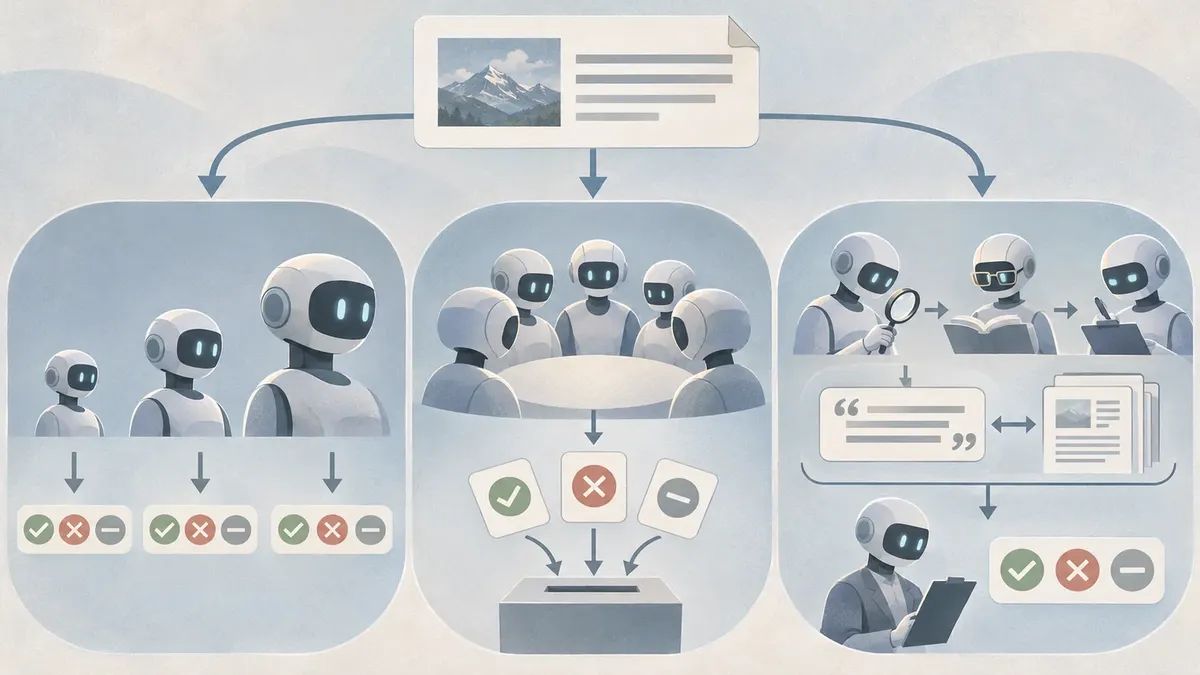
Should an AI fact-checker use a larger model, combine several judgments, or divide the work among specialized roles? This study compares those approaches using fixed supplied evidence, without retrieval. Its results concern the tested claims and configurations, not a general rule for fact-checking.
Comparing ways to spend more computation
An AI fact-checker might use a larger model, ask several judges to vote, or assign different jobs to a multi-role team. This study compares those options while holding the evidence fixed for the comparison. Because there was no retrieval, the experiment tests decisions made from supplied evidence—not the ability to find sources on the web.
The team approach, called a Tribunal, has roles that propose quoted findings. Code checks the quotations, then an auditor judges each finding without seeing the proposed relation. Code derives a verdict or abstention from the results. This process checks quotations and separates parts of the judgment, but the abstract does not establish that it guarantees factual correctness.
How the test was set up
The researchers evaluated 300 claims from AVeriTeC. Each claim’s annotated question-and-answer items were mixed with items written for other claims. The comparison included individual judges from four open-weight models across three families, a vote of five, and six assignments of models to Tribunal roles. The auditor’s input differed in one stated respect: it did not include the proposed relation.
What the abstract reports
For judges from the same model family, the 9-billion-parameter model got 186 claims right, compared with 156 for the 27-billion-parameter model. The larger judge declined to decide more often and was no more accurate when it did decide. This is a result for two judges in one family, not evidence that larger models generally do worse.
The five-judge vote got 196 claims right. Replacing a 9B judge’s verdict with Tribunal certificates yielded 195, at a similar cost. The Tribunal by itself reached between 153 and 164 correct claims and abstained on nearly half of the claims. The abstract reports six role assignments but does not say that assignment differences alone explain the range.
A hearing’s outcome followed the auditor’s model and was nearly indifferent to the proposers’. Using a larger auditor, or one from another family, did not make certificates more often correct: the reported range was 77% to 81%. Those changes also did not make the certificates more independent of the individual judge.
Replacing judges’ verdicts with certificates improved each judge by 3 to 10 points, according to the abstract. But certificates also overturned four to five in a hundred of the judge’s correct verdicts. The abstract does not specify further denominator details, so that wording should not be read as a more precise rate.
When the annotated evidence was withheld, judges and the Tribunal still decided on 7% to 14% of claims. This shows that they sometimes issued decisions without those annotated items; the abstract does not say whether those decisions were correct or whether other relevant information was available.
What the results can—and cannot—tell us
In this test, the vote and the 9B judge-plus-certificate setup had similar correct-claim counts, while the Tribunal alone abstained often. Certificates brought gains but sometimes replaced correct judgments. These findings do not establish how the approaches would perform with web retrieval, on other datasets, or in real-world fact-checking.
This account is based on the arXiv abstract rather than a full-paper review. The available material does not provide enough methodological or statistical detail to assess the results fully, and it does not establish the paper’s peer-review status. Treat the numbers as results reported for this particular study, not settled guidance about which fact-checking design is best.
- AI fact-checking
- large language models
- multi-agent systems
- fixed evidence
- fact-checking evaluation
Reviewed cross-references
These connections were reviewed by a model, not independently fact-checked by a human. Similarity does not imply agreement; consult the original papers and the evidence below.
AI debate partners can craft evidence that misleads automated fact-checkers
Supporting evidence: Both studies indicate that automated fact-checking can be vulnerable to problematic evidence: Pavlíček et al. report decisions even when annotated evidence is withheld, while Huang et al. report attacks using injected adversarial passages. These are different conditions and outcomes, so this supports only the bounded point that evidence quality and integrity matter, not a direct comparison of attack effectiveness.
Model review: · openai-codex/gpt-6-luna
Evidence and provenance
Selected excerpts, not complete papers. PDF extraction can omit figures or damage equations, tables and reading order; sources may be preprints.
2611.29687v1 — Original paper
Excerpt reference:
static/papers/2611.29687v1.md:13-50
Basis: Paper text
Source SHA-256:27174e83cd37819e9f9fa306a9f04f186e0ab3b385f89c9febb25ea3de78c77f2611.29687v1 — Original paper
Excerpt reference:
static/papers/2611.29687v1.md:1910-1963
Basis: Paper text
Source SHA-256:27174e83cd37819e9f9fa306a9f04f186e0ab3b385f89c9febb25ea3de78c77f2611.08756v1 — Original paper
Excerpt reference:
static/papers/2611.08756v1.md:221-311
Basis: Paper text
Source SHA-256:4bd0472a88571f2327f733098deb04fc1fc7888938854f7d966ffff03a7d8cd8
Related reading
Automatically matched by shared topic keywords. These links do not imply that the sources agree or establish a consensus.
Choosing better training tasks for AI agent teams
Source published
Shared keywords: large language models, multi agent systems
Can One AI Agent Learn From a Whole Team?
Source published
Shared keywords: large language models, multi agent systems
When AI Agents Talk in Latent Space, Does It Help?
Source published
Shared keywords: large language models, multi agent systems
How AI agents can learn from interaction over time
Source published
Shared keywords: large language models, multi agent systems
How local mistakes travel through AI teams
Source published
Shared keywords: large language models, multi agent systems