TRANSMISSION // 2611.29650v1
A sharper ceiling for communication through relaxing qubits
Source published
A new mathematical bound limits how much quantum information or secret key can pass through a relaxing qubit, while leaving the exact communication capacity unresolved.
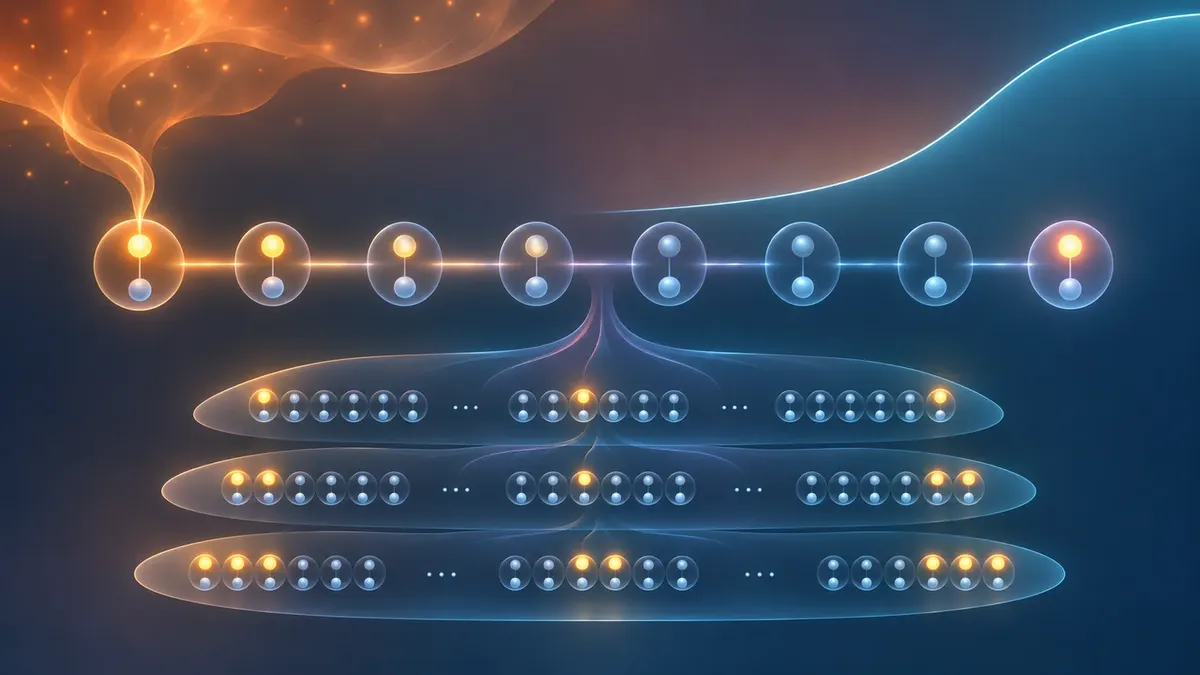
A qubit that loses its excitation is a simple model of quantum noise—but how much communication can survive if sender and receiver can coordinate in both directions? Stefano Pirandola derives a tighter upper limit for this setting and extends the method to qubits exposed to thermal excitation.
A qubit can store information in two states, often pictured as a ground state and an excited state. In an amplitude-damping channel, the excited state may decay to the ground state, while the ground state remains unchanged. This idealized model describes, among other things, optical loss restricted to the vacuum and one-photon states.
The question in this paper is not simply how well one message travels through one noisy qubit. It is how much quantum information, entanglement, private communication, or secret key could be sent per channel use when the two parties can exchange unlimited authenticated classical messages in both directions and use local quantum memories. These flexible strategies make exact capacity calculations difficult.
Stefano Pirandola presents a new upper bound: a mathematical ceiling on the achievable rates, rather than a protocol that necessarily reaches them. If the probability of decay is γ, the unrestricted bound is log₂[1 + (1−γ)γ^(γ/(1−γ))], with its endpoint values defined by continuity. The result applies to two-way-assisted quantum communication, entanglement distribution, private communication, and secret-key agreement. The paper states that, for every decay probability strictly between zero and one, this bound is lower than three established upper bounds: the PLOB relative-entropy bound, an analytic max-relative-entropy bound, and an optimized balanced squashed-entanglement construction.
Keeping track of excitation sectors
The key move is to use a feature of the qubit model that can be lost when it is treated as an unrestricted optical mode: each qubit contains at most one excitation. The analysis groups several qubits by their total excitation number. For example, among three qubits, the one-excitation sector contains the states in which the excitation is in the first, second, or third position. A superposition of those possibilities can still carry quantum information.
Within each fixed-excitation sector, the author constructs an exact simulation of the channel using teleportation and a shared resource state. The required corrections are phase rotations and permutations of qubits, which preserve the allowed two-level structure. This simulation lets the problem of bounding an adaptive communication protocol be recast as an accounting problem for entanglement in shared states. The argument also allows quantum memories and correlations across successive channel uses; it does not assume that each use is an isolated attempt.
For ordinary amplitude damping, the paper calculates the relevant resource entanglement exactly, including its additivity across the resources used in the construction. That result supports the capacity bound, but does not show that any communication protocol achieves it. In the paper’s terms, the bound is a weak converse: rates above it cannot be achieved with vanishing error under the stated assumptions, but the result does not claim that error must approach its maximum above the bound.
A close comparison near strong damping
The paper also compares the new ceiling with an existing achievable benchmark, the triple-rail protocol. Near complete damping, that protocol reaches more than 99.54% of the new bound’s leading coefficient. This is a comparison of leading behavior as the survival probability becomes small, not a claim that the protocol achieves 99.54% of the exact capacity. The remaining gap is nonzero at that order, and the exact capacity is not established.
The bound can also be refined when the sender’s average excitation is limited. In plain terms, sending fewer excited states on average can lower the ceiling on the communication rate. The paper gives a corresponding expression for this constrained setting.
When the bath can excite as well as relax
A second part treats generalized amplitude damping, in which a thermal bath can both remove and add excitations. The same sector-based simulation still applies, but the entanglement calculation is less complete: different histories of loss and excitation can overlap. Instead of an exact resource-entanglement formula, the paper combines the amplitude-damping result with bounds for a unital channel and with the boundary beyond which the channel is entanglement breaking. An entanglement-breaking channel cannot distribute entanglement or secret key under the assumptions considered.
The resulting expression recovers the ordinary amplitude-damping bound at zero bath excitation and vanishes throughout the entanglement-breaking region. Comparisons in the paper show improvements over established benchmarks across broad parameter ranges, but not everywhere: near part of the entanglement-breaking boundary, a max-relative-entropy bound is tighter. The exact entanglement of the generalized-damping resources remains open, leaving room for improved bounds.
These are mathematical limits, not demonstrations of a new device or communication system. The source is an arXiv preprint, and the available material does not establish that it has undergone peer review. The manuscript also discloses the use of AI tools during preparation of candidate derivations, proofs, and presentation, with the author stating that the results were independently examined and that he assumes responsibility. The findings should therefore be read as claims made in a preprint, not as settled experimental evidence.
- quantum communication
- amplitude damping
- qubit
- quantum capacity
- entanglement
- thermal noise
Related reading
Automatically matched by shared topic keywords. These links do not imply that the sources agree or establish a consensus.
Why Incoherent Quantum Codes Struggle with Noise
Source published
Shared keywords: quantum capacity, quantum communication
A quantum switch may carry information through loss
Source published
Shared keywords: quantum capacity, quantum communication
How much coherence can cross a misaligned channel?
Source published
Shared keywords: quantum communication
Waiting to measure can unlock an unbounded quantum communication advantage
Source published
Shared keywords: quantum communication
A Stepped Fiber Helps a Pendulum Meet an Entanglement Test
Source published
Shared keywords: thermal noise