TRANSMISSION // 2611.29637v1
A service robot that keeps moving through crowds—but at what cost?
Source published
TASC combines selective attention to pedestrians with a time-to-collision signal and continuous steering. In simulation it rarely froze, but collisions increased in larger crowds.
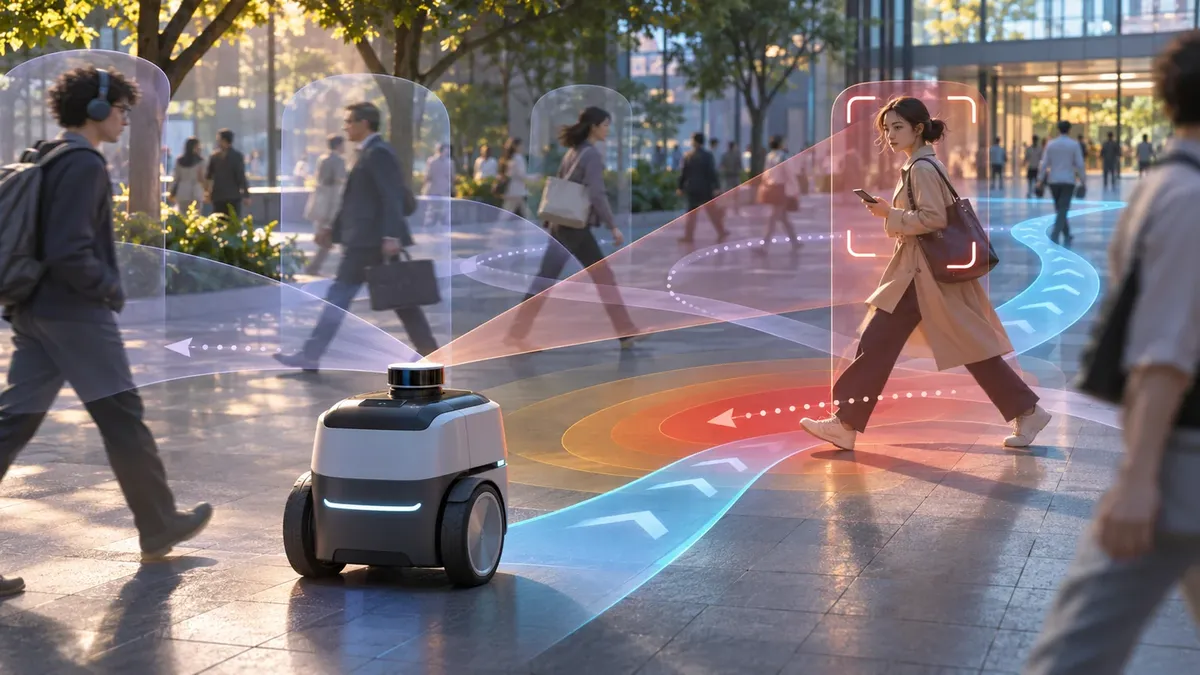
A robot in a busy corridor must avoid people without simply giving up and stopping. TASC is a navigation system designed for a wheeled service robot, and its tests reveal a sharp tension: keeping the robot moving did not guarantee safe passage.
A robot that stops whenever people approach may avoid some immediate risks, but it can also become stuck in a crowd. A robot that presses ahead, meanwhile, could collide with someone. This is a practical challenge for service robots with differential-drive wheels: unlike a holonomic robot, they cannot move sideways, and their steering and speed are constrained by their design.
A system called TASC aims to combine continuous steering with a way to focus on pedestrians most relevant to the robot’s next move. The authors tested whether this approach could keep a robot progressing through crowds without treating forward motion as proof of safety.
Attention and anticipation
TASC uses a navigation policy trained with reinforcement learning. Its attention module weighs information about nearby pedestrians and can assign some of them no weight, rather than distributing attention across everyone. A second feature estimates time to collision (TTC): roughly, how soon a pedestrian and robot might make contact if their current motion continued. The researchers describe their closing-speed estimate as conservative: it may indicate a threat even when straight-line motion would not actually lead to contact.
The TTC estimate is included both in what the policy observes and in its reward during training. The attention method, adapted from work on discrete-action systems, is paired with continuous velocity commands suitable for a differential-drive base.
Training took place in NVIDIA Isaac Lab, using a three-dimensional robot model and 10,000 parallel simulated environments. Simulated pedestrians followed a social-force model and sometimes stopped at random. They reacted to the robot only within a forward-facing arc and nearby range. The researchers randomized crowd size during training, then evaluated a selected policy checkpoint in a circular-crossing scenario with five, seven or ten pedestrians.
Few timeouts, more collisions in bigger crowds
Across 30,000 evaluation episodes, fewer than 0.5% timed out at each tested crowd size. But the low timeout rate came with an important safety cost. Pedestrian collisions rose from 4.5% with five pedestrians to 17.4% with ten. The success rate—reaching the goal without contact—fell from 93.4% to 78.8% across those conditions. The authors identify that trade-off, rather than the low timeout rate, as the main result.
Tests of individual components offer some clues. Disabling TTC in the already-trained policy led to more collisions, while policies retrained without TTC had success rates four to seven percentage points lower in the reported comparisons. These findings support a role for TTC in the system, but do not isolate whether the observation signal or its reward contribution matters more: both were removed together in the retraining test. The attention-selection thresholds, by contrast, made little difference when switched off in the trained policy under these tests. That is not the same as showing attention is unnecessary; the other components were not retrained without it.
The team also ran the policy in Gazebo without retraining and tested its software and controls on a commercial robot. In that hardware-in-the-loop test, the robot and its control system were real, but pedestrians were simulated, and the robot did not perceive the people present. The test checks that the system can run through the robot’s software and control pipeline; it does not demonstrate safe navigation among real pedestrians.
What the results do—and don’t—show
The experiments used simulated people and a particular crossing task, not busy corridors, groups, sudden reversals or real-world sensor errors. The authors note that their model can make pedestrians walk into a stopped robot, and argue that this may help explain the collision results. They also warn that a temporary stop may be safer around real people, so low timeout rates should not be treated as a deployment goal. The tests do not establish that TASC is socially acceptable or safe for use around people.
The paper says it was accepted for the 2027 IEEE/SICE International Symposium on System Integration. Its findings remain limited by the scenarios and methods studied. Comparisons with previously published systems are not direct rankings because robot models, pedestrian behavior and test conditions differ. The TTC retraining study used four seeds per variant, while several other component checks used a single trained policy. Further testing with realistic pedestrian behavior, perception and explicit safety constraints would be needed before drawing conclusions about real-world performance.
- service robots
- crowd navigation
- robot safety
- time to collision
- reinforcement learning
- robotics
Related reading
Automatically matched by shared topic keywords. These links do not imply that the sources agree or establish a consensus.
A safety shield for image-based robot parking
Source published
Shared keywords: robot safety
A safety gate for AI-planned lunar repairs
Source published
Shared keywords: robot safety
HomeLoop tests whether home robots investigate before intervening
Source published
Shared keywords: robot safety
Editing a Robot Model’s Hidden Goal Without Changing Its Instructions
Source published
Shared keywords: robot safety
DexDICE teaches robots from cautious and fast demonstrations
Source published
Shared keywords: robot safety