TRANSMISSION // 2611.29634v1
When extracting vacuum photons costs sensing power
Source published
A theoretical preprint finds that cavity loss can sharply reduce the precision advantage predicted for sensing light–matter coupling by converting virtual photons into detectable ones.
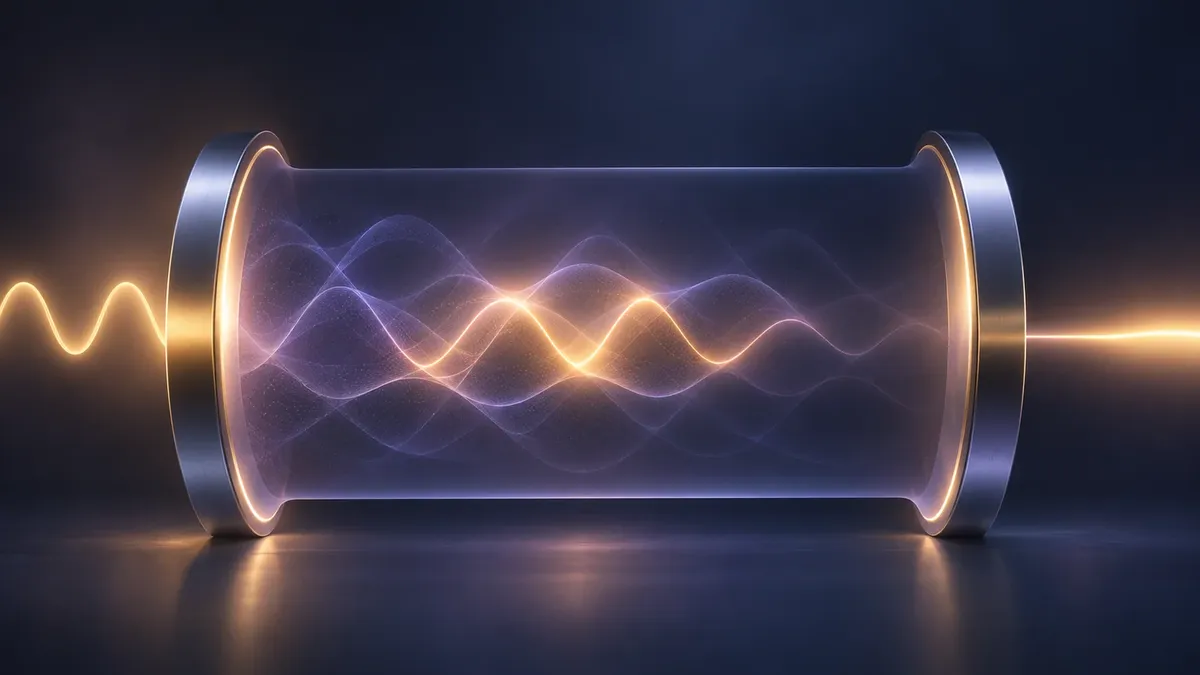
Virtual photons in an ultrastrongly coupled cavity may encode information about the interaction strength, but they cannot be detected directly. One proposed route is to convert them into real, extractable photons. This preprint examines a trade-off: the cavity port that allows extraction also removes photons, limiting how much information remains.
In ultrastrong light–matter coupling, the cavity’s ground state is not simply empty: it contains what physicists call virtual photons. These are features of the coupled system’s quantum state, not ordinary light that a detector can collect. The challenge is to use the state’s sensitivity to the coupling strength without losing the measurement advantage during readout.
The authors study a route based on the dynamical Casimir effect. A parametric drive at a suitable resonance can convert virtual photons into real photons that can be extracted. But extraction is not free: the cavity port also removes photons. The paper asks how much of the potential measurement advantage survives this competition between conversion and loss.
The work is theoretical. According to the abstract, the researchers analyze driven versions of two models: the quantum Rabi model and a Dicke model involving 32 qubits. They calculate quantum Fisher information (QFI), a measure of how much a quantum state can reveal about an unknown parameter—in this case, the light–matter coupling strength. They compare an ideal pure-state limit with information retained in open-system dynamics that include cavity loss.
The headline result is that the ideal limit can greatly overstate the usable advantage. In the driven Rabi model, the calculated pure-state QFI reaches 1.7 × 10⁵ times the coherent-probe baseline. At a cavity linewidth of 246 MHz, the master-equation calculation retains 0.96% of that value. In the Dicke-model calculation, the retained fraction is 2.6% at the largest photon basis the authors computed.
Across 18 lossy configurations from both models, the authors report that retained information follows one curve when plotted against accumulated loss—the product of cavity linewidth and interrogation time. On that curve, the retained information falls to half at a product of 0.13. Their central message is that a protocol’s practical value depends not only on its lossless precision ceiling, but also on how much information remains after photon extraction and associated cavity loss.
These are model-based results, not a demonstration of a working sensor. The reported percentages and loss relationship apply to the calculations described in the abstract; they do not establish that the same values hold for every device, readout method, or noise source. The Dicke-model estimate is reported at a finite photon-basis limit, so it should not be treated as a result for an unlimited basis. The available source is the paper’s abstract only, leaving details such as parameter choices, numerical convergence, and the precise scope of the 18 configurations unavailable for independent assessment. The paper is an arXiv preprint, and the supplied source does not establish peer review. These findings therefore offer a theoretical warning about extraction costs, not a settled experimental limit.
- quantum metrology
- ultrastrong coupling
- dynamical Casimir effect
- cavity loss
- quantum Fisher information
- quantum optics
Reviewed cross-references
These connections were reviewed by a model, not independently fact-checked by a human. Similarity does not imply agreement; consult the original papers and the evidence below.
When a quantum sensing limit depends on the model
Shared method: Both studies use quantum Fisher information to assess coupling-estimation precision. Deuyekbe et al. examine driven Rabi and Dicke probes under cavity loss, whereas Lu and Yu analyze static ground-state families across truncated gauge frames; their results therefore do not directly validate or contradict one another.
Model review: · openai-codex/gpt-6-luna
Evidence and provenance
Selected excerpts, not complete papers. PDF extraction can omit figures or damage equations, tables and reading order; sources may be preprints.
2611.29634v1 — Original paper
Excerpt reference:
static/papers/2611.29634v1.md:45-152
Basis: Paper text
Source SHA-256:a3f1a68947b80a638e58377e9b5406b814cbdeb0cf526d5c3cbe8e66150364432611.12471v1 — Original paper
Excerpt reference:
static/papers/2611.12471v1.md:12-79
Basis: Paper text
Source SHA-256:ef1bd98fe8b1dd660377a811e4e45197c5782489dfef865260d7a063f71a72e5
Related reading
Automatically matched by shared topic keywords. These links do not imply that the sources agree or establish a consensus.
When a quantum sensing limit depends on the model
Source published
Shared keywords: quantum fisher information, quantum metrology, ultrastrong coupling
A Magnetic-Drive Proposal for Paired Quantum Emission
Source published
Shared keywords: dynamical casimir effect, quantum optics
A Precision Bound for Local Measurements in Quantum Field Theory
Source published
Shared keywords: quantum fisher information, quantum metrology
Quantum sensing proposal aims to stop gravitational-wave signals cancelling out
Source published
Shared keywords: quantum fisher information, quantum metrology
Can one photon make a better quantum sensor?
Source published
Shared keywords: quantum metrology, quantum optics