TRANSMISSION // 2611.29609v1
A safety shield for image-based robot parking
Source published
JEPA-Shield adds calibrated motion uncertainty and a backup-based safety check to a latent world-model planner. In simulated parking tests, it achieved high success with no observed constraint violations, but its guarantee depends on assumptions and its evaluation is not a real-world deployment.
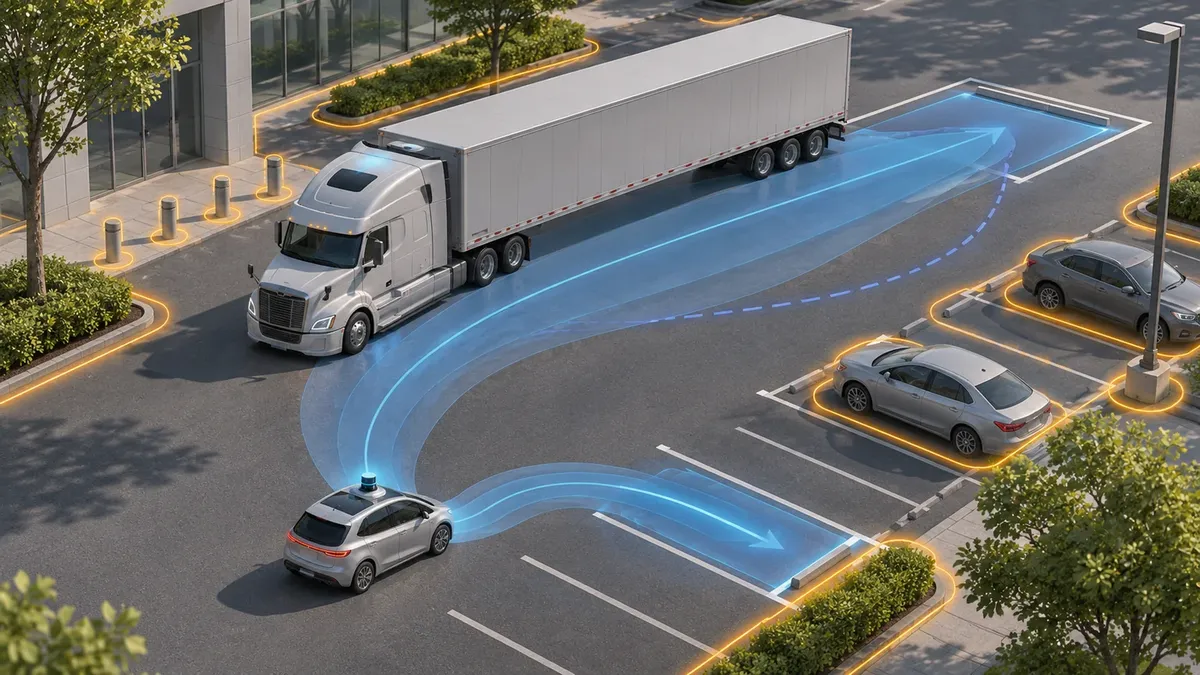
A robot can imagine what might happen next without knowing whether its imagined route is physically safe. JEPA-Shield is a planning method designed to bridge that gap, tested on simulated parking tasks for cars and tractor-trailers.
A robot planner that works from images can predict how a sequence of actions might unfold. But a plausible prediction is not the same as a safe one: the robot must avoid obstacles, stay within its workspace and, for a tractor-trailer, avoid jackknifing. JEPA-Shield, a new research preprint, adds an explicit safety-checking layer to a planner built around a latent world model.
A latent world model predicts future representations of a scene rather than reconstructing every pixel. That can support planning from visual observations, but its internal predictions do not automatically describe the physical quantities needed to check collisions or other constraints. JEPA-Shield addresses this by translating imagined model rollouts into predicted relative motion, while a separate model estimates unsafe regions from the current image.
The method then accounts for motion-prediction error. The researchers use split conformal prediction, a calibration technique that uses held-out examples to set an uncertainty range. Here, it creates multi-step “tubes” around predicted motion: instead of checking only one nominal path, the planner checks a range of possible positions. A backup-based shield evaluates candidate plans against physical constraints and can reject a proposed path in favor of a previously validated backup. The shield checks sampled candidates and the planner’s final proposal.
The researchers tested the method in VParkBench, a visual parking benchmark they introduce. It includes geometric simulations for cars and tractor-trailers, plus a photorealistic parking-lot environment reconstructed using Gaussian splatting. The tractor-trailer task includes an additional jackknifing constraint. The evaluation covered 288 benchmark trials across three settings: geometric car parking, geometric tractor-trailer parking and photorealistic car parking.
JEPA-Shield’s reported success rates were 84.4%, 82.3% and 99.0% in those settings, respectively, with no observed constraint violations in the 288 trials. These are experimental results, not a guarantee that a deployed robot will never be unsafe. In an ablation that removed conformal uncertainty expansion but retained shielding, success fell to 78.1%, 72.9% and 97.9%, and unsafe episodes reappeared in the geometric settings. Another ablation without shielding had a 34.4% unsafe-episode rate for tractor-trailer parking. The authors say these comparisons show complementary contributions from shielding and uncertainty calibration.
The paper also makes a narrower theoretical claim. Under stated assumptions—including exchangeability between calibration and test trajectories, a valid initial backup, and conservative evaluation of physical constraints—it establishes probabilistic constraint satisfaction at action-block boundaries for a returned plan executed without replanning. In practice, the system replans after each action block. The conformal guarantee covers motion-prediction error; the authors note that safety claims involving image-decoded unsafe geometry additionally require that constraint evaluation be conservative. The guarantee is therefore conditional, not a blanket certificate covering every source of error or every real-world situation.
The evidence is limited to the benchmark and setup described in the paper. Simulated parking, including a reconstructed photorealistic scene, does not establish performance on physical vehicles or in varied, changing environments. The dataset and generation code were described as pending legal review, so their availability may affect independent replication. And because this is an arXiv preprint, its claims should be treated as preliminary rather than as peer-reviewed conclusions. The work’s central idea is more specific: predictions in a learned visual representation can be useful for planning, but safety checks need task-relevant physical quantities and an explicit account of prediction uncertainty.
- robotics
- robot safety
- world models
- JEPA
- conformal prediction
- model predictive control
- robot parking
Reviewed cross-references
These connections were reviewed by a model, not independently fact-checked by a human. Similarity does not imply agreement; consult the original papers and the evidence below.
WARP-JEPA speeds up AI planning by learning which routes to try
Shared method: Both methods keep a JEPA world model frozen while using it in planning: JEPA-Shield evaluates proposed trajectories with task-space safety checks, whereas WARP-JEPA uses learned proposers and world-model rollout selection. This shared component does not imply the planners or safety guarantees are the same; WARP-JEPA addresses inference cost and task success, not conformal safety shielding.
Model review: · openai-codex/gpt-6-luna
Evidence and provenance
Selected excerpts, not complete papers. PDF extraction can omit figures or damage equations, tables and reading order; sources may be preprints.
2611.29609v1 — Original paper
Excerpt reference:
static/papers/2611.29609v1.md:13-66
Basis: Paper text
Source SHA-256:73379602a2b11d75ba88db96af16a0252135bcd7becc705cb5967d5a016df2572611.10806v1 — Original paper
Excerpt reference:
static/papers/2611.10806v1.md:13-87
Basis: Paper text
Source SHA-256:338cc77457ec52c35631737282db50f6cf75ff5ecabb867a9b7d0704cc9cee34
Related reading
Automatically matched by shared topic keywords. These links do not imply that the sources agree or establish a consensus.
Can AI World Models Help Robots Understand the Ocean?
Source published
Shared keywords: world models
Can robot planners think in point clouds?
Source published
Shared keywords: world models
A smoother way for robot AI to imagine what actions do
Source published
Shared keywords: world models
Teaching robot video models to focus on what moves
Source published
Shared keywords: world models
Why one action may not teach an AI how actions work
Source published
Shared keywords: world models