TRANSMISSION // 2611.29605v1
A Symmetry-Aware Approach to Quantum Memory
Source published
A preprint proposes a Markovian embedding that preserves a symmetry in the bath response. Its possible savings depend on the approximation and the bath.
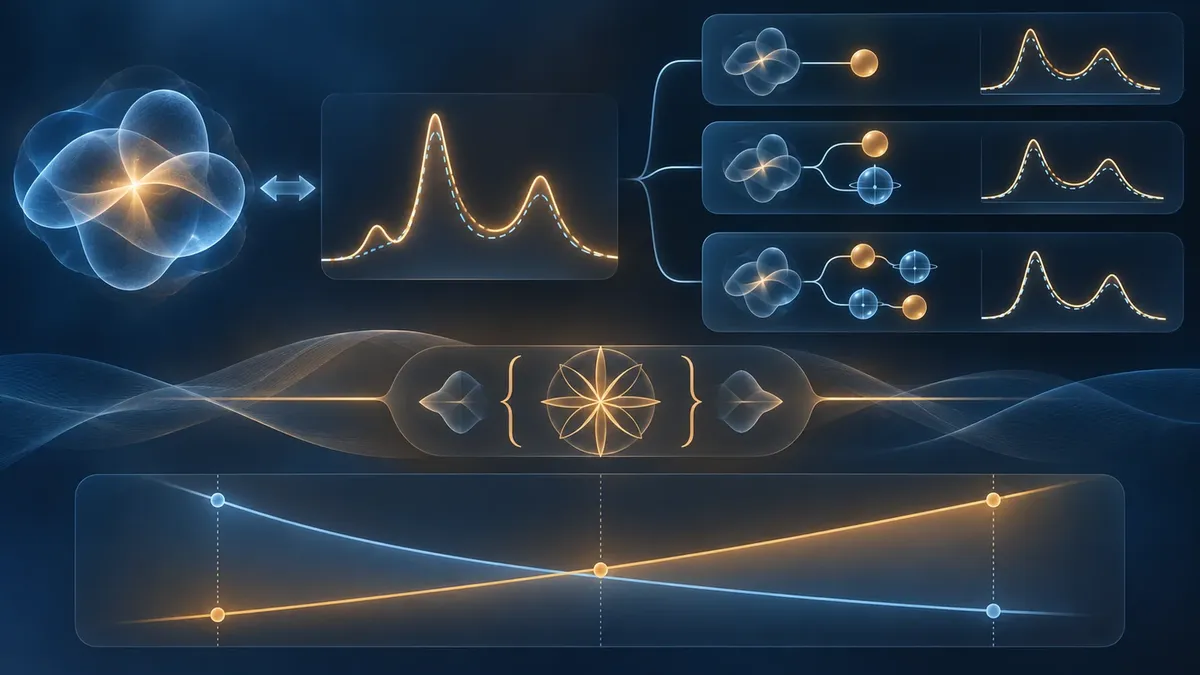
When a quantum system’s environment can influence it later, modeling that memory can require extra variables. Vasilii Vadimov’s preprint describes an embedding method that uses a symmetry in the environment’s frequency response. It sets out a potential reduction in model size, while emphasizing that computational gains depend on the bath and the quality of the approximation.
Why model the environment?
A quantum system rarely exists in perfect isolation. Its surroundings can absorb energy, disturb its state and, in some cases, influence it again later. This dependence on past interactions is called non-Markovian dynamics. One strategy for studying it is to expand the model: include auxiliary variables that represent some of the environment, so the enlarged description can evolve according to Markovian equations even when the original system retains memory.
In Just another Markovian embedding for open quantum systems, Vasilii Vadimov proposes a way to build such an embedding. The central idea is to preserve a symmetry in a mathematical approximation of the environment’s frequency-dependent response. The paper asks whether doing so can yield a useful embedding with fewer auxiliary degrees of freedom.
From bath response to an embedding
The method begins with the bath correlation function, which describes how environmental fluctuations are related over time. The author approximates it in the frequency domain using rational functions, a form that can be represented through poles and residues. Such approximations are used in approaches including free-pole hierarchy methods and pseudomode models, which represent environmental effects with auxiliary variables or oscillator-like modes.
The proposed approximation retains a relation between poles at opposite frequencies, expressed in the paper as a symmetry involving frequency and its negative complex conjugate. Vadimov argues that this symmetry can reduce the number of indices in the hierarchy relative to a general, nonsymmetric pole treatment. The abstract describes the resulting embedding as using half a degree of freedom per pole. These are related but distinct counts: hierarchy indices are not themselves the same thing as physical auxiliary degrees of freedom. The reduction is also conditional; its practical value depends on how many poles a symmetry-preserving approximation needs to reach the desired accuracy.
To turn the approximation into an embedding, the paper uses spectral factorization: a mathematical procedure for expressing a frequency-dependent response in terms of factors that can be used to construct the enlarged model. The author derives a construction whose evolution preserves complete positivity and trace (CPTP) under the conditions specified for that construction.
There is a special case when the approximation has an odd number of poles. The author says the direct GKSL, or Lindblad-type, embedding construction used in the paper cannot be applied in that case, and instead develops a hybrid quantum-classical master equation. This equation describes some auxiliary variables quantum mechanically and others classically. That is a choice and limitation of the presented construction—not proof that no GKSL representation could exist by some other method.
Accuracy, scope and practical limits
The embedding is approximate. The paper explains that an exact match is generally unavailable because the constructed noise response is rational, whereas the exact thermal response is not. The method therefore aims to approximate the relevant frequency-dependent self-energies within a chosen tolerance. The author also notes that there is no universal bound translating this frequency-domain approximation error into errors in the dynamics of arbitrary systems at arbitrary times. A tolerance alone therefore does not guarantee a particular level of accuracy for every application.
The analysis has specific scope conditions. It restricts attention to rational bath spectral densities for which both ωJ(ω) and J(ω)/ω are bounded on the real frequency axis, and assumes the spectral density is supplied in a factorized form. The paper notes that the stated error condition excludes sub-Ohmic baths except at zero temperature; treating those baths would require a different error measure.
Nor does preserving symmetry automatically make a calculation smaller or faster. The pole count needed for a given accuracy matters, and a bath spectral density that already has many poles may leave little room for savings. In the numerical implementation described in the preprint, the method outperforms the free-pole approach only for the simplest baths in the comparison, using non-optimized approximations. Finding the best rational approximation is outside the paper’s main focus.
The contribution is thus a proposed mathematical construction, not a general demonstration of superior speed or accuracy, and the paper reports no experimental test. This account is based on the version-one arXiv preprint. Preprints can be useful reports of research, but their claims should be interpreted with the usual caution about work that may not yet have been independently evaluated through publication and peer review.
- open quantum systems
- non-Markovian dynamics
- Markovian embedding
- bath correlation function
- quantum-classical master equation
- spectral factorization
Reviewed cross-references
These connections were reviewed by a model, not independently fact-checked by a human. Similarity does not imply agreement; consult the original papers and the evidence below.
A better boundary for simulating quantum systems and their surroundings
Shared method: Both papers use enlarged Markovian descriptions to represent environmental effects: Vadimov constructs an embedding from a rational bath-correlation approximation, while Chen, Luo and Yu discuss closing a chain with finitely many damped modes. These are related strategies, not the same construction; their excerpts do not establish a direct performance comparison.
Model review: · openai-codex/gpt-6-luna
Evidence and provenance
Selected excerpts, not complete papers. PDF extraction can omit figures or damage equations, tables and reading order; sources may be preprints.
2611.29605v1 — Original paper
Excerpt reference:
static/papers/2611.29605v1.md:61-147
Basis: Paper text
Source SHA-256:442d56f22e8bcfa2b7da56be113970ebb36e4969d0cd365e2fd5e4798ea6eb1f2611.29605v1 — Original paper
Excerpt reference:
static/papers/2611.29605v1.md:1518-1567
Basis: Paper text
Source SHA-256:442d56f22e8bcfa2b7da56be113970ebb36e4969d0cd365e2fd5e4798ea6eb1f2611.12782v1 — Original paper
Excerpt reference:
static/papers/2611.12782v1.md:68-120
Basis: Paper text
Source SHA-256:52b5fe67b65473938fbd489f44b43d1932441faa9ccc69420189c07ada2784132611.12782v1 — Original paper
Excerpt reference:
static/papers/2611.12782v1.md:1021-1154
Basis: Paper text
Source SHA-256:52b5fe67b65473938fbd489f44b43d1932441faa9ccc69420189c07ada278413
Related reading
Automatically matched by shared topic keywords. These links do not imply that the sources agree or establish a consensus.
Higher-Order Equations for Quantum Systems With Memory
Source published
Shared keywords: non markovian dynamics, open quantum systems
When three-time tests reveal quantum memory
Source published
Shared keywords: non markovian dynamics, open quantum systems
A quantum exceptional point depends on what you measure
Source published
Shared keywords: non markovian dynamics, open quantum systems
When Structured Noise Reshapes Photon-Loss Errors
Source published
Shared keywords: non markovian dynamics
A quantum environment that remembers—and carries control between spins
Source published
Shared keywords: non markovian dynamics