TRANSMISSION // 2611.29597v1
One simulation, many dark-energy histories
Source published
A new matching method tests whether simulations with constant dark energy can reproduce the evolving structures predicted by time-varying models.
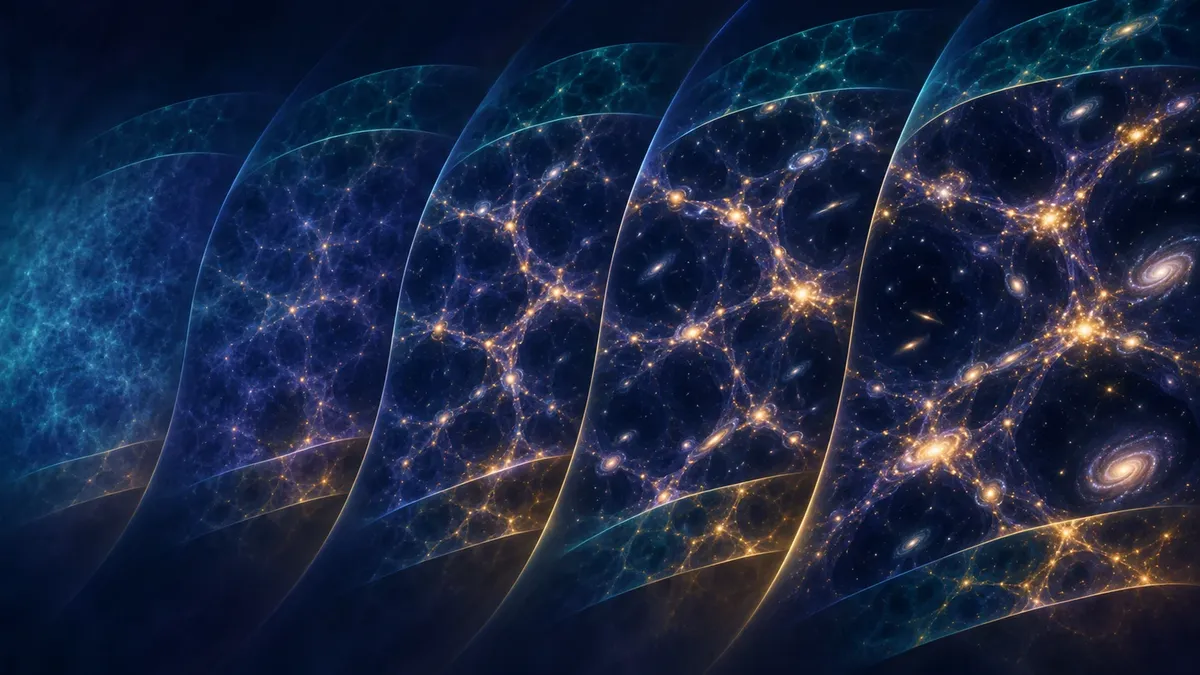
Cosmologists need simulations for many possible cosmic histories, but each one is costly. This study tests a shortcut: can one simulation with constant dark energy reproduce the evolving structures predicted by a time-varying model?
The challenge: simulating an evolving universe
Dark energy is the name given to whatever drives the universe’s accelerated expansion. One way to describe possible changes in dark energy is the Chevallier–Polarski–Linder (CPL) model, in which its equation-of-state parameter, w, varies with the scale factor. The authors note that some combinations of DESI measurements with other data have suggested evolving dark energy. If researchers want to model such possibilities, they need predictions for how matter clusters—but running a separate large simulation for every cosmological model is expensive.
Yuxi Meng and colleagues test whether simulations made with a simpler, constant-w model can stand in for simulations with evolving CPL dark energy. Their focus is not just broad summaries of structure, but whether the simulated matter fields themselves can be reproduced.
Matching expansion histories
The method uses a time coordinate called superconformal time. In this formulation, the equations for simulated particles depend on the background cosmology through Ωma(τ), where Ωm is the matter density parameter and a(τ) describes how the universe’s scale factor changes with superconformal time. With Ωm held fixed, identical a(τ) histories and identical starting conditions would give identical particle trajectories, under the paper’s assumption that dark energy does not cluster significantly.
A constant-w model cannot usually match an evolving CPL model’s expansion history exactly. The researchers choose the constant value of w that makes a(τ) as close as possible to the target history. They then pair snapshots at epochs with the same linear growth factor—a measure of how much small matter fluctuations have grown—and rescale velocities using a correction from linear theory.
The team tested the approach with 100 pairs of simulations across a grid of matter densities and CPL parameters. The grid includes models in a region favoured by the particular DESI, cosmic microwave background and supernova data combination cited in the paper; this is not a claim that DESI results generally establish evolving dark energy. Each target and matched simulation shared random phases, helping isolate differences between the models. The main simulations used the MG-GLAM particle-mesh code. The team also checked one DESI-like example with two other simulation codes. Comparisons covered density fields and statistics such as power spectra, bispectra, velocities, redshift-space clustering, and halo and void abundances.
Close matches in the tested cases
For the DESI-like example, the paper reports matter power spectra agreeing to better than 0.25% for k ≲ 1 h Mpc⁻¹ and better than 0.9% up to the simulation mesh’s Nyquist scale, about k ≲ 3 h Mpc⁻¹, across redshifts 0 to 3. Here k is spatial frequency: higher values correspond to smaller structures. The density fields were also closely correlated. The paper’s “stochasticity,” 1−r², measures the fraction of variance in the target density field that the matched field does not explain. For this DESI-like pair, it stayed below 10⁻⁵ for k ≲ 1 h Mpc⁻¹.
Across the 100 models with negative wₐ, most power-spectrum errors were below 1% on scales k ≲ 1 h Mpc⁻¹. The authors also found close agreement for other tested quantities, including redshift-space multipoles, bispectra, and halo and void abundances. In general, errors grew when the constant-w model was a poorer fit to the target’s expansion history.
The shortcut exchanges some accuracy for efficiency. In the DESI-like comparison, an earlier approach that matched each redshift separately was more accurate on some smaller scales at redshifts above zero, but needed a separate simulation for each output redshift. The new method uses one constant-w simulation to provide snapshots across the tested redshifts.
Limits and uncertainties
A constant-w simulation is not a reliable substitute for every evolving-dark-energy model. In a stress test with positive wₐ, some models had appreciable dark energy at early times. Their expansion histories were difficult to match with a constant-w model, and some errors exceeded 1% even on k ≲ 1 h Mpc⁻¹ scales. The method also assumes negligible dark-energy clustering and no additional scale dependence. It does not straightforwardly cover cases such as massive neutrinos or scale-dependent modified gravity.
These are comparisons between simulations, not direct tests against observations and not evidence that dark energy is evolving. The results show that the shortcut can reproduce selected simulations under the stated assumptions; they do not determine which model describes the universe. The source is an arXiv manuscript. Although its text is formatted as a 2026 journal preprint, it retains publication placeholders, and the supplied material does not establish its peer-review or final publication status. Its conclusions are limited to the tested models and simulation setups.
- dark energy
- cosmological simulations
- DESI
- large-scale structure
- N-body simulations
- cosmology
Related reading
Automatically matched by shared topic keywords. These links do not imply that the sources agree or establish a consensus.
Can one simpler simulation stand in for many dark-energy models?
Source published
Shared keywords: dark energy, large scale structure, n body simulations
Combining Cosmic Probes to Test Dark Energy
Source published
Shared keywords: dark energy, large scale structure
DES Year 6 tests the cosmic picture
Source published
Shared keywords: dark energy
Choosing galaxies could shape the science of a future giant telescope
Source published
Shared keywords: dark energy
Why Galaxy Bias Depends on How You Measure It
Source published
Shared keywords: cosmological simulations, large scale structure