TRANSMISSION // 2611.29523v1
A millisecond pulsar with a very brief eclipse
Source published
A 2.7-year study of PSR J1840+1102 reports pulsed gamma rays, a brief radio eclipse and evidence favoring a helium-white-dwarf companion—but its identity is not confirmed.
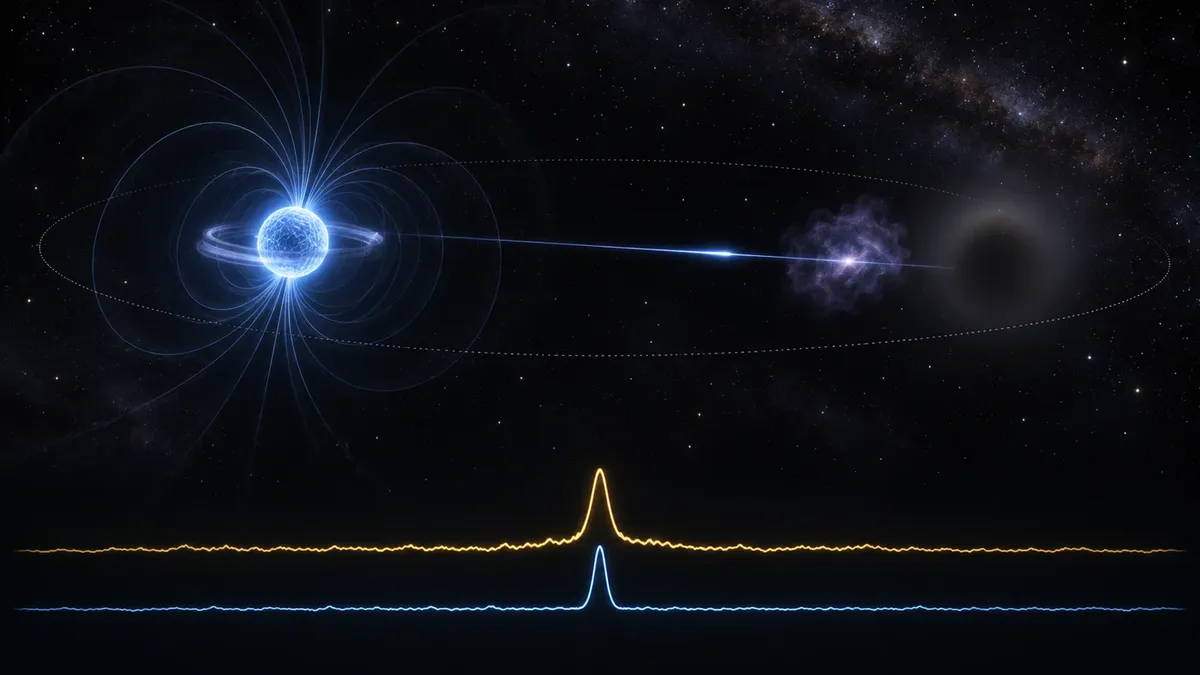
PSR J1840+1102 spins more than 600 times a second, yet its radio signal is briefly disturbed as it passes through material in its binary system. Researchers tracked the pulsar for nearly three years, finding precise pulse timing, evidence of gamma-ray pulses and clues—but no definitive identification—of its companion.
A neutron star can act like a remarkably steady clock: its radio pulses arrive at intervals astronomers can track over years. PSR J1840+1102 is a millisecond pulsar, spinning once every 1.60 milliseconds, in a binary system with an orbital period of about 1.68 days. What is its companion, and how suitable is this pulsar for precision-timing studies? A new preprint reports a detailed effort to investigate those questions.
The pulsar was discovered in the SCOPE survey using the Giant Metrewave Radio Telescope (GMRT). For the timing study, the team used radio observations from June 2023 to March 2026, generally near 650 megahertz, along with lower-frequency observations to study how the signal changes on its journey to Earth. They measured pulse arrival times and fitted a model for the pulsar’s spin and nearly circular orbit. Keeping track of every rotation between observations—a process called phase connection—lets researchers test how accurately the model predicts the pulses.
The team also corrected for changes in dispersion measure (DM), a measure related to free electrons along the line of sight that delay radio waves. They searched archival Fermi gamma-ray data using the radio timing model, looked for an optical counterpart, and studied changes in pulse shape and brightness that can reveal effects of gas and plasma.
A clock, with a short interruption
Across a 2.7-year timing baseline, the fitted model’s radio-pulse residuals had a weighted root-mean-square of about 2.14 microseconds. Residuals are differences between observed pulse arrival times and the model’s predictions. The researchers excluded data near the eclipse, where plasma can distort arrival times, and adjusted the estimated uncertainties when fitting the model. This small residual is encouraging, but it does not by itself establish that the pulsar will be useful in a pulsar timing array, which searches for subtle, shared timing shifts across many pulsars.
The system’s most striking feature is its brief radio eclipse. Near one point in the orbit, the pulsar’s signal passes through material associated with its companion and shows a sharp timing disturbance. At 650 megahertz, the measured eclipse spans about 0.40% of the orbit. The authors argue that the eclipsing region is too small to be the companion’s full surface, pointing instead to surrounding plasma.
An optical search found no counterpart, but that does not settle the companion’s identity: it could simply be too faint to detect at the estimated distance and along this dusty line of sight. Orbital measurements imply a minimum companion mass of about 0.16 times the Sun’s mass. Considering this constraint, the nearly circular orbit, the brief eclipse and comparisons with known binary pulsars, the authors favor a helium white dwarf surrounded by plasma. A low-mass main-sequence star remains possible. The white-dwarf interpretation is an inference, not a direct detection.
Gamma rays and intervening material
Using 17 years of Fermi-LAT observations, the team reports evidence for pulsed gamma-ray emission at a significance of 4.2 sigma. The gamma-ray pulse peak appears aligned in phase with the radio profile. This reported alignment concerns the timing of the peaks; it does not by itself establish that the emissions share a physical origin or follow the same beam path.
Radio observations from 300 to 750 megahertz let the researchers estimate how scattering broadens pulses at different frequencies. They report a scattering index of 1.65 ± 0.15. The index describes how scattering changes with frequency and depends on the line of sight and modeling choices; it is not a universal property of the interstellar medium. The team also estimates a refractive-scintillation timescale of roughly 16 days, but says the data do not clearly favor a changing signal over a constant one. More frequent observations are needed to confirm that estimate.
The study reports no measurable orbital-period variation or glitches over the current baseline. DM measurements show slow changes as well as a few unexplained outliers. Longer monitoring matters because changes in scattering can complicate precise timing even when DM is measured and corrected. The authors describe PSR J1840+1102 as a potential addition to pulsar timing array campaigns, not as an established array source.
This article is based on the authors’ November 2026 arXiv preprint, a public manuscript that may not yet have completed peer review. It concerns one system observed over a limited baseline. The companion classification, gamma-ray evidence and scintillation estimate each have uncertainties. Follow-up timing, deeper optical searches and eclipse measurements across a wider range of radio frequencies could clarify the picture.
- millisecond pulsar
- PSR J1840+1102
- pulsar timing
- gamma rays
- helium white dwarf
- radio eclipse
- interstellar scattering
Related reading
Automatically matched by shared topic keywords. These links do not imply that the sources agree or establish a consensus.
A fast-spinning pulsar reveals a changing companion star
Source published
Shared keywords: millisecond pulsar
Why Bigger Telescopes Alone Cannot Perfect Pulsar Timing
Source published
Shared keywords: interstellar scattering, pulsar timing
Seven pulsar binaries sharpen measurements of stellar orbits and distances
Source published
Shared keywords: pulsar timing
A pulsar’s gamma rays brighten when its X-rays fade
Source published
Shared keywords: gamma rays
Could a hidden pulsar power the LHAASO Peanut?
Source published
Shared keywords: gamma rays