TRANSMISSION // 2611.29468v1
A geometric workaround for watermarking 360° images
Source published
RSWP uses an icosahedron-based design to help recover watermarks from rotated panoramas and rendered viewport images. Its reported tests are promising, but do not establish performance in every setting.
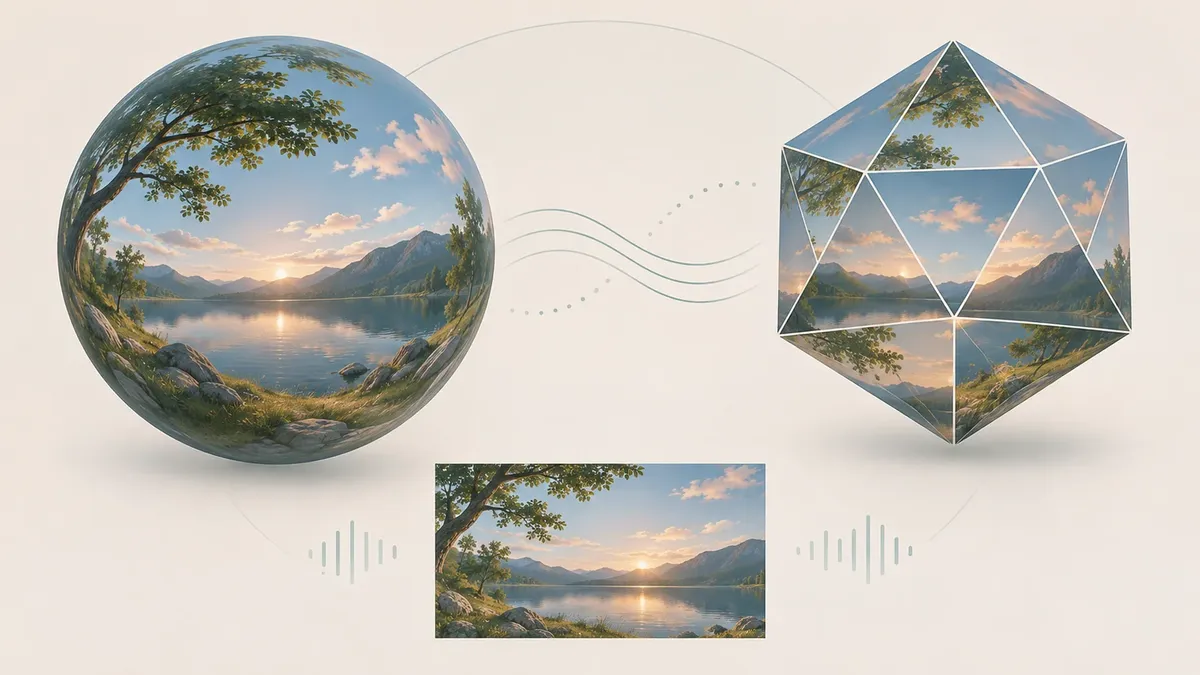
The authors frame panoramic watermarking as a geometry problem: a 360° scene is stored in a flat format, while viewers can rotate their direction or see a rendered viewport. A new preprint proposes an icosahedron-based method designed to help decode watermark information despite those changes.
A panorama captures the surroundings on a sphere, but it is commonly stored as a rectangle. In the paper’s account, rotating the view on the sphere can warp and shift patterns in that rectangular representation. A headset may also display only a limited viewport, making it difficult to extract a watermark using methods designed for ordinary flat images.
In RSWP: Robust SO(3)-Equivariant Watermarking for Panoramic Images, Pengzhen Chen and colleagues ask whether a geometry-aware system can recover watermark information after three-dimensional viewing rotations and directly from rendered viewport images, without remapping those images to the full panorama.
A sphere represented by triangular facets
RSWP projects a panorama onto 20 triangular facets associated with an icosahedron. The icosahedral group has 60 elements. The authors describe rotations in this discrete group as corresponding to changes in facet order together with local rotations within facets. Their decoding design uses this decomposition; the resulting invariance claim depends on the paper’s architectural assumptions and derivation.
The encoder divides a 320-bit binary watermark into sub-watermarks assigned to the facets, embeds them, then maps the resulting signals back into the panorama representation. At decoding, an equivariant feature extractor is designed to make facet features respond predictably to rotations. A sorting module makes the combined result insensitive to facet order. Together, these components aim to synchronize features for watermark recovery.
A separate viewport decoder is trained on rendered viewport images to recover the corresponding facet sub-watermark. The paper does not establish that every partial viewport yields the entire 320-bit message. Its approach is designed to retrieve watermark information directly from viewports without requiring geometric calibration to remap them to the panorama.
What the authors report
The experiments use images selected from panoContext and SUN360: 8,000 for training and 2,000 for testing. The reported panorama resolution is 640 × 320, and viewport images are 128 × 128. The authors compare RSWP with four methods designed for conventional 2D images and one panoramic-watermarking method. Measures include the proportion of watermark bits recovered correctly and image-fidelity metrics.
The paper reports high recovery for many tested rotations and individual image-processing attacks. For one arbitrary-rotation example, it reports panoramic bit accuracy above 83%. In viewport tests, reported bit accuracy is high under several listed attacks, but varies by condition; for example, the table reports 90.66% under one blur setting. Some combined attacks involving rotation and other distortions also reduce recovery. These are the authors’ results under their stated test setup, not independent confirmation of broader performance claims.
The authors report favorable visual-fidelity results against selected baselines, but the extracted comparison table is difficult to read reliably. The exact comparisons across metrics therefore cannot be established from the text available here.
A key qualification is that the paper’s mathematical invariance result concerns the discrete icosahedral group. To address continuous rotations, the system uses a bank of 500 candidate orientations and a confidence-based selection procedure. The authors say their quotient-space sampling construction bounds residual angular misalignment to 5 degrees. This is a design guarantee under the stated construction, not evidence that every practical input or deployment condition has been tested. The authors describe evaluating candidate orientations in parallel and frame the approach as suitable for offline verification.
What remains uncertain
The reported evidence is specific to the chosen datasets, image sizes, baselines and transformations. It does not establish performance across a wider range of panorama capture, display or distribution conditions. Nor does successful watermark retrieval alone prove ownership or show that a watermark cannot be removed by an adversary.
The source is an arXiv preprint; the supplied material does not establish peer-review status. The theoretical and performance claims should be understood as the authors’ claims and read alongside the specific experimental setup. RSWP presents a geometry-aware approach to panoramic watermarking, while broader independent testing would help clarify how well it transfers beyond the reported experiments.
- panoramic images
- digital watermarking
- computer vision
- icosahedral geometry
- rotation robustness
- preprint
Reviewed cross-references
These connections were reviewed by a model, not independently fact-checked by a human. Similarity does not imply agreement; consult the original papers and the evidence below.
Why 360° Drone Tracking Challenges AI
Supporting evidence: Both studies report geometry-related challenges when spherical imagery is represented in equirectangular format: RSWP describes rotation and viewport warping for watermark extraction, while PanoUAV-Track reports latitude distortion and seam discontinuities in tracking. This supports the bounded point that ERP geometry can complicate downstream vision tasks; the tasks and evaluated outcomes differ, so it does not establish a shared solution or directly comparable performance.
Model review: · openai-codex/gpt-6-luna
Evidence and provenance
Selected excerpts, not complete papers. PDF extraction can omit figures or damage equations, tables and reading order; sources may be preprints.
2611.29468v1 — Original paper
Excerpt reference:
static/papers/2611.29468v1.md:139-222
Basis: Paper text
Source SHA-256:91468d488811c0a21c74ad06606669bb7096a55cf065c1e8d35a34b84c556cc42611.27383v1 — Original paper
Excerpt reference:
static/papers/2611.27383v1.md:90-145
Basis: Paper text
Source SHA-256:2700b947f6a5597e2cd0bfe66475dd2e7d7041c62b39e4dccc6926a452df031a
Related reading
Automatically matched by shared topic keywords. These links do not imply that the sources agree or establish a consensus.
A 360-degree image can map a room—but not every surface
Source published
Shared keywords: computer vision
SplatLab puts an AI research loop to work on 3D scenes
Source published
Shared keywords: computer vision
Teaching AI to Generate Event-Camera Signals
Source published
Shared keywords: computer vision
A DETR-Based Vehicle Detector Tested on Bangladeshi Roads
Source published
Shared keywords: computer vision
Shrinking video memories without retraining the model
Source published
Shared keywords: computer vision