TRANSMISSION // 2611.29464v1
Can one photon make a better quantum sensor?
Source published
A theoretical cavity-QED study explores single-photon sensing with a trapped atom, including situations without a stable shared phase reference.
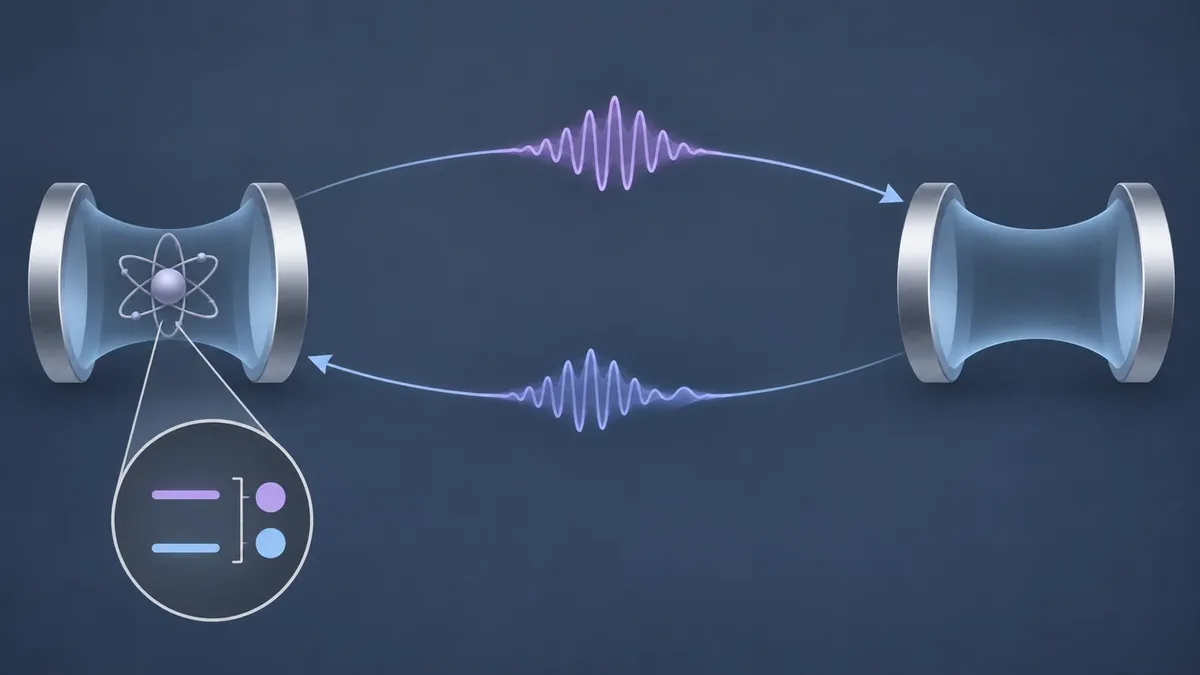
A sensor learns about its target by measuring how a probe changes. Joshua Burns, Mattias Keller and G. J. Milburn propose using a single photon and a trapped atom in a cavity to make that measurement. Their calculations point to advantages in specific conditions, but this is a theoretical proposal, not a laboratory demonstration.
The sensing problem
Quantum sensors estimate quantities such as frequency shifts by measuring how light or matter responds to them. Raising the probe’s power can improve sensitivity, but may be undesirable in settings where light could disturb the target. Burns, Keller and Milburn ask whether a pulse containing exactly one photon can be useful when a stable, shared reference for the light’s phase is unavailable.
Their proposed sensor couples one atom to an optical cavity. A timed classical control pulse drives a Raman transition, and the atom–cavity system interacts with an incoming photon. The measurement is based on the probability that this interaction changes the atom’s state through photon absorption. It does not rely on conventional phase-sensitive detection of the light.
How the study works
The authors use a Fock-state master equation to model the dynamics of a fixed-one-photon input interacting with the atom and cavity. They compare that input with a coherent pulse having the same mean photon number per pulse. A coherent state has a fluctuating photon count, whereas a Fock state contains exactly one photon. The comparison depends on the pulse and readout conditions; it is not a blanket comparison of all single-photon and coherent-light sensors.
The paper studies two tasks. In the first, the unknown parameter changes the detuning of the atom’s two-level transition. A change in detuning alters the probability of photon absorption, which can be estimated by repeating the measurement and recording the atom’s final state.
In the second task, the photon first encounters a remote reflecting cavity. That cavity changes the photon’s spectral phase in a parameter-dependent way, thereby reshaping its temporal mode. The photon returns to the local atom–cavity system, whose absorption probability is used to infer properties of the distant cavity. The authors emphasize that this arrangement does not require a shared coherent phase reference.
They calculate the sensor’s response and optimize pulse and control settings numerically, including with machine-learning-based methods. These are model calculations, not measurements from an assembled device.
What the calculations suggest
For the atom-detuning example, the paper reports a steeper absorption-probability response for a single-photon pulse than for the coherent pulse in the comparison presented. A steeper response can help distinguish small parameter changes, assuming comparable readout noise and other conditions. The calculations also find that optimizing pulse widths can bring the modelled absorption probability close to one and improve calculated detuning sensitivity.
For the remote-cavity example, the challenge is to extract information after the photon has acquired a parameter-dependent spectral phase, without relying on a shared phase reference. The local atom–cavity system acts as a controlled readout of the altered photon pulse. In the paper’s optimized example, this atomic readout captures more information than its baseline configuration, while remaining below the information theoretically available in the probe.
The comparison with coherent light depends on phase access. If a stable coherent reference is available, a coherent probe can carry additional information through its mean phase response. Without that reference, the paper finds equal Fisher information per photon for the ideal probes in its analysis; the single-photon probe can nevertheless perform better with the particular saturable, atom-based readout studied. Thus, the proposed advantage is conditional on the sensing and measurement setup—not a general claim that one photon is always better than coherent light.
Limits and uncertainty
The paper explicitly considers some imperfections, including errors in preparing and reading out the atom’s state, and noise in the detuning. Such effects reduce the information available from the binary measurement. The authors also discuss possible platforms, but identifying candidate systems is not evidence that the complete sensor has been built or tested. The calculations do not establish how every practical source of loss or control error would affect performance.
This is version 1 of an arXiv preprint, posted in November 2026. The supplied source record does not establish peer review. Its results should therefore be read as a theoretical design study: Raman-controlled absorption offers a proposed way to read single-photon sensing signals, particularly when a shared phase reference is impractical. Whether an experimental implementation achieves the modelled performance remains an open question.
- quantum sensing
- single photons
- cavity QED
- quantum optics
- atom-cavity systems
- quantum metrology
Related reading
Automatically matched by shared topic keywords. These links do not imply that the sources agree or establish a consensus.
Why one recycled photon can be gentler on a sample
Source published
Shared keywords: quantum metrology, quantum sensing
A theoretical route to few-photon diodes
Source published
Shared keywords: quantum optics, single photons
Quantum limit cycles may help spins sense more precisely
Source published
Shared keywords: quantum metrology, quantum sensing
When extracting vacuum photons costs sensing power
Source published
Shared keywords: quantum metrology, quantum optics
When a quantum sensing limit depends on the model
Source published
Shared keywords: quantum metrology, quantum sensing