TRANSMISSION // 2611.29454v1
A Small Visual Cue Helps a Robot Navigate Around Obstacles
Source published
MobileNeTTT estimates time-to-transit from coarse camera-based depth, then uses it to guide a robot through simulated and laboratory obstacle courses.
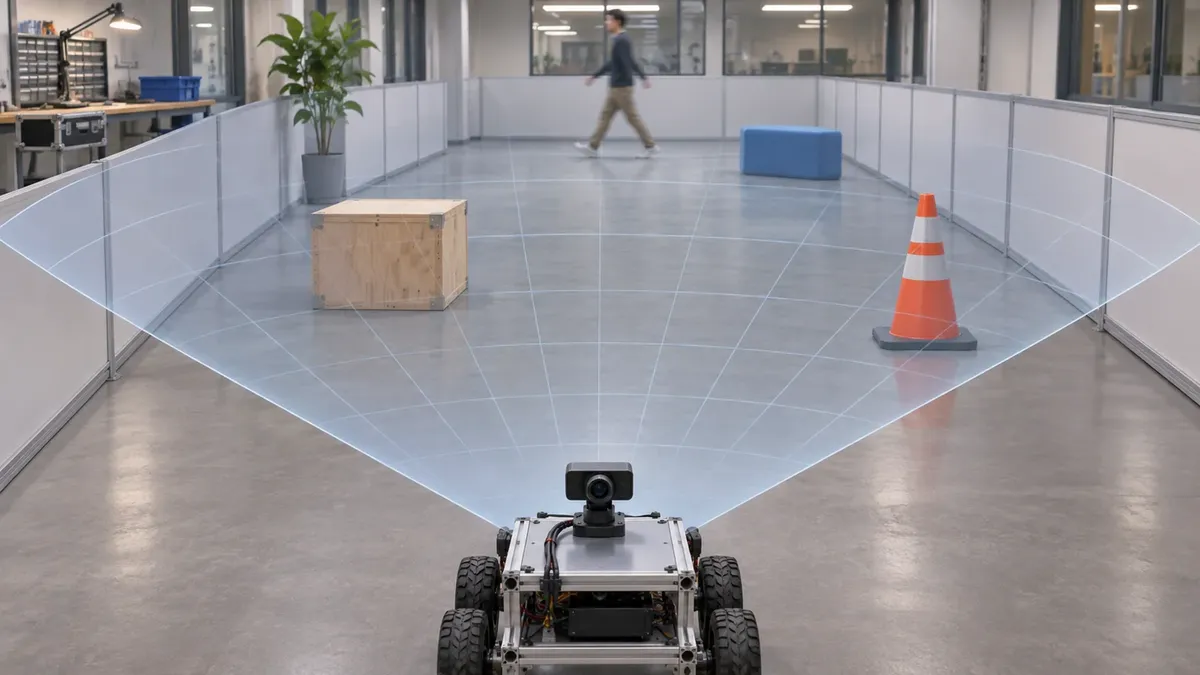
A robot steering through a cluttered space may not need a detailed 3D map. MobileNeTTT estimates a simpler cue: how long it would take the robot, moving in a straight line at its current speed, to reach a plane through a visible feature. The researchers tested whether this estimate could help a camera-equipped robot steer around obstacles.
A robot can use its camera to estimate not just what is nearby, but how its movement relates to what it sees. One such cue is time-to-transit (TTT): roughly, the time a robot moving in a straight line at its current speed would take to reach a plane through a visible feature. TTT is not a detailed map or a precise description of an object. It offers a coarser signal that may be enough to help a robot choose where to steer.
The paper introduces MobileNeTTT, a compact neural-network system for estimating this cue across a camera’s field of view. The researchers ask whether coarse depth estimates can provide useful TTT information for responsive navigation, without relying on the feature tracking and optical-flow calculations used in an earlier approach.
From coarse depth to a navigation cue
In the earlier method discussed in the paper, optical flow—the movement of image features between frames—was used to estimate TTT. The paper describes limitations: estimates were averaged over a few fixed image regions, could be noisy, and were sensitive to camera rotation. That method also used a sense-and-act cycle that restricted when the robot could turn while sensing.
MobileNeTTT instead uses sequential RGB images to predict coarse depth, then divides the predicted depth by the robot’s speed to obtain TTT. The network does not produce a detailed depth value for every pixel. It outputs a 10-by-20 grid covering the image, along with a confidence mask indicating which estimates are considered reliable. This keeps the representation compact while retaining information across the full view.
The team compared several neural-network architectures and selected a MobileNet-based model with 1.95 million parameters. They trained it on a custom dataset collected in the Gazebo robot simulator, then fine-tuned the selected model on KITTI driving scenes and indoor RGBD-SLAM sequences. For a direct comparison with the optical-flow method, they also used simulated sequences, including cases where the older method’s assumptions about straight motion could be checked. The evaluations covered depth estimates, TTT estimates, computation time and navigation outcomes.
What the tests showed
On an NVIDIA Jetson Orin Nano, the paper reports 97 frames per second and an inference time of about 10 milliseconds for the selected model. These are measurements on the tested hardware; performance may differ on other devices.
In the simulated TTT comparison, MobileNeTTT’s estimates were closer to the reference values than those from the optical-flow baseline, both with and without rotations. The researchers then used TTT estimates with simple steering rules. These compare estimates from different parts of the image and adjust the regions used for steering based on the estimated TTT pattern.
The navigation table reports trials in an L-shaped corridor, an obstacle course, a dynamic environment with walking agents, and a real-world laboratory obstacle course. For each of the three simulated settings, MobileNeTTT reached the goal in 10 of 10 trials; the optical-flow baseline reached it in 5 of 10 L-shaped-corridor trials and 0 of 10 trials in each of the other two settings. In the laboratory obstacle course, MobileNeTTT succeeded in 4 of 5 trials, while the baseline succeeded in 1 of 5. The paper also describes a zig-zag corridor with obstacles, but it is separate from those three simulated categories in the table. These results apply to the specific setups and trial counts, not to navigation safety in general.
What remains uncertain
Some evidence comes from simulation, and the physical tests took place in an indoor laboratory with a particular robot and camera. The real-world trial count was small, so each outcome has a substantial effect on the reported success rate. The authors say the network was trained exclusively on simulated scenarios for the real-world evaluation, and identify adding real-world data as ongoing work. Although they report tests in a previously unseen simulated environment and laboratory settings, performance under other lighting conditions or camera configurations was not established in the described results.
The system estimates a coarse navigation cue; it is not presented as a general scene-understanding system. The moving-agent trials also do not establish that the system detects or identifies people. The paper is a preprint submitted to IEEE for possible publication; its peer-review status is not established. Its findings should be read as the authors’ reported results rather than settled evidence. Overall, MobileNeTTT explores whether a small model estimating coarse depth can support responsive steering in the tested settings, without requiring a detailed visual map.
- robot navigation
- time-to-transit
- computer vision
- mobile robots
- neural networks
- edge computing
Related reading
Automatically matched by shared topic keywords. These links do not imply that the sources agree or establish a consensus.
Two images and underwater sound help AI assess fish feeding
Source published
Shared keywords: computer vision, edge computing
HyVox pairs two kinds of chips to cut speaker-identification energy
Source published
Shared keywords: edge computing
When fewer missed deadlines is the wrong goal for an AI scheduler
Source published
Shared keywords: edge computing
A vision-inspired network that is less confidently wrong
Source published
Shared keywords: computer vision, neural networks
MADSNet turns spike-camera signals into images
Source published
Shared keywords: computer vision