TRANSMISSION // 2611.29400v1
A compact DNA model tests overlapping k-mers
Source published
HGDNA combines overlapping DNA tokens with a hybrid sequence model. In reported benchmarks, its small model performs competitively, though results vary by task.
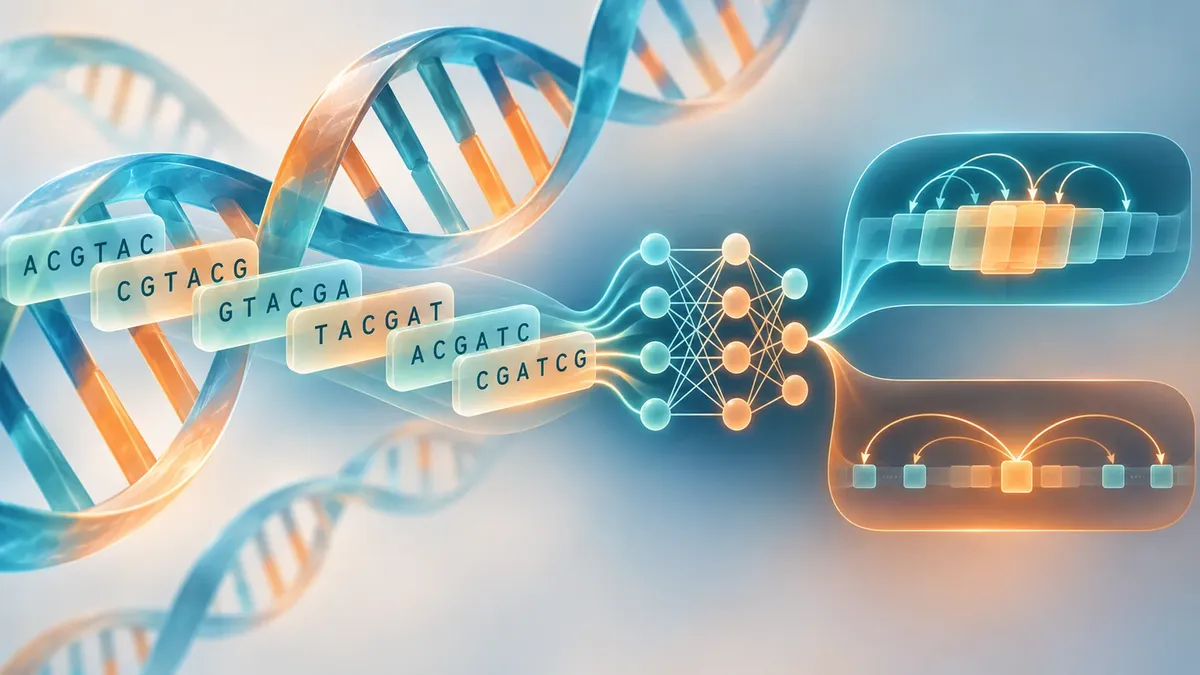
Can a compact genomic language model preserve useful local DNA patterns while also handling long sequences? HGDNA explores overlapping k-mer tokens and reports strong results on several classification and embedding benchmarks, with important task-specific exceptions.
Why rethink DNA tokenization?
Genomic language models treat DNA as a sequence that a model can learn to predict and represent. A central design choice is how to divide that sequence into tokens. One option is to use single nucleotides; another is to group neighboring bases into short strings called k-mers. With overlapping k-mers, each token shares most of its bases with the next. For example, consecutive six-base tokens share five nucleotides.
That overlap carries local context, but it creates a challenge for training: neighboring tokens partly reveal one another. The authors of HGDNA ask whether overlapping k-mers can work well with causal language modeling, which predicts the next token without seeing future tokens, and whether this approach can pair local detail with efficient processing of long DNA sequences.
How HGDNA works
HGDNA uses overlapping six-mers and causal next-token prediction. Because consecutive six-mers share five bases, the next token has only four overlap-consistent possibilities: the shared five-base sequence followed by one of DNA’s four nucleotides. The model’s prediction head still scores its full vocabulary, but the structure of the sequence makes the transition informative.
The model combines two kinds of sequence processing. Gated DeltaNet maintains a recurrent memory, while sliding-window attention handles nearby tokens. The paper says both components scale linearly with sequence length when their width and window size are fixed. HGDNA also learns to predict a species-group label during pretraining. For downstream classification, it reuses special class tokens rather than adding a separate classification head.
The team pretrained a 30-million-parameter model on gene-annotated sequence fragments drawn from RefSeq genomes across seven taxonomic groups. The paper reports 19 billion pretraining tokens. It evaluates HGDNA on GUE, a short-sequence classification benchmark; a long-context task from GENERator; and DNA Foundation Bench, where XGBoost classifiers use the model’s frozen, mean-pooled embeddings. The authors also compare design choices in ablation experiments.
What the paper reports
On GUE, HGDNA’s reported average score is 71.77, the highest among the listed models in the paper’s table. The authors say this exceeds the listed NTv2-500M score of 68.69, despite HGDNA’s smaller parameter count and fewer reported pretraining tokens. But it does not lead on every GUE task: DNABERT-2 retains the lead on TFH, and the authors describe the results as task-dependent.
For sequences extending to about 96 kilobases, HGDNA scores 98.30 on taxonomic classification without input chunking. The paper compares this with 98.02 for NTv2-100M and 97.44 for DNABERT-2, both evaluated with chunked inputs. On gene classification, HGDNA’s score is 63.17, which the authors report is 1.01 points below NTv2-500M. These results suggest that performance depends on the task and evaluation setup, not just model size.
The frozen-embedding evaluation also shows mixed outcomes. With XGBoost, HGDNA’s embeddings score higher than the strongest listed baselines on multi-species promoter detection and epigenetic-mark prediction. On human promoter detection, however, HGDNA scores slightly below Caduceus-Ps.
Ablations offer clues about the design. In the reported GUE comparisons, overlapping tokenization with causal prediction improves the average score over a DNABERT-2-like BPE-and-masked-modeling baseline. The authors also find that different k-mer sizes favor different tasks; six is not best for everything. Species-classification supervision and reused class tokens improve the reported overall score in their ablation.
What remains uncertain
These are benchmark results, not evidence that HGDNA improves biological discovery or clinical decisions. The comparisons involve different model sizes, training budgets, and—in the long-context comparison—input chunking, so they do not isolate every factor. The paper’s results also show clear exceptions, and a benchmark score does not establish performance on every species or genomic application.
HGDNA is presented in an arXiv preprint, which may not have undergone peer review. The supplied paper text describes the experiments and reports that code is available, but this account cannot independently verify the implementation or reproduce the results. The findings are best read as evidence that overlapping k-mers with causal training are a promising design to test further, not as a settled ranking of genomic models.
- genomic language models
- DNA tokenization
- overlapping k-mers
- causal language modeling
- HGDNA
- genomics AI
Reviewed cross-references
These connections were reviewed by a model, not independently fact-checked by a human. Similarity does not imply agreement; consult the original papers and the evidence below.
A learned tokenizer gives DNA models a new alphabet
Supporting evidence: Both studies report that tokenizer design can affect downstream genomic-model performance: HGDNA’s ablations favor overlapping k-mers with causal pretraining over its tested alternatives, while BQDNA reports higher GUE average MCC with its learned BQVAE codes than with base or vanilla VQVAE tokenization under the same hybrid backbone. These are separate experiments with different benchmarks and comparisons, so they do not establish which approach is better overall.
Model review: · openai-codex/gpt-6-luna
Evidence and provenance
Selected excerpts, not complete papers. PDF extraction can omit figures or damage equations, tables and reading order; sources may be preprints.
2611.29400v1 — Original paper
Excerpt reference:
static/papers/2611.29400v1.md:423-517
Basis: Paper text
Source SHA-256:f26d22dcc61f9a7672cb67c033ee7b05faa509224c4c632dd311118444abf4242611.29395v1 — Original paper
Excerpt reference:
static/papers/2611.29395v1.md:314-371
Basis: Paper text
Source SHA-256:67d521b0c019c7b8ae0b93f8adf97682838b1f734aa4a60c6293fdc395f4779f
Related reading
Automatically matched by shared topic keywords. These links do not imply that the sources agree or establish a consensus.