TRANSMISSION // 2611.29339v1
Teaching Robot AI to Focus on Motion, Not Scenery
Source published
A latent-reasoning approach trains robot policies to focus on how interactions evolve toward a goal, rather than only on future-scene appearance. Tests report higher success in several changed-scene settings, but broader generalization remains unproven.
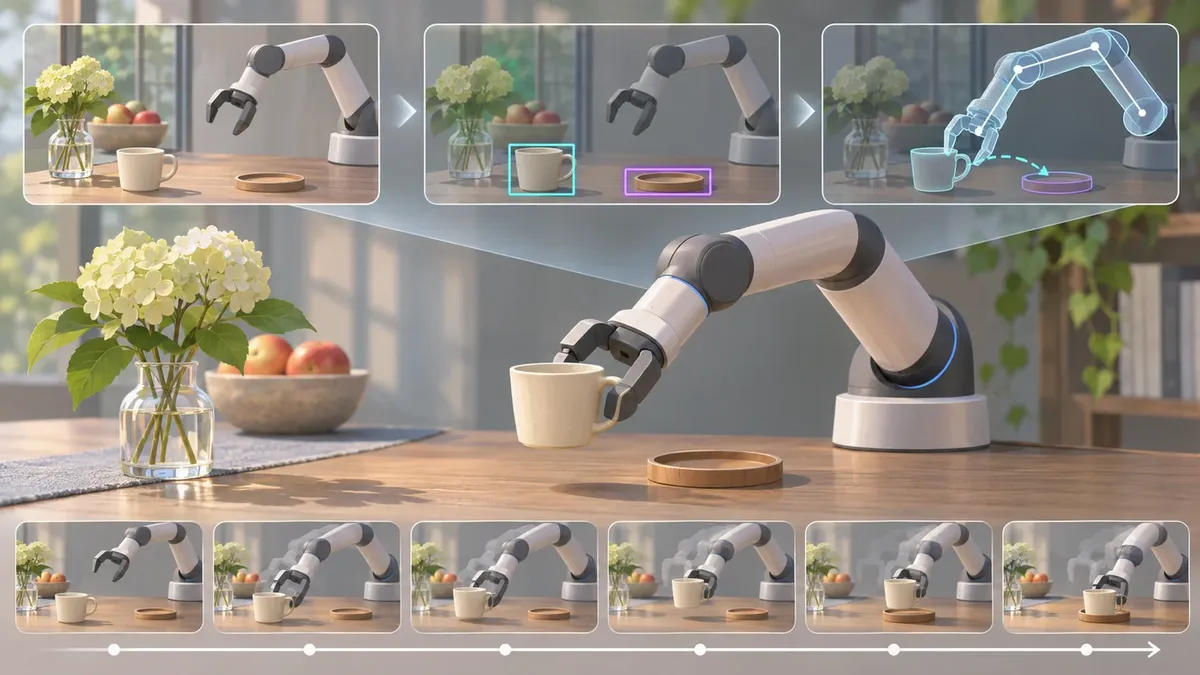
A robot moving a cup does not need to remember every detail of the room. It needs to know what should move, where it should go, and how its arm must act. This preprint proposes an approach that makes a robot policy’s internal predictions focus on those interactions—and reports stronger results in tests that change the scene.
Vision-language-action models, or VLAs, use visual input and written instructions to control robots. Some use latent reasoning: compact internal representations that let a model anticipate what may happen before producing actions, without spelling out a long explanation in words.
But what should those representations predict? The authors argue that a common approach borrows too much from image understanding. It trains each latent representation to match a snapshot of a future scene. That can encourage a model to encode the room’s appearance, even though a robot needs to predict how an interaction will unfold as it works toward a goal.
The researchers propose Motion-Oriented Latent Reasoning. First, semantic latents represent stages such as the subtask, intended movement and plan. Then, for each anticipated future step, motion-oriented latents describe the scene at three levels: its overall layout, an interaction region, and the robot’s state. The interaction region is a bounding box enclosing the manipulated object and its destination—not a path between them. Across future steps, these representations are intended to form a coarse-to-fine account of movement toward the goal.
The researchers train the representations using robot demonstrations. Future frames and robot states provide training targets. Object and destination regions are identified offline using detection and segmentation tools, with manual correction when needed. At deployment, the model generates its latent representations without those annotations or future frames. Its action-generation procedure follows the same general latent-reasoning setup as the comparison model, LaST₀.
The team evaluated the approach in simulation on SimplerEnv-WidowX and LIBERO, including tests with altered scenes and other changes. They also tested it on an AgileX Piper dual-arm robot, using its right arm for four tabletop tasks. In the paper’s headline comparison with LaST₀, mean success on SimplerEnv-WidowX rose from 37.5% to 55.2% in familiar conditions and from 22.4% to 30.2% under out-of-distribution shifts. On the real robot, mean success rose from 60.8% to 90.8% in training scenes and from 6.7% to 37.5% under environmental changes.
Those averages do not mean the method solved every task or handled every change equally well. Results varied across benchmarks and perturbations. On the out-of-distribution LIBERO-PRO test, for example, the method’s mean was 53.3%: above LaST₀’s 49.1%, but below the reported 56.6% for OpenVLA-OFT. The comparisons support an improvement over the latent-model baseline in the reported settings, not universal superiority over other robot systems.
The authors also tested whether the model’s internal visual features still identified a task when its background changed. On five LIBERO-Long tasks with visibly changed scenes, the reported recognition rate was 66% for their method and 2% for LaST₀. This is a diagnostic measure of task recognition, not a robot success rate. It is consistent with the authors’ explanation that focusing on interaction regions may reduce reliance on background appearance, but does not by itself establish why the success rates changed.
There are important qualifications. The approach depends on offline reasoning and spatial annotations, so errors can affect its training targets. Its interaction region is represented by one two-dimensional box, which may not capture multiple simultaneous interactions or depth—potential concerns for bimanual or dexterous tasks. The real-robot tests used task-specific policies and a limited set of tabletop tasks; learning from large-scale human video is left for future work.
These results come from an arXiv preprint, not a peer-reviewed publication in the material provided here. The paper reports evaluations in simulation and on one robot platform, but they do not establish performance across all robots, homes, objects or real-world conditions. The central idea is narrower: for action, predicting how an interaction unfolds may be more useful than simply picturing what a future frame looks like.
- robot manipulation
- vision-language-action models
- latent reasoning
- robot learning
- generalization
- robotics
Reviewed cross-references
These connections were reviewed by a model, not independently fact-checked by a human. Similarity does not imply agreement; consult the original papers and the evidence below.
A robot plan that knows what remains—and when to consult a demonstration
Supporting evidence: Both papers report gains from structuring intermediate representations around future task progress rather than relying only on the current observation: the origin paper’s motion-oriented latents improve reported success under scene shifts, while JEPA-ICL’s plans predict ordered future states and support action generation, with gains reported on LIBERO and LIBERO-Plus. This is a bounded connection, not a direct comparison: the methods, benchmarks, and evaluation conditions differ.
Model review: · openai-codex/gpt-6-luna
Evidence and provenance
Selected excerpts, not complete papers. PDF extraction can omit figures or damage equations, tables and reading order; sources may be preprints.
2611.29339v1 — Original paper
Excerpt reference:
static/papers/2611.29339v1.md:141-192
Basis: Paper text
Source SHA-256:5c44562c166964dedf28d051462998a3743f251743ee7051d0edc1c5715c0adb2611.29339v1 — Original paper
Excerpt reference:
static/papers/2611.29339v1.md:13-79
Basis: Paper text
Source SHA-256:5c44562c166964dedf28d051462998a3743f251743ee7051d0edc1c5715c0adb2611.30516v1 — Original paper
Excerpt reference:
static/papers/2611.30516v1.md:13-81
Basis: Paper text
Source SHA-256:addb8cbc619029faa27aa9504299bdaeb9f10bc3987343bf3d4bd044d93d8adb2611.30516v1 — Original paper
Excerpt reference:
static/papers/2611.30516v1.md:82-172
Basis: Paper text
Source SHA-256:addb8cbc619029faa27aa9504299bdaeb9f10bc3987343bf3d4bd044d93d8adb
Related reading
Automatically matched by shared topic keywords. These links do not imply that the sources agree or establish a consensus.
Can a general AI model control a robot arm?
Source published
Shared keywords: robot learning, robot manipulation, vision language action models
A robot plan that knows what remains—and when to consult a demonstration
Source published
Shared keywords: robot learning, robot manipulation, vision language action models
Robots Need to Know Not Just What to Do, but When
Source published
Shared keywords: robot manipulation, vision language action models
A small change helps robot arms coordinate
Source published
Shared keywords: robot learning, vision language action models
MomentMem teaches robots to save visual memories
Source published
Shared keywords: robot learning, robot manipulation