TRANSMISSION // 2611.29311v1
Giving image tokens more building blocks when they need them
Source published
PrimiTok adapts how visual codebook elements are combined, aiming to preserve both image detail and meaning in a shared representation.
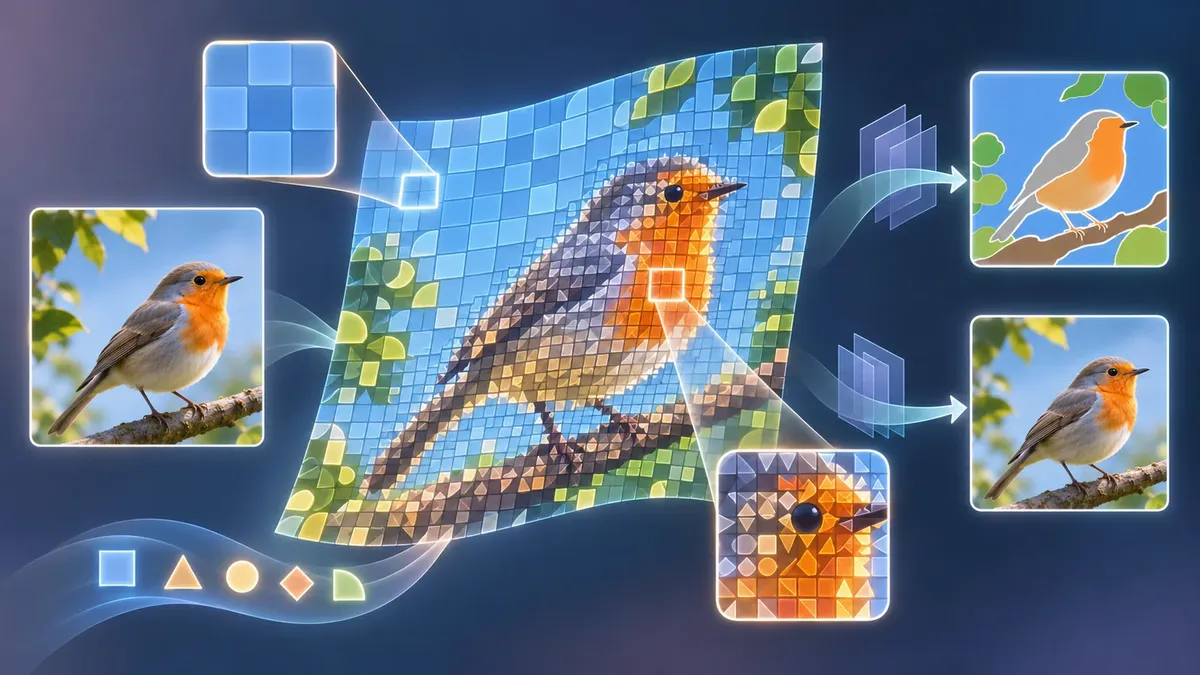
A visual tokenizer turns an image into a representation that an AI system can process. PrimiTok’s authors argue that one fixed amount of information per image patch is a poor fit: some patches need more building blocks than others. Their preprint tests a tokenizer that adjusts this allocation, reporting improvements on several image-reconstruction and recognition measures while finding weaker results for one image-generation comparison.
Why change visual tokenization?
AI systems that both interpret images and generate them need a useful internal representation. It should retain meaning—for example, what objects are present—and enough fine detail to reconstruct the image. The paper describes a trade-off in existing approaches: continuous representations can be aligned with text but may lose details useful for reconstruction; discrete representations use codebooks, or collections of learned visual patterns, but quantization can discard information.
PrimiTok explores a different approach to discrete tokenization. Instead of giving every visual token the same number of codebook entries, it treats them as reusable “primitives” that can be selected and combined in different quantities. The idea is that a simple patch might be represented with a few primitives, while a more difficult patch can draw on more.
How the method works
The system first encodes an image into a grid of visual tokens. Its quantizer divides each token’s features among eight sub-codebooks. A Dynamic Primitive Allocator (DPA) estimates how many primitives to use from each sub-codebook and assigns weights to combine them. The allocator is trained using embedding reconstruction error as a proxy for how difficult a token is to represent: greater error signals a need for a larger allocation.
A second component, Diverse Quantitative Primitives (DQP), encourages the sub-codebooks’ average vectors, or centroids, to differ from one another. The aim is to reduce redundancy in the available building blocks. Training combines image reconstruction with image–text contrastive learning, which encourages image and caption representations to align. The paper also uses a warm-up period before enabling the adaptive allocation and diversity mechanisms, since the authors say error-based allocation may be unreliable early in training.
The researchers evaluate the tokenizer on reconstruction, zero-shot image classification, image–text retrieval, multimodal understanding and image generation. Their comparisons include matched UniTok settings, where training data and initialization are more directly aligned, as well as other published systems. Those distinctions matter: comparisons with different training data, pretrained encoders or model configurations cannot isolate tokenizer design as cleanly.
What the experiments report
On ImageNet-1K reconstruction, PrimiTok improves several measures over matched UniTok reproductions. With CLIP-pretrained initialization and the resampled DC-1B-R training data, the paper reports an rFID of 0.31 and zero-shot Top-1 classification accuracy of 70.5%, compared with 0.35 and 69.9% for the matched UniTok reproduction. Lower rFID indicates closer image distributions under that metric; higher classification accuracy means more correct top-ranked predictions. The paper also reports a PSNR of 24.95 dB for PrimiTok versus 24.40 dB for that UniTok reproduction.
In a separate random-initialization comparison on DC-1B-R, PrimiTok’s rFID is 0.36 versus 0.41 for UniTok, while accuracy is 69.8% versus 68.6%. On MSCOCO reconstruction, the authors report rFID falling from 4.22 to 3.86 and PSNR increasing by 0.69 dB relative to the original DC-1B UniTok model. These results support the paper’s claim that the approach can improve reconstruction while retaining useful semantic information, but they are results on particular datasets and setups—not a guarantee across images or applications.
An ablation study compares adaptive allocation with fixed allocations. In that setting, DPA averages about 60 primitives per token chunk and scores better across the five reported metrics than the fixed-allocation alternatives, including a fixed allocation with a comparable average count. This suggests that where primitives are allocated may matter, not only how many are used overall. The paper’s heatmaps are token-level estimates shaped by spatial context, however, not direct measurements of image complexity.
The results are not uniformly favorable. For ImageNet image generation, the PrimiTok-based system has a reported gFID of 3.06, compared with 2.51 and 2.45 for two listed baselines; lower is better for this metric. The authors caution that these systems also differ in generator size, batch size, image-generation resolution and encoder initialization, so the gap cannot be attributed to tokenizer design alone. In the LLaVA-1.5 understanding evaluation, PrimiTok’s reported average is 65.4, but the paper’s comparison includes a baseline with a pretrained visual encoder, unlike PrimiTok’s randomly initialized tokenizer.
What remains uncertain
The findings are promising but bounded by the experiments described in this paper. Benchmarks and training settings do not establish how the method will perform in every unified multimodal system, on other data, or at other resolutions. The reported generation comparison in particular has important setup differences. The source is an arXiv preprint, so its claims should be treated as preliminary rather than as settled evidence from peer review. Overall, PrimiTok offers a specific, testable design for adapting quantization to image content; broader and more controlled evaluations will be needed to establish where its benefits hold.
- visual tokenization
- multimodal AI
- image reconstruction
- vector quantization
- image-text alignment
Related reading
Automatically matched by shared topic keywords. These links do not imply that the sources agree or establish a consensus.
A visual AI that treats pixels as code
Source published
Shared keywords: visual tokenization
When image and text directions diverge
Source published
Shared keywords: image text alignment, multimodal ai
A Reconstruction-Based Test for AI Image Descriptions
Source published
Shared keywords: multimodal ai
Recommendation Systems Turn Dense Embeddings Into Tokens
Source published
Shared keywords: vector quantization
FlowAlign uses learned paths to align different kinds of data
Source published
Shared keywords: image text alignment