TRANSMISSION // 2611.29275v1
When AI’s imagined drives miss the odds
Source published
A pre-registered benchmark tests whether driving video models generate futures in realistic proportions—not just realistic-looking clips. Its authors report that all 11 tested models are miscalibrated, with uncertainty too narrow.
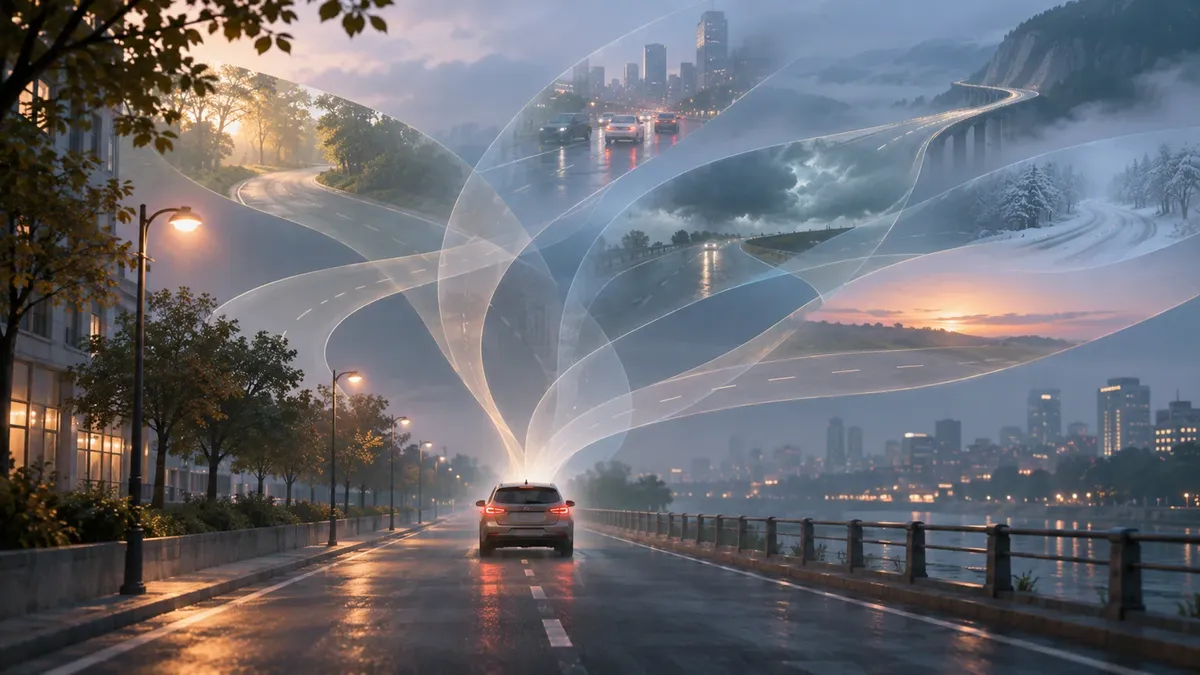
A driving video model can produce plausible scenes and still mislead a planner if it gives possible futures the wrong probabilities. DriveOddsBench tests that question using recorded driving histories and generated video futures.
Plausible scenes, wrong probabilities
A video world model can imagine what might happen next on the road. But if it is used to help plan or test a driving system, visual realism is not enough: its collection of possible futures should reflect how likely those outcomes are in the real world.
That is the question behind DriveOddsBench, a benchmark introduced in a preprint by Jiaxi Liu and colleagues. The authors point out a central difficulty: for any recorded driving history, the dataset contains just one observed future. That makes the true probabilities of alternative outcomes unknowable from that history alone.
Testing odds without knowing them
The benchmark uses a statistical idea: if a model’s generated futures follow the real distribution, the real outcome should occupy a uniformly distributed rank among them. Put simply, the observed future should not systematically land near one end of the model’s predictions. Pooled ranks can therefore reveal a mismatch without requiring known probability labels for every possible future.
The authors also aim to separate model errors from measurement errors. They use one validated instrument to read quantities—including the gap to the lead vehicle and the motion of the car carrying the camera—from generated futures and from the real future. The real video is first passed through the model’s autoencoder, so real and generated videos are assessed in a comparable way. According to the abstract, the confirmatory analyses were fixed before test clips were measured, to reduce selective reporting.
The study evaluates 11 general-purpose and driving-focused world models on 200 held-out histories from Argoverse 2, across five scenario families. In total, the researchers generated 35,200 futures.
Narrow uncertainty across the board
The authors report that none of the tested models was aligned with real-world odds, and that every model underestimated uncertainty. In 28–61% of cases, the observed outcome fell outside the range spanned by all 16 generated samples; the abstract gives 11.8% as the expected rate if the samples followed the real distribution.
Five models showed statistically significant skew, with errors pointing in opposite directions. The largest errors concerned the motion of the camera-carrying car. The results also distinguish prediction skill from calibration: nine models performed better than a climatology baseline, yet were still not aligned. Among those nine, the authors say neither model type nor scale predicted which came closest to alignment.
What this does—and doesn’t—show
The findings suggest that a model may produce useful predictions without representing the odds of different outcomes reliably. That matters when downstream systems treat generated samples as a distribution of possible futures rather than as illustrative clips. The abstract does not establish how these errors affect real-world driving decisions or safety.
This account is based on the paper’s abstract, not a full examination of its methods, results tables, or statistical details. The abstract does not name all models or provide confidence intervals, limiting how fully readers can assess the results. The test uses a particular dataset, five scenario families, and a fixed sample count; the findings should not automatically be generalized to every driving environment or world model.
DriveOddsBench is a preprint. The available evidence does not establish its review status, and the findings would benefit from independent scrutiny and replication. Its central message is narrower but important: when judging a world model, ask not only whether its imagined roads look real, but whether its possible futures appear in realistic proportions.
- world models
- autonomous driving
- video generation
- uncertainty calibration
- DriveOddsBench
- Argoverse 2
Reviewed cross-references
These connections were reviewed by a model, not independently fact-checked by a human. Similarity does not imply agreement; consult the original papers and the evidence below.
A Shared Map for a City’s Many Sensors
Supporting evidence: The survey flags that generative simulators may be used to evaluate planners without validated fidelity on rare events; DriveOddsBench reports that 11 tested driving video models misrepresented outcome odds on 200 Argoverse 2 histories. Together they support the bounded caution that generated simulations need validation of relevant predictive properties before being trusted for evaluation; the benchmark’s sample and measured quantities do not establish results for every simulator or rare-event setting.
Model review: · openai-codex/gpt-6-luna
Evidence and provenance
Selected excerpts, not complete papers. PDF extraction can omit figures or damage equations, tables and reading order; sources may be preprints.
2611.29275v1 — Original paper
Excerpt reference:
static/papers/2611.29275v1.md:1404-1456
Basis: Paper text
Source SHA-256:88f47bb7336390a61a6c7d0a2171ff6da842cb654bbd9bf9d407c9a6fa68ff642611.28129v1 — Original paper
Excerpt reference:
static/papers/2611.28129v1.md:1021-1091
Basis: Paper text
Source SHA-256:47f9675e5be79938ef163e61da886f0d80f62075a80ed85689414a274d996df4
Related reading
Automatically matched by shared topic keywords. These links do not imply that the sources agree or establish a consensus.
Can a Recorded Street Become a Reusable Driving Simulation?
Source published
Shared keywords: autonomous driving, world models
Can AI-generated worlds keep up with robots and self-driving cars?
Source published
Shared keywords: autonomous driving, video generation, world models
Do Driving World Models Follow Specified Trajectories?
Source published
Shared keywords: autonomous driving, world models
A safety shield for image-based robot parking
Source published
Shared keywords: world models
A Driving AI That Weighs What Might Happen Next
Source published
Shared keywords: autonomous driving