TRANSMISSION // 2611.29255v1
Testing NoeVera’s evidence loop for LLM serving
Source published
NoeVera links research sources, simulator estimates and scoped records to guide configuration searches for LLM serving. Its results are promising but limited to a particular system and evaluation.
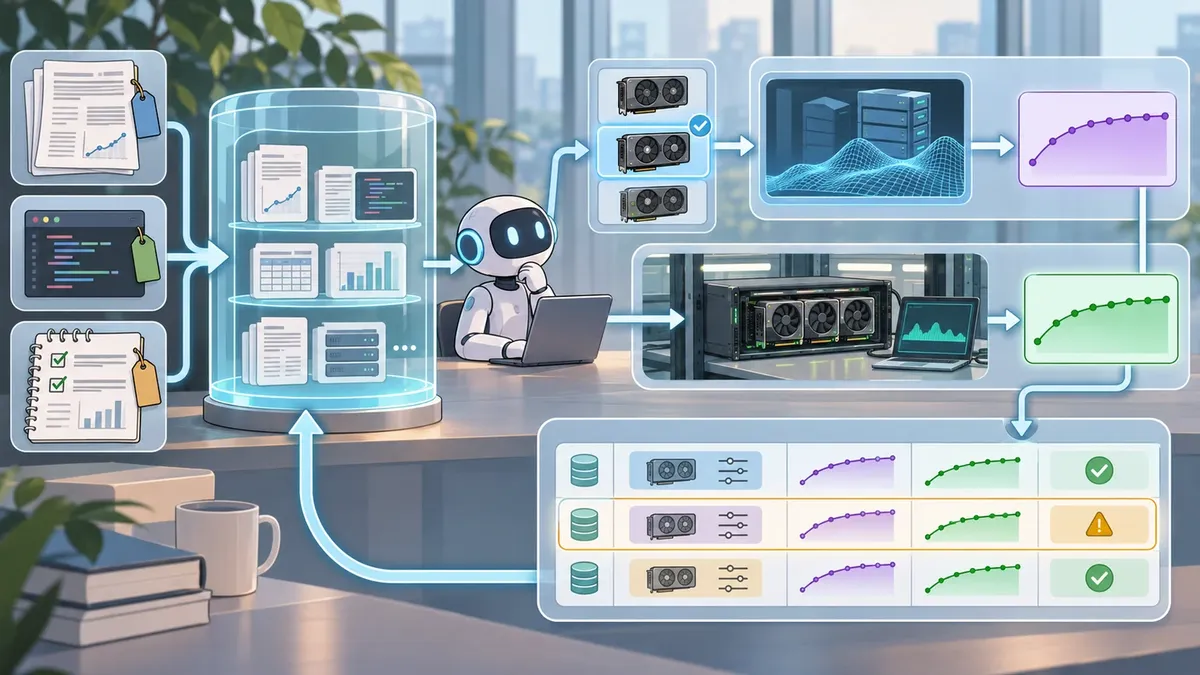
When engineers tune a large language model service, the challenge is not only predicting how a setting will perform. They must decide what is worth testing—and whether an earlier result applies to a new workload. NoeVera, described in an arXiv preprint, is designed to connect technical evidence with simulator experiments and preserve the conditions attached to each finding.
The question: what should be tested?
Large language models can help engineers search papers, code and documentation. But a relevant passage may describe different hardware or a different workload. A simulator can estimate a proposed configuration, yet that estimate does not explain why the configuration was chosen. And without persistent records, findings from one investigation may not help with the next.
The authors ask whether an agent can use organized technical knowledge to choose experiments, then record results with enough context to inform later decisions. They study this question in one specific area: serving large language models (LLMs), or running them so users receive responses. Engineers seek high throughput while meeting targets for response delay and memory use.
How NoeVera works
NoeVera organizes information into three connected parts: source evidence, synthesized claims and comparisons, and records of how the agent used its knowledge. The authors report that its knowledge base included 2,627 source files, such as papers, documentation, code and benchmark reports.
For each question, the system assembles a compact evidence pack using several search methods. Three agent roles—a scout, investigator and synthesizer—work with that material. When a question calls for a quantitative estimate and the available evidence does not directly fit the target setup, the system can select configurations and run a simulator. The main evaluation uses Vidur; a separate comparison replaces the on-demand simulator with GAUSS.
Each experimental record is meant to include its workload, hardware, configuration, tool and assumptions. When a later question draws on the record, the design calls for checking how well those conditions match: a partial match should be presented with a caveat, and a mismatch rejected as directly applicable evidence. This describes intended behavior, not a guarantee that the right record will always be retrieved or judged correctly. The authors acknowledge that traceable evidence can still be wrong and that persistence does not ensure successful retrieval.
What the evaluation reports
In four configuration-search scenarios on A100 GPUs, NoeVera with Vidur reached within 5% of the exhaustive-Vidur simulator optimum after a median of six simulator calls. Bayesian optimization took a median of nine calls, and a knowledge-free agent with the same tools took 15. These are simulator-search results, not proof of better performance across workloads. The comparison also combines NoeVera’s search approach with access to a precomputed Vidur grid that the baselines did not have. The authors say the four scenarios are too few for a confirmatory significance test.
The authors then tested selected configurations with vLLM on A100 hardware. At the search budget of ten calls, the reported mean throughput was 1.31 times the vLLM default across feasible-seed measurements; runs without a feasible configuration were excluded from that mean. The selected configurations met the latency target in all four tested scenarios. These hardware measurements are distinct from simulator estimates: the paper notes that Vidur could misstate the size of performance gaps, and bases hardware-performance claims on the vLLM runs.
For a reuse test, the researchers held NoeVera’s reasoning process fixed and varied how a finding was stored, comparing evidence records with Mem0 memory and plain text chunks. On cases designed to trap overgeneralization, evidence records did so in 8% of cases, versus 28% for Mem0 and 33% for chunks. The confirmatory comparison with Mem0 rests on eight parent investigations, so these rates should not be read as broad estimates of performance in other settings.
A separate 50-query evaluation, organized into ten clusters and run in five random orderings, found that write-back reduced simulator calls from 1.4 per question in the first ten questions to 0.5 in the last ten. The paper reports that savings became substantial only after related evidence had accumulated; this result does not establish the same reduction for other query streams.
On the held-out portion of a 72-task benchmark, NoeVera with a simulator scored 0.80 overall, compared with 0.62 for an equally equipped agent and 0.59 for a single-call retrieval system with simulator access. “Overall” is the mean of the Knowledge Navigation and Evidence Evolution tracks; it excludes the separate Decision-and-Experiment track. These are rubric-based benchmark scores, not measures of research productivity in real deployments.
For evidence revision specifically, the authors also tested NoeVera without Vidur against prompt-matched baselines given NoeVera’s synthesis instructions. Prompt matching closed much of the gap. NoeVera’s remaining advantage over the best prompt-matched baseline was 0.08 on the Evidence Evolution score, with a 95% confidence interval of 0.03 to 0.13; this was the reported confirmatory test and survived the study’s correction for multiple comparisons. This is distinct from the simulator-enabled overall scores above.
Limits and context
The study concerns LLM-serving research, not autonomous research in general. Its benchmark is a bounded task set, results depend partly on the underlying language model, and the system requires an offline knowledge-base build and costs more per query than single-call retrieval. The GAUSS comparison also retains a Vidur-built offline grid and uses a Vidur-defined optimum, so it is not independent of Vidur.
This is an arXiv preprint, not evidence of peer review. Its findings are the authors’ reported results, not independent validation or proof of field performance. The work offers a specific, testable proposal: in this setting, preserving the conditions behind experimental findings may help an agent reuse evidence more cautiously. Whether that approach transfers to other systems or domains remains an open question.
- NoeVera
- LLM serving
- AI research agents
- simulator experiments
- evidence provenance
- configuration search
Reviewed cross-references
These connections were reviewed by a model, not independently fact-checked by a human. Similarity does not imply agreement; consult the original papers and the evidence below.
AI Research Agents With Memory Start Faster—but Do Not Reliably Finish Better
Supporting evidence: Both studies report that carrying prior state can improve efficiency, but neither shows that efficiency gains necessarily improve final outcomes. NoeVera reports near-optimal serving configurations in a median of 6–7 simulator calls; Continual AutoResearch reports improved fixed-budget research efficiency across five agents, while final held-out gains were inconsistent. The tasks and measures differ, so this supports only the bounded distinction between efficiency and final performance, not a direct comparison.
Model review: · openai-codex/gpt-6-luna
Evidence and provenance
Selected excerpts, not complete papers. PDF extraction can omit figures or damage equations, tables and reading order; sources may be preprints.
2611.29255v1 — Original paper
Excerpt reference:
static/papers/2611.29255v1.md:13-80
Basis: Paper text
Source SHA-256:20dd646c5627722e125f7e95848743b58243d50df738cc4db9e966720e0aa5ad2611.05108v1 — Original paper
Excerpt reference:
static/papers/2611.05108v1.md:13-75
Basis: Paper text
Source SHA-256:c4c3b6e402917e0966941845bcf86d0844ca513f42e70a0292bb9b5b149835d4
AI can spot a simulator’s flaw and still choose the wrong design
Supporting evidence: Both studies caution that simulator-based reasoning does not by itself ensure a sound decision: NoeVera notes that simulator estimates inherit modeling assumptions and that provenance does not guarantee correctness; SIRIS reports that identifying a simulator limitation does not ensure correct design selection. Their evaluations differ—configuration search versus constructed workload pairs—so this is a bounded methodological connection, not a direct comparison.
Model review: · openai-codex/gpt-6-luna
Evidence and provenance
Selected excerpts, not complete papers. PDF extraction can omit figures or damage equations, tables and reading order; sources may be preprints.
2611.29255v1 — Original paper
Excerpt reference:
static/papers/2611.29255v1.md:1181-1253
Basis: Paper text
Source SHA-256:20dd646c5627722e125f7e95848743b58243d50df738cc4db9e966720e0aa5ad2611.10329v1 — Original paper
Excerpt reference:
static/papers/2611.10329v1.md:13-92
Basis: Paper text
Source SHA-256:b673d66d5b292e0d28f1c3ee03a015e7d034f5ebd6d3b6c7c2147626be8478e72611.10329v1 — Original paper
Excerpt reference:
static/papers/2611.10329v1.md:1245-1311
Basis: Paper text
Source SHA-256:b673d66d5b292e0d28f1c3ee03a015e7d034f5ebd6d3b6c7c2147626be8478e7
Related reading
Automatically matched by shared topic keywords. These links do not imply that the sources agree or establish a consensus.
Busy GPUs, wasted research time
Source published
Shared keywords: ai research agents
AI Research Agents With Memory Start Faster—but Do Not Reliably Finish Better
Source published
Shared keywords: ai research agents
EMBERS probes how AI research agents fail when questions and searches change
Source published
Shared keywords: ai research agents
How Data Agents Organize Analytical Work
Source published
Shared keywords: evidence provenance
A Safety Check Before AI Changes Live Infrastructure
Source published
Shared keywords: evidence provenance