TRANSMISSION // 2611.29224v1
When Galaxy Embeddings Bend, Linear Probes Can Miss
Source published
A study of galaxy embeddings finds that their geometry can shape local errors in linear predictions—and that neighbourhood-specific corrections offer modest gains.
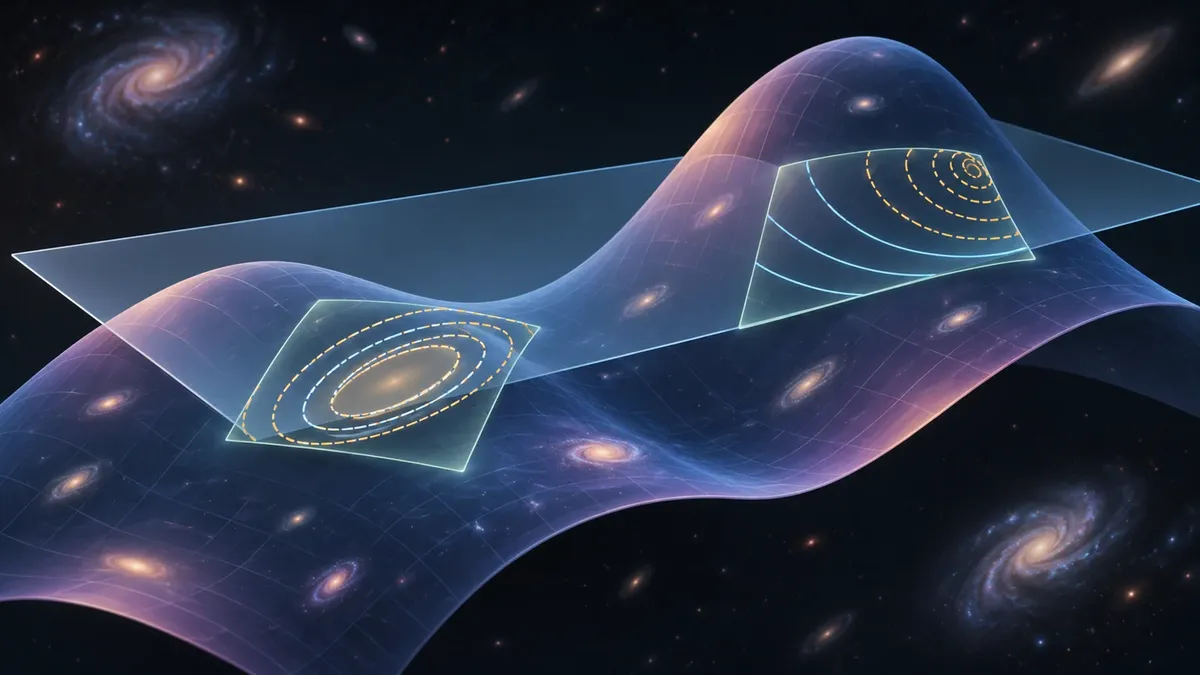
A linear model can make uneven predictions from one neighbourhood of galaxy data to another. A new study investigates whether the shape of the representations it reads helps explain why—and when changing a probe’s local bend improves its fit.
Why a linear probe can make local errors
Astronomers and machine-learning researchers often use linear probes: simple models that read a frozen representation, or embedding, and predict a quantity such as a galaxy’s redshift or stellar mass. A probe is affine—a linear function plus an offset—in the full embedding space. But if the data occupy a curved surface within that space, restricting the probe to that surface can produce a locally curved prediction. The probe’s effective bend is inherited from the geometry of the representation.
That bend may help if it resembles how the target quantity changes locally. If the two bends differ, it may contribute to prediction error. The authors call the probe’s induced bend “probe-facing curvature” and investigate its relationship to local errors in galaxy-property estimates.
How the researchers tested the idea
The study used embeddings for 86,471 galaxies from the AstroPT galaxy set. The four catalogue targets were r-band magnitude, photometric redshift, smooth fraction, and stellar mass. The researchers examined five pretrained image encoders, including a supervised Vision Transformer and four other encoders.
To estimate the local shape of the embedding space, they trained a decoder—a model that maps a lower-dimensional code back into an embedding. Derivatives of the decoder provided estimates of the space’s curvature around individual galaxies. The authors checked this method on a synthetic surface with known curvature, where the estimates closely matched the specified geometry.
They fitted ridge-regression probes and assessed local performance around 512 anchor galaxies, using 2,048 nearby galaxies for each neighbourhood. They estimated how the probe bends and how each catalogue label changes locally, then compared the two. They also tested interventions: removing the probe’s curvature or adjusting it locally, and evaluating predictions on held-out neighbours. Analyses accounted for factors such as neighbourhood size and label variation; the researchers additionally estimated the contribution of label noise to their curvature measurements.
What they found
The results do not support a blanket rule to keep or remove curvature. Across encoder and label combinations, retaining the probe’s inherited bend fit better than removing it at 79–99% of anchors; with tuned probe penalties, the range was 93–100%. In other words, the bend often helped. But where the probe’s bend and the label’s estimated bend were less aligned, removing it was more likely to improve fit than in the most aligned regions. The authors describe these alignment comparisons as exploratory, and some reported gains were small.
The team also tested a neighbourhood-specific bend correction: a local adjustment to the probe’s curvature, evaluated on held-out neighbours. For the ViT-B encoder, held-out local R² rose by 0.0059 to 0.0095 across the four targets. The abstract summarizes the galaxy result as an increase of 0.006 to 0.010. This is a local-fit measure, not evidence of a similar improvement across every encoder or in an astronomy workflow. In the ViT-B analysis, the authors report that the curvature component accounted for less than half of the gain; the remainder was not attributed to curvature.
To test whether the results simply reflected a generic advantage from least-squares fitting, the researchers held the fitted probe weight fixed and substituted different bends. The probe’s own local bend outperformed a bend taken from a distant neighbourhood at most anchors. Rotating the bend’s directions—while keeping its size—greatly reduced how often it helped. This supports the authors’ interpretation that the local geometry and the directions in which it bends matter.
What remains uncertain
The work studies one galaxy sample, four catalogue targets, and five encoders. The authors estimate that the noise floor makes up about half of the squared norm of the estimated label Hessian—a measure of local label curvature. That is a specific estimate about this curvature measurement, not a claim that half of all measured curvature or prediction error is noise. They also caution that local residual curvature cannot reliably rank individual galaxies.
Some analyses are exploratory, and certain tests treat overlapping neighbourhoods as independent, which may make their uncertainty estimates less secure. A separate experiment applied the correction to molecular data, but it used one encoder and one decoder and has its own limitations; it does not establish generality across scientific datasets.
The practical message is cautious: a probe’s overall score can hide local weaknesses, and the geometry of its representation may help explain some of them. Local curvature correction improved held-out fit in the reported experiments, but the study does not show that it will help every target or application. This article is based on the supplied arXiv v1 paper text, which identifies the work as a contribution to the 9th Workshop on Machine Learning and the Physical Sciences. The supplied source does not establish its peer-review status.
- galaxy embeddings
- linear probes
- machine learning
- representation geometry
- astronomy
- local prediction error
Related reading
Automatically matched by shared topic keywords. These links do not imply that the sources agree or establish a consensus.
Language-model axes matter—but only partly
Source published
Shared keywords: representation geometry
How an Audio Codec Could Help AI Tell Where Sounds Come From
Source published
Shared keywords: machine learning
When Do Looped Transformers Retrieve Stored Facts?
Source published
Shared keywords: machine learning
Language models show broad emotion patterns while retaining finer distinctions
Source published
Shared keywords: linear probes
Simple probes detect factuality signals inside quantized language models
Source published
Shared keywords: linear probes