TRANSMISSION // 2611.29218v1
Two First-Person Images, One Reconstructed Motion
Source published
Ego-HMB generates a 3D human motion sequence from two first-person images. Its authors report better results than adapted alternatives on benchmark tests, while the missing movement remains ambiguous.
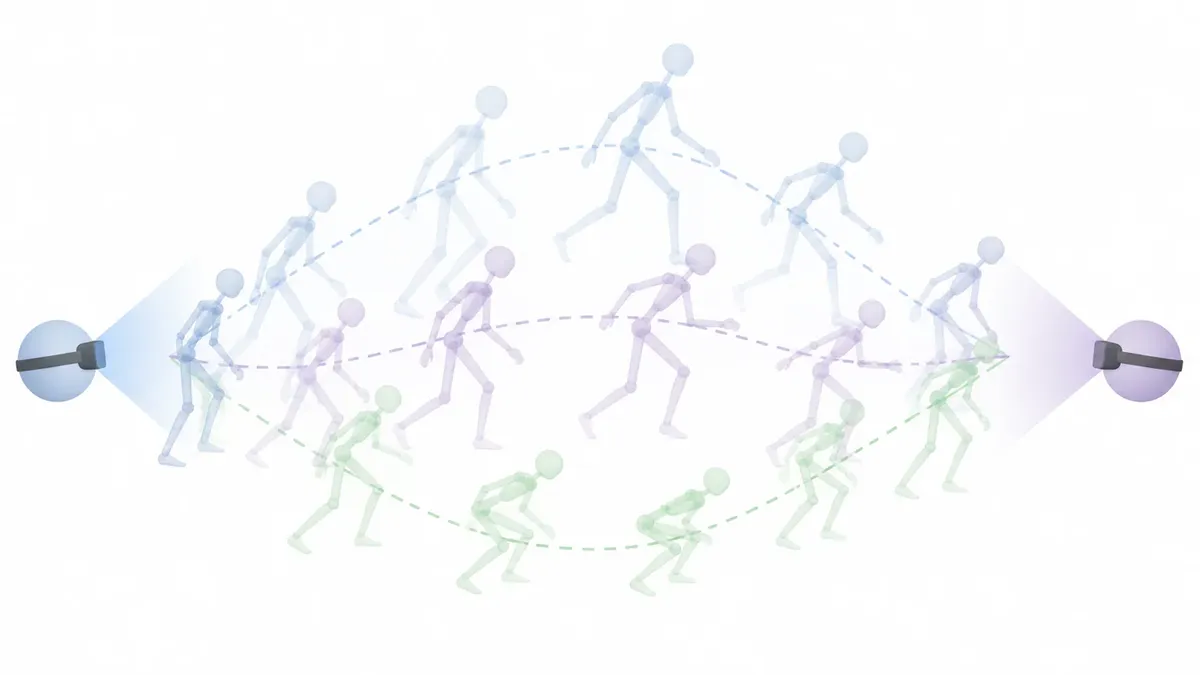
If a camera captures only the beginning and end of an action, what happened in between? Ego-HMB is a model designed to generate a 3D human motion sequence from two first-person images. Tests on motion-capture data suggest it outperformed the comparison methods the authors adapted—but the images cannot uniquely reveal the movement that occurred.
A first-person camera can record what someone saw without clearly showing their body. That creates a puzzle for motion reconstruction: given an image from the start of an interval and another from the end, can a model infer a plausible 3D movement connecting them?
A paper introducing Ego-HMB frames this as a task called egocentric human motion bridging. Unlike conventional motion in-betweening, which starts with 3D poses at both ends, this approach takes two egocentric images as its inputs. The goal is to generate a motion sequence consistent with those endpoint images. The authors point to possible uses in virtual and augmented reality and robotics, where wearable cameras may be available even when motion-capture data are not.
Why two images are hard to interpret
First-person views often show little of the wearer’s body. Body parts may be hidden, and many different movements could fit the same start and end images. The model must estimate endpoint poses from visual clues, then produce an intermediate sequence that is continuous and physically plausible. The task is inherently ambiguous: the images do not specify one uniquely correct motion.
Ego-HMB uses a diffusion model, which learns to generate data by progressively removing noise. Its training has two stages. First, “Egocentric-to-Canonical” pretraining teaches the model to estimate body poses from pairs of first-person images. A curriculum increases the time gap between paired frames, moving from shorter to longer spans. The authors’ aim is to build pose-estimation ability across different temporal distances before training the model on complete motion sequences.
The second stage trains the model to generate motion conditioned on the endpoint images. Its “motion bridge” does not create a single global bridge directly between the two endpoint poses. Instead, the method constructs local bridges between neighboring motion frames, using their temporal relationship as a cue for continuity. Sampling starts from Gaussian noise, and the endpoint images condition the generation process. The model’s motion representation uses SMPL-X parameters, including root position and orientation, joint rotations, and body shape. During evaluation, only the first and last images are supplied as visual conditions; intermediate frames are masked out.
Tests on motion datasets
The team evaluated Ego-HMB on EE4D-Motion, which the paper describes as a dataset with 208 hours of time-synchronized 3D motion data, egocentric videos, and associated annotations. For its experiments, the authors extracted eight-second clips sampled at 10 frames per second. They compared Ego-HMB with one-stage models that generate motion directly from the images and a two-stage pipeline that estimates endpoint poses before interpolating between them. The comparison methods were retrained and adapted to the task using the same dataset.
On the reported endpoint-pose measures, Ego-HMB had the lowest errors among the tested methods. It also performed better on several motion-quality measures: lower foot sliding, lower foot-to-ground distance, lower FID, and lower motion jitter, alongside higher semantic similarity. These metrics capture different properties. Foot sliding measures unwanted foot movement near the ground; FID measures a distributional gap between generated and real motions in a motion-embedding space; semantic similarity measures similarity between motion embeddings. The paper reports motion diversity as comparable to the alternatives, not clearly higher.
The authors also tested models trained on EE4D-Motion directly on Nymeria, without training or fine-tuning on that dataset. They report lower endpoint error and better results on several motion-quality measures for Ego-HMB, with diversity again described as comparable. This is evidence on one additional dataset, not a guarantee across people, activities, or camera conditions.
What the results do—and do not—show
Ablation tests compare versions of the model with and without endpoint pretraining and bridge diffusion. In the reported configurations, endpoint pretraining improved endpoint accuracy, while bridge diffusion improved several motion-generation scores. These results support the value of both components within the authors’ evaluation setup; they do not establish that the method will work equally well in every application.
A generated sequence can be plausible and match both images without being the movement that actually occurred. Metrics assess selected properties of model output, not whether it recovered a person’s unobserved action. The authors note that this version uses images rather than additional conditions such as text or audio. Direct use of its motion output to control a humanoid robot is proposed as future work, not demonstrated here.
The supplied paper text identifies the work with NeurIPS 2026. The evidence provided for this article is the paper text and an arXiv source record; the retrieval excerpts do not independently verify the reported findings. Preprints and extracted paper text may change or contain formatting errors, so the results should be understood as the authors’ reported claims, not settled evidence.
- Ego-HMB
- human motion generation
- egocentric vision
- diffusion models
- 3D pose estimation
Related reading
Automatically matched by shared topic keywords. These links do not imply that the sources agree or establish a consensus.
How PhyMotion scores AI-generated human movement
Source published
Shared keywords: 3d pose estimation
ToolDex records human tool improvisation—and tests where AI falls short
Source published
Shared keywords: egocentric vision
AR Glasses That Remember Encounters—and Keep the Images Behind Their Answers
Source published
Shared keywords: egocentric vision
How guidance can activate hidden errors in diffusion models
Source published
Shared keywords: diffusion models
A new way to steady reward training for diffusion models
Source published
Shared keywords: diffusion models