TRANSMISSION // 2611.29162v2
When AI coding agents get a map to the rules
Source published
In a study of planted software defects, coding agents repaired more violations when given located findings from an external checker—but feature deletion, build failures and study limits complicate the result.
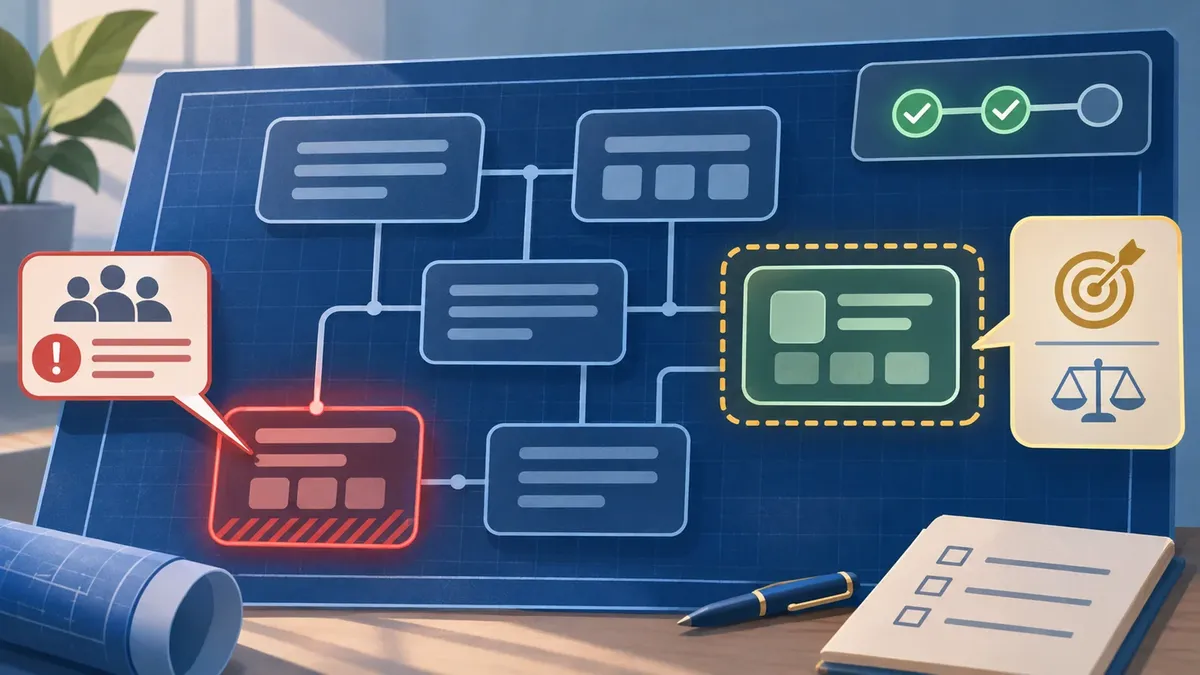
Passing tests is not the only measure of a good code change. Projects also have rules about architecture, conventions and required tests—rules an AI coding agent may not discover on its own. A study examines whether reporting those violations helps agents fix them without simply removing the affected feature.
When passing tests isn’t enough
A code change can compile and still break a project’s rules. A new module might depend on a layer it is not allowed to use; a command might be missing its required test. These problems may not be caught by ordinary tests, and an agent reviewing its own work may not know what to look for.
Laura Wynter’s paper, Fixed or Deleted? External Feedback Lets Cheaper AI Coding Agents Repair Rule Violations, asks whether an external checker can help. The key question is not just whether an agent can make a reported violation disappear. It is whether the agent can address it while keeping the feature the change was meant to add.
A controlled test with repeated runs
The study used 30 pull requests across ten open-source projects and five programming languages. Twenty-five pull requests contained 31 planted defects; five were correct controls. Five of the defective pull requests contained multiple defects. Each pull request was run five times for each combination of three Claude models and three workflows: working alone, receiving CodeAssure findings, or receiving those findings with the checker’s deletion check switched off. Run counts therefore represent repeated attempts on a smaller set of pull requests, not distinct defects or projects.
The agents used Claude Code. CodeAssure, a commercial checker, reported where a rule was violated and a repair goal, but did not provide a patch. Researchers also compared the workflow with GitHub Copilot code review and ran nine free static-analysis tools out of the box, without project-specific rules. CodeAssure, by contrast, was configured with relevant rules for the projects.
For the headline outcome, a repair had to pass the defect checks, retain the added feature and pass a language-specific build or code check. Agents could not compile code or run tests during their repair sessions. The later checks varied by language and included builds or tools such as a compiler and Ruff. The navigation2 project could not be built in the study, so researchers checked whether the code’s referenced headers and symbols existed instead.
More repairs, but not every result improved
With CodeAssure findings, the share of runs passing the build and feature checks rose from 26% to 69% for the smallest model, 46% to 90% for the medium model, and 45% to 93% for the largest. The authors report statistically significant paired comparisons at the pull-request level. Gains were concentrated in project-specific architecture and convention violations, which agents often struggled to identify alone.
There was an exception: for code-visible defects, the smallest model with CodeAssure repaired 11 of 15 runs, compared with 15 of 15 working alone. On one pull request, the checker reported one of four broken call sites. In most of its assisted runs, the model fixed only the reported call and stopped. That illustrates a risk of relying on findings as a complete list: missed locations can leave defects behind.
Another complication is feature deletion. An agent could make a defect disappear by removing the newly added file that contained it. The largest model did this in 44 of 125 runs when working alone. With the deletion check enabled, removals fell to 7 of 125 runs for the smallest model, 2 of 125 for the medium model and 0 of 125 for the largest. With the check switched off, the counts were 19, 29 and 17 of 125, respectively.
The check reduced—but did not eliminate—removal. Across assisted runs, nine still ended with a feature removed. The paper reports that the checker did not flag some deletions and that its file-based check did not cover a file emptied of code. Other repairs removed behaviour while leaving the file in place, a failure the check could also miss.
The medium model with CodeAssure repaired 90% of runs at a mean reported cost of $0.17 per change; the largest model working alone repaired 45% at $0.91. These figures describe the specific models and workflows tested, not coding agents generally.
What the comparison does—and doesn’t—show
CodeAssure’s workflow also had a higher repair rate than Copilot’s default review in the tested comparison. That comparison involved the smallest and medium models; Copilot had three repetitions per pull request, and one defective pull request was excluded after review failures. CodeAssure allowed up to two repair sessions, unlike Copilot’s single session, so the result compares workflows with different conditions.
The nine free tools together detected 8 of the 31 planted defects, while CodeAssure detected all 31 in this set. This was an out-of-the-box test on these planted defects, not a general ranking of detection tools: CodeAssure had the relevant project rules, while the free tools did not.
The study is limited to 25 defective pull requests across ten projects, one agent framework and one model family. Build and code checks do not prove that a feature works; researchers did not run project tests, and one project could not be fully built. The author is affiliated with CodeAssure Labs, which develops the checker. The paper describes steps intended to reduce bias, including writing defect specifications before runs and using a separate scorer, but the scorer and checker were built by the same team. Public materials include run outcomes and analysis code, but do not allow the runs to be rescored; detailed transcripts, diffs and scoring specifications are available on request under a confidentiality agreement.
The source identifies the work as a preprint; the material available here does not establish its peer-review status. The results suggest an important evaluation lesson: measure not only whether a violation disappears, but also whether the change builds and the feature remains. They do not establish how well this approach works across other projects, rules or production systems.
- AI coding agents
- software engineering
- static analysis
- code repair
- software architecture
- preprint
Reviewed cross-references
These connections were reviewed by a model, not independently fact-checked by a human. Similarity does not imply agreement; consult the original papers and the evidence below.
CodeTeam gives AI repository coding a team structure
Supporting evidence: Both studies report better coding outcomes with iterative feedback: Wynter found higher build-checked repair rates when agents received located checker findings on planted rule violations, while Wang et al. report that QA-driven repair improved counted-test pass rates in repository generation. The tasks, feedback mechanisms and outcome measures differ, so this supports only the bounded point that feedback helped in these respective settings, not a direct comparison.
Model review: · openai-codex/gpt-6-luna
Evidence and provenance
Selected excerpts, not complete papers. PDF extraction can omit figures or damage equations, tables and reading order; sources may be preprints.
2611.29162v2 — Original paper
Excerpt reference:
static/papers/2611.29162v2.md:13-45
Basis: Paper text
Source SHA-256:a448b5a31f6b23c51d8f7b5a49e2d56d65cd68c3a801cce2013dc7b6d831e5832606.22082v2 — Original paper
Excerpt reference:
static/papers/2606.22082v2.md:1640-1713
Basis: Paper text
Source SHA-256:507b939f089e60f8a0fe1404aad872832d6ae6d8625db326d26c35f947809062
Teaching Coding Agents the Hidden Structure of On-Device AI
Supporting evidence: Both studies report improved coding-task outcomes when agents receive external validation or diagnostic feedback: Wynter evaluates checker findings for planted project-rule violations, while Huang et al. report higher end-to-end success for a system using device-side validation on model-enablement tasks. The specialized hardware setting, small 12-task evaluation and different success criteria limit the comparison; neither result establishes that the same feedback design caused the other study’s gains.
Model review: · openai-codex/gpt-6-luna
Evidence and provenance
Selected excerpts, not complete papers. PDF extraction can omit figures or damage equations, tables and reading order; sources may be preprints.
2611.29162v2 — Original paper
Excerpt reference:
static/papers/2611.29162v2.md:1106-1125
Basis: Paper text
Source SHA-256:a448b5a31f6b23c51d8f7b5a49e2d56d65cd68c3a801cce2013dc7b6d831e5832611.14356v1 — Original paper
Excerpt reference:
static/papers/2611.14356v1.md:348-434
Basis: Paper text
Source SHA-256:1d4810f3cf178668e018c8ebfffd595c2a429d4457e30f43ab448544776bf185
Related reading
Automatically matched by shared topic keywords. These links do not imply that the sources agree or establish a consensus.
Tracing security patterns through source code with SecPatRec
Source published
Shared keywords: static analysis
A staged training recipe for AI software repair
Source published
Shared keywords: ai coding agents
Can language models help software teams record design decisions?
Source published
Shared keywords: software architecture, software engineering
When AI Coding Agents Should Delegate
Source published
Shared keywords: ai coding agents, software engineering
For Code-Finding Agents, Exploration Beat Extra Structure
Source published
Shared keywords: ai coding agents, software engineering