TRANSMISSION // 2611.29154v1
How MVAgent coordinates AI to understand multiple videos
Source published
MVAgent assigns a separate AI agent to each video and uses a global agent to combine evidence. Tests show higher benchmark scores than single-pass models, but important errors remain.
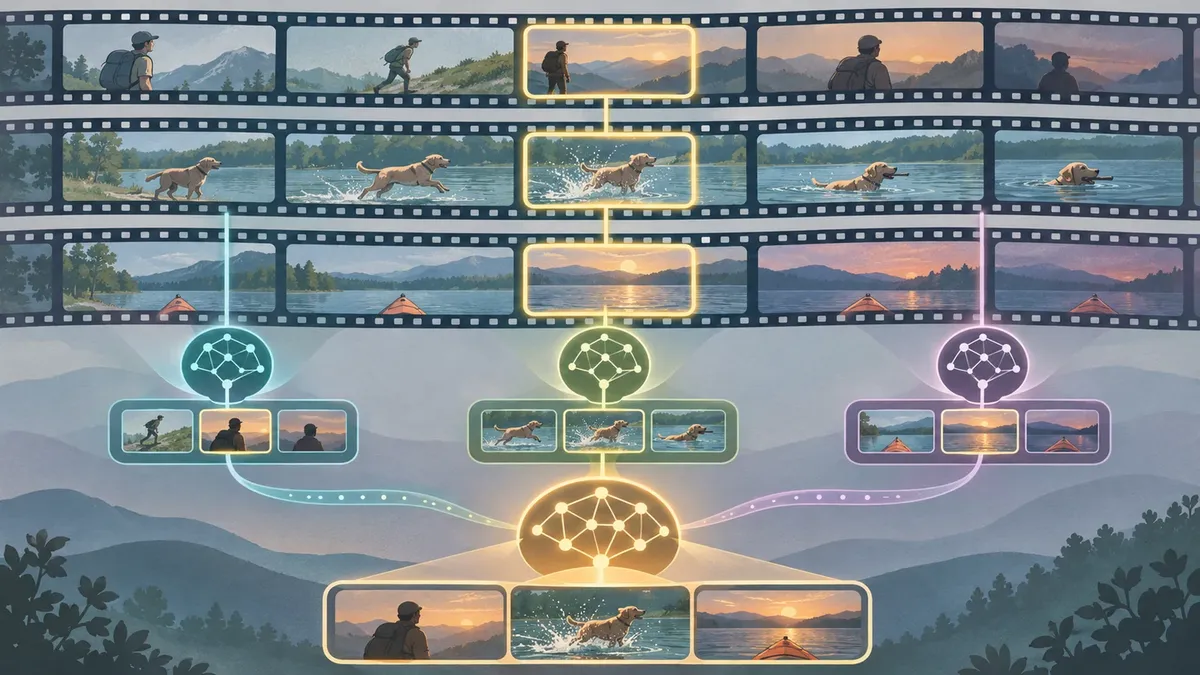
Comparing several videos can require finding the right moments in each one, then checking how those moments relate. MVAgent divides that work between per-video agents and a coordinator. The authors report improved benchmark scores and faster execution than comparable agents in their tests, while also documenting failures in observation and answer synthesis.
A question about several videos may hinge on a small detail in each: which clip shows a certain action, whether two clips depict the same object, or what order events occur in. An AI system must decide not only what to look for in each video, but also how to compare what it finds. If all observations are fed into one controller, its working context can grow as the investigation proceeds.
A preprint by Kewei Wei and colleagues proposes a different arrangement, called MVAgent. It gives each video its own LocalAgent and assigns a GlobalAgent to coordinate the investigation. The idea is to let the LocalAgents focus on what is visible in their respective videos, while the GlobalAgent handles the question that spans them.
A coordinator and a set of video specialists
The GlobalAgent sends instructions to selected LocalAgents. Each LocalAgent decides which time intervals to inspect, what visual detail to check, and how densely to sample the video. It keeps a private history of its observations, so it can use earlier checks when deciding what to inspect next. It returns a written report rather than sending all its detailed observations to the coordinator.
The GlobalAgent can ask for further checks and, when a comparison depends on visual details that reports may have missed, request a joint observation of clips from multiple videos. It then combines reports and observations to answer, or continues gathering evidence. The roles use frozen models: the framework is described as training-free, meaning the agents do not receive additional training for this task.
This division is meant to keep detailed, video-specific observations out of the coordinator’s growing context while preserving a global view of the question. It also makes evidence-gathering iterative: a comparison can prompt a more targeted look at one or more clips.
Tests on three benchmarks
The researchers evaluated MVAgent on CVBench, MVU-Eval and CrossVid, benchmarks for multi-video understanding. They tested three Qwen3.5 models of different sizes and GPT-6-sol, and compared the results with single-pass inference using the same model and with existing agent systems. Single-pass inference processes the input in one model call rather than repeatedly gathering evidence.
Across the 12 benchmark-and-model settings, MVAgent scored higher than same-model single-pass inference in every setting. The authors report average gains of 5.1 percentage points for the Qwen3.5 models and 4.3 points for GPT-6-sol. For Qwen3.5, MVAgent’s aggregate scores were also, on average, 5.0 points above those of the strongest prior agent using the same model.
On the same hardware, the authors report that MVAgent ran 1.8 to 2.7 times faster than comparable agent systems. They attribute the speed advantage mainly to generating fewer output tokens, not simply to running LocalAgents in parallel. In their Qwen3.5 runs, MVAgent used an average of 109.9 frames per question, compared with a maximum allowance of 512 frames per question for single-pass evaluation. These results suggest that the system can select evidence efficiently in these tests; they do not establish that it will do so for every kind of video or question.
Better scores do not mean reliable answers
The paper’s error analysis shows why the results need qualification. A LocalAgent can miss or inaccurately describe a decisive detail. Even when a report contains relevant evidence, the GlobalAgent may omit it from its final answer or draw an inconsistent conclusion. MVAgent’s open-ended answers covered 10.3 percentage points fewer rubric items than same-model single-pass answers, and this weakness persisted with GPT-6-sol. AgentCVR remained stronger in some comparison and open-ended settings.
The benefit of joint observation depended on the task. Removing it reduced performance on questions requiring visual matching across views, but improved results on one benchmark. The authors suggest that unnecessary joint observations can consume decision rounds or introduce irrelevant detail. Gathering more evidence is not automatically helpful; choosing when to do so matters too.
There are limits to what the evaluation establishes. The researchers used a stratified random sample of 2,500 CrossVid questions rather than the full benchmark, so those results describe that fixed subset. Open-ended answers were evaluated by an automated model judge using the benchmark’s scoring procedure. Reported speed comparisons were measured on the specified hardware; remote GPT-6-sol runtime was not measured because network and serving delays complicate timing.
The article is an arXiv preprint. Its findings are benchmark results, not evidence that the system is dependable in real-world settings. The authors identify memory management, better ways to transfer evidence between agents, and more deliberate exploration as open problems. MVAgent offers a design for organizing multi-video analysis, but its tests show that finding evidence and reasoning correctly from it remain separate challenges.
Source: Wei et al., “MVAgent: Per-Video Agents under Global Coordination for Multi-Video Understanding,” arXiv:2611.29154v1. Read the preprint.
- multi-video understanding
- AI agents
- video reasoning
- multimodal AI
- benchmark evaluation
Reviewed cross-references
These connections were reviewed by a model, not independently fact-checked by a human. Similarity does not imply agreement; consult the original papers and the evidence below.
V-STORM tests whether video AI can connect the evidence it finds
Supporting evidence: Both papers report a gap between obtaining relevant evidence and combining it correctly: MVAgent’s analysis identifies errors in cross-video synthesis even when evidence is available, while V-STORM reports that models can localize spatio-temporal evidence yet struggle to compose it into multi-step reasoning. This supports a limited comparison about evidence composition, not a direct performance comparison: MVAgent studies multi-video agent trajectories, whereas V-STORM evaluates fine-grained video reasoning and structured supervision.
Model review: · openai-codex/gpt-6-luna
Evidence and provenance
Selected excerpts, not complete papers. PDF extraction can omit figures or damage equations, tables and reading order; sources may be preprints.
2611.29154v1 — Original paper
Excerpt reference:
static/papers/2611.29154v1.md:861-929
Basis: Paper text
Source SHA-256:39864202f30be7bc6b8080becae09df02ef8dd49f58b93b4d0c5a75a8c4610662611.09511v1 — Original paper
Excerpt reference:
static/papers/2611.09511v1.md:658-711
Basis: Paper text
Source SHA-256:9059e75b6a44b78ca504416f09c9afb17329cb7f7716429d3e827e2490b3d2c4
Related reading
Automatically matched by shared topic keywords. These links do not imply that the sources agree or establish a consensus.
V-STORM tests whether video AI can connect the evidence it finds
Source published
Shared keywords: multimodal ai
When an AI agent must remember before it knows what matters
Source published
Shared keywords: ai agents, benchmark evaluation, multimodal ai
When AI Uses a Tool, Did the Tool Actually Help?
Source published
Shared keywords: ai agents, benchmark evaluation, multimodal ai
AVIS Lets Vision-Language Models Spend Effort Where It May Help
Source published
Shared keywords: multimodal ai
AdaAlloc helps video AI decide where to look closely
Source published
Shared keywords: multimodal ai