TRANSMISSION // 2611.29096v1
Teaching robot policies to anticipate their next move
Source published
JEPA-Tuner trains robot policies to predict how actions change visual and physical context, then reuses that predictor to prepare action chunks during inference delays.
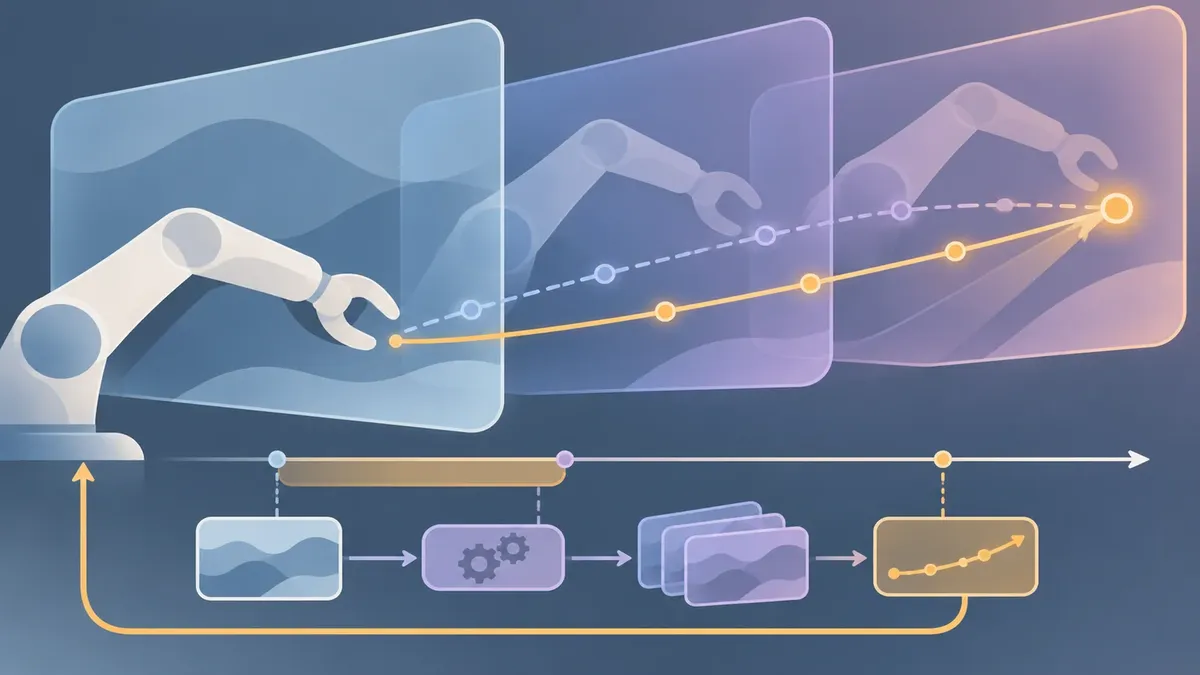
A robot’s view can become outdated while its next move is being computed. JEPA-Tuner aims to help vision-language-action models anticipate that change, reporting gains in simulated tasks and tests on two robot platforms.
A robot policy often plans in chunks: it receives an image, a task instruction and information about its own physical state, then proposes several actions. But while the next chunk is being computed, the robot may still be moving. By the time the actions arrive, the scene and the robot’s position may have changed. How can a policy account for that delay without making its movements jerky or less responsive?
JEPA-Tuner, a method introduced in an arXiv preprint, tackles the problem by teaching a vision-language-action (VLA) model to predict how its guidance should change after actions are taken. The authors also use that learned prediction to prepare the next action chunk in advance.
Predicting guidance, not just actions
A VLA model combines visual input, a language instruction and information about the robot’s state to generate actions. In the authors’ account, conventional action-supervised fine-tuning teaches a model to map its current inputs to demonstrated actions, but does not explicitly train the internal guidance used by the action-generating component to reflect how those inputs will evolve after movement.
JEPA-Tuner adds a predictor and a trainable adapter that brings visual, language and state information together. During training, the predictor receives the current guidance, the robot’s state and the actions taken over an interval. It tries to predict visual guidance and robot state at a later point. The future observation and measured state provide targets. Meanwhile, the action-generating component learns from both current and predicted guidance, so that prediction is trained to remain useful for control.
The pretrained vision-language backbone stays frozen in the described setup; the adapter, predictor and action expert are trained. The approach is inspired by joint-embedding predictive architectures, which learn by predicting representations rather than necessarily reconstructing every detail of an image.
Using the predictor during a delay
At deployment, the robot can keep executing actions already committed while the model works on the next chunk. JEPA-Tuner feeds those committed actions into its trained predictor to estimate the guidance needed at the next handoff. The action expert then generates a new chunk from that anticipated guidance, starting at its first action. In the proposed scheme, this avoids skipping an elapsed part of the chunk or applying inference-time overlap correction.
The researchers tested synchronous control—where the policy acts on current observations—and asynchronous control, where inference takes place while the robot moves. They evaluated fine-tuning on LIBERO and Meta-World MT50, and asynchronous performance on the LIBERO simulator and physical SO-101 and ALOHA robots. Their comparisons included standard fine-tuning and several asynchronous methods. The paper reports matching training budgets within each backbone for its comparisons, while some LIBERO standard fine-tuning results were taken from published work.
What the experiments report
For synchronous evaluation, the authors say JEPA-Tuner improved average task success over standard fine-tuning for each of three tested backbones on both LIBERO and Meta-World. The improvements were not identical across models or benchmarks. For example, on LIBERO the reported average for SmolVLA rose from 77.9% to 78.4%, while for GR00T it rose from 93.9% to 96.8%. On Meta-World, the reported average for π0.5 rose from 37.2% to 44.0%.
In asynchronous LIBERO tests, JEPA-Tuner recorded the highest success in five of six combinations of model and imposed delay, according to the paper. One competing method led in the remaining setting. The authors also measured changes between consecutive actions as an indicator of movement smoothness. Their results show a trade-off: methods that more strongly favor continuity could have smaller changes at chunk boundaries, while JEPA-Tuner often had higher task success in the reported comparisons.
On the physical robots, each method was tested for 20 trials per task and delay. JEPA-Tuner had the highest reported success in five of eight conditions and tied for the highest in two; another method led in the remaining condition. It reduced boundary action changes compared with the naive asynchronous baseline in all eight conditions, but did not produce the smallest changes in every comparison.
What remains uncertain
These are benchmark- and task-specific results, not evidence that the approach will work equally well across robots, tasks or real-world conditions. The authors characterize their evaluation as small-scale fine-tuning on two robot platforms, and identify broader pretraining and more diverse real-world tasks as future work. Physical trials were limited, and success was manually scored. The reported smoothness measure captures changes in commanded actions at chunk boundaries; it does not by itself establish overall safety or comfort.
The paper is an arXiv preprint, so its claims should be treated as provisional rather than settled findings. Results also depend on the tested models, training setups, latency settings and comparison protocols. Readers can consult the paper and accompanying materials for implementation details and context. JEPA-Tuner offers a specific strategy for joining predictive learning with delayed robot control; further testing will be needed to establish how broadly it applies.
- robotics
- vision-language-action models
- JEPA-Tuner
- robot learning
- asynchronous inference
- predictive learning
Reviewed cross-references
These connections were reviewed by a model, not independently fact-checked by a human. Similarity does not imply agreement; consult the original papers and the evidence below.
A robot plan that knows what remains—and when to consult a demonstration
Shared method: Both methods use prediction in a learned representation space to inform robot action generation: JEPA-Tuner predicts action-conditioned future guidance, while JEPA-ICL predicts ordered future JEPA states through subtask completion. The predictive targets and training setups differ, so this is a shared methodological principle, not evidence that either method validates the other.
Model review: · openai-codex/gpt-6-luna
Evidence and provenance
Selected excerpts, not complete papers. PDF extraction can omit figures or damage equations, tables and reading order; sources may be preprints.
2611.29096v1 — Original paper
Excerpt reference:
static/papers/2611.29096v1.md:332-421
Basis: Paper text
Source SHA-256:3fe2963ae17176851aa4c236645dda04dd30260e7758db6d62247a27cc65321e2611.30516v1 — Original paper
Excerpt reference:
static/papers/2611.30516v1.md:82-172
Basis: Paper text
Source SHA-256:addb8cbc619029faa27aa9504299bdaeb9f10bc3987343bf3d4bd044d93d8adb
Related reading
Automatically matched by shared topic keywords. These links do not imply that the sources agree or establish a consensus.
Teaching robot policies to handle stale observations
Source published
Shared keywords: asynchronous inference, robot learning
A faster handoff between robot policies
Source published
Shared keywords: asynchronous inference, vision language action models
Can a general AI model control a robot arm?
Source published
Shared keywords: robot learning, vision language action models
How to combine robot skills without making them clash
Source published
Shared keywords: robot learning, vision language action models
A critic helps robot policies learn from logged experience
Source published
Shared keywords: robot learning, vision language action models