TRANSMISSION // 2611.29074v1
When Heavy Tails Change the Rules for Quadratic Forms
Source published
A mathematical preprint derives distributions and moments for quadratic forms of multivariate t variables, and explains why some normal-theory results do not carry over.
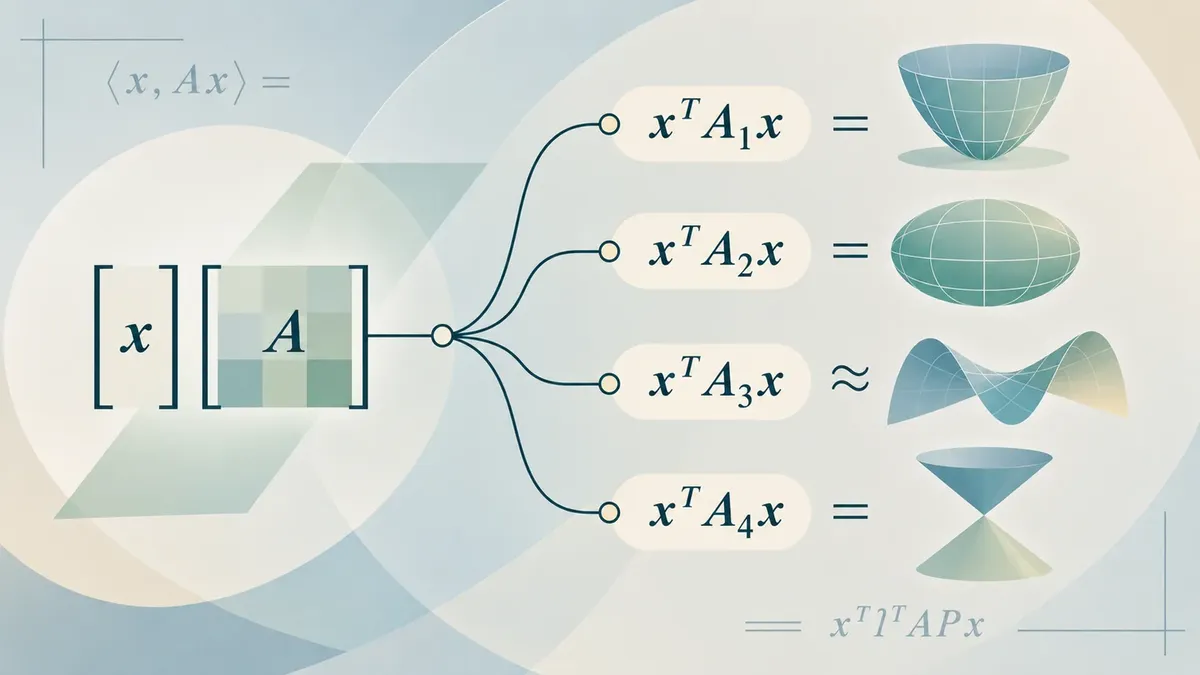
A quadratic form, such as \(X'AX\), combines a vector of values with a matrix to produce a number. What can be said about that number—or several such forms—when the vector follows a multivariate t-distribution? Brendan Kline’s preprint derives answers under specific matrix conditions, including results on dependence, moments and ratios.
Why study quadratic forms under a t-distribution?
A quadratic form takes a vector, applies a matrix, and produces a scalar, such as (X'AX). Its interpretation depends on the matrix. Researchers may also need the joint behavior of several such forms, or the distribution of one divided by another.
Kline studies these questions when the vector follows a multivariate t-distribution, allowing for a nonzero location. The paper emphasizes that familiar results for multivariate normal variables do not automatically apply. In particular, it challenges formulas for a single quadratic form that it says have been asserted in standard references. The paper’s expected-value check supports this challenge when the relevant expectation exists; for a t-distribution, that qualification matters because some moments may not exist.
What the paper derives
For its main results on multiple forms, the paper imposes specific conditions on their matrices: they must be symmetric, satisfy an idempotence condition involving the distribution’s scale matrix, and meet a stated relationship with one another. These assumptions limit the scope of the results; they do not cover every possible quadratic form.
Under those conditions, the joint distribution is represented as a discrete mixture involving an inverted Dirichlet distribution. A mixture expresses a distribution as a weighted combination of component distributions. From this representation, the paper derives the joint density and other properties.
The forms can remain dependent even when the matrices satisfy the stated relationship. The paper contrasts this with the multivariate normal case, where the corresponding forms are independent under those conditions. In the multivariate t setting studied here, the forms remain dependent.
The representation also supports a finite-series approximation to the cumulative distribution function (CDF), which gives probabilities up to specified thresholds. The paper provides an error bound for truncating this series. It also derives closed-form expressions for mixed moments—the expected values of products of powers of several forms—when those moments exist.
That final condition is important. The paper specifies when mixed moments exist and when they do not. For a single quadratic form, it also considers inverse moments, whose existence has a different condition from that for positive moments. The analysis further derives distributions for inverses and ratios of quadratic forms.
Scope and limitations
This is a theoretical mathematics paper, not a report of an experiment or dataset analysis. Its results provide formulas and conditions for calculations involving multivariate t variables, but the supplied text does not demonstrate performance in a particular application or compare practical computational performance with alternatives.
The conclusions depend on the stated assumptions about the matrices and scale matrix. The text does not establish that the same formulas apply when those assumptions are absent. Likewise, an error bound for a finite approximation offers a way to control truncation error, but does not establish that every calculation will be convenient; the required number of terms depends on the bound’s parameters.
The source is an arXiv preprint. The supplied evidence does not specify its peer-review status, so that status is unknown here. Mathematical notation and layout in the extracted text are damaged in places; this account therefore avoids reproducing equations that cannot be read reliably. The search excerpts provided with the source concern unrelated papers and do not independently verify these claims.
The central point is that multivariate t behavior can change what follows from familiar matrix conditions: quadratic forms that would be independent in the stated normal setting remain dependent in the t setting. Kline’s preprint develops distributional results for this case under explicit assumptions; how well they serve a particular application is not established by the source text.
- multivariate t-distribution
- quadratic forms
- statistical distributions
- heavy-tailed data
- moments
- probability theory