TRANSMISSION // 2611.29038v1
How Motion Shapes Quantum Vacuum Correlations
Source published
A theoretical study compares how four accelerated paths affect detector responses and quantum correlations harvested from a vacuum field.
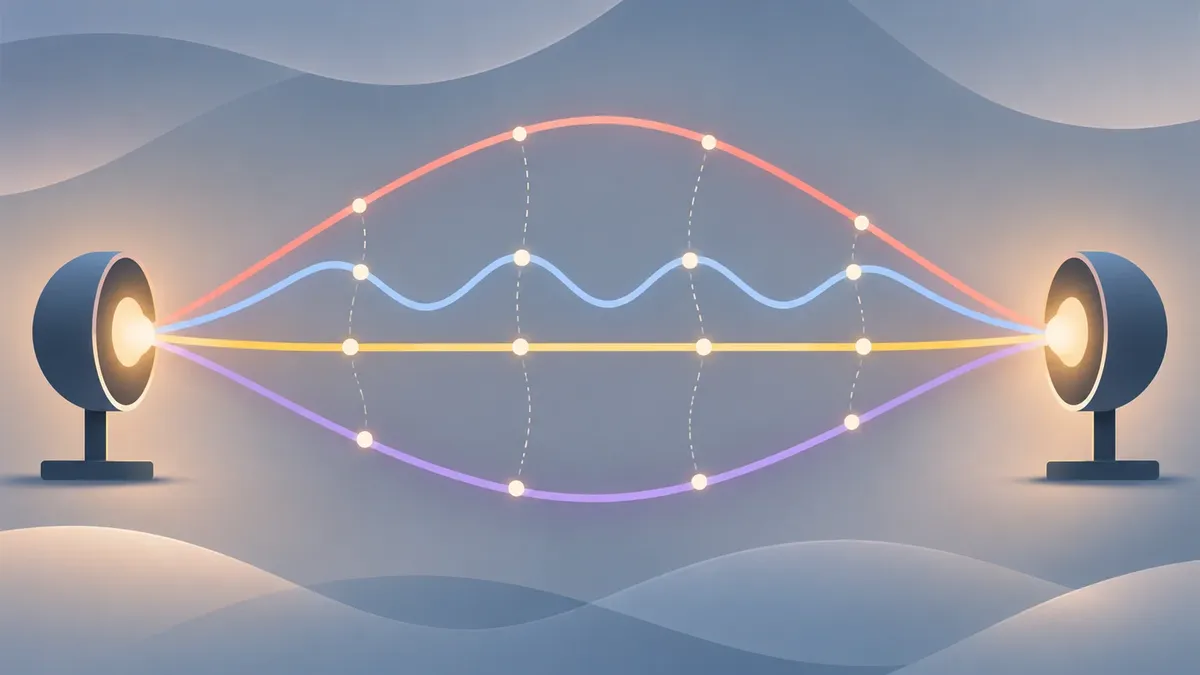
A detector moving through a quantum vacuum can respond to the field even when no particles are present in the usual sense. This preprint examines how the detector’s path affects that response—and whether two detectors can harvest shared quantum correlations.
A detector moving through empty space might seem destined to register nothing. In quantum field theory, however, an accelerating detector can respond to the vacuum in ways sometimes compared with thermal effects. This study calculates detector responses and an effective temperature, without establishing that the response is equivalent to encountering a real thermal environment.
The authors ask how different trajectories affect both a single detector and a pair seeking quantum correlations from a field’s vacuum. They model a massless scalar field in flat spacetime with two spatial dimensions and one time dimension. The four trajectory classes they compare are linear, catenary, cusped and circular.
The detectors are Unruh–DeWitt models: idealized systems coupled to a quantum field. Their interaction is switched on and off with a Gaussian profile, so it changes smoothly over time. For one detector, the researchers calculate its transition probability—the probability of a change in its energy—and an associated effective temperature. They examine how both vary with acceleration and with a parameter described as the ratio of torsion to acceleration. The abstract says continuous variation of this parameter connects the four trajectory classes, but does not give further details of that relationship.
For the two-detector protocol, the pair follows horizontally displaced copies of the same trajectory while interacting with the field. The study assesses harvested concurrence and quantum mutual information. These measures are reported as indicators of entanglement and shared correlations, respectively; the abstract does not provide their formal definitions.
The abstract reports that transition probability and effective temperature generally increase with acceleration. Their dependence on the torsion-to-acceleration ratio can be nonmonotonic, with the pattern depending on the detectors’ energy gap. In other words, changing the trajectory parameter does not necessarily push either quantity steadily in one direction.
For detector pairs, increasing acceleration or separation generally suppresses both harvested concurrence and quantum mutual information. How much they are suppressed at a fixed acceleration depends strongly on the trajectory class. The authors also identify regimes for each of the four classes in which vacuum correlations alone are sufficient to entangle the detectors. In those regimes, the communication contribution alone cannot overcome local noise.
These are theoretical results from an idealized model, not observations of real detectors. The abstract does not give numerical values or enough detail to evaluate parameter ranges, computational checks or how strongly the results depend on modeling choices. It therefore cannot establish when the predicted effects would be largest or whether they could be observed experimentally.
The source is an arXiv preprint, and the evidence available for this article is its abstract rather than the full paper. The abstract does not state whether the work has undergone peer review. The findings should therefore be read as results reported by the authors, with those source limitations in mind—not as experimental confirmation.
- quantum field theory
- Unruh effect
- particle detectors
- entanglement harvesting
- quantum correlations
- accelerated motion
Related reading
Automatically matched by shared topic keywords. These links do not imply that the sources agree or establish a consensus.
GAPS: A balloon-borne search for rare cosmic antimatter
Source published
Shared keywords: particle detectors
A Precision Bound for Local Measurements in Quantum Field Theory
Source published
Shared keywords: quantum field theory
A Rényi Route to Quantum Energy Bounds
Source published
Shared keywords: quantum field theory
Keeping spacetime continuous in quantum path integrals
Source published
Shared keywords: quantum field theory
How a trap may explain phase locking in a cold-atom quantum simulator
Source published
Shared keywords: quantum field theory