TRANSMISSION // 2611.28978v1
Can AI World Models Help Robots Understand the Ocean?
Source published
A review maps how predictive AI models might aid marine robots and biodiversity monitoring, while stressing that most proposed ocean applications remain untested.
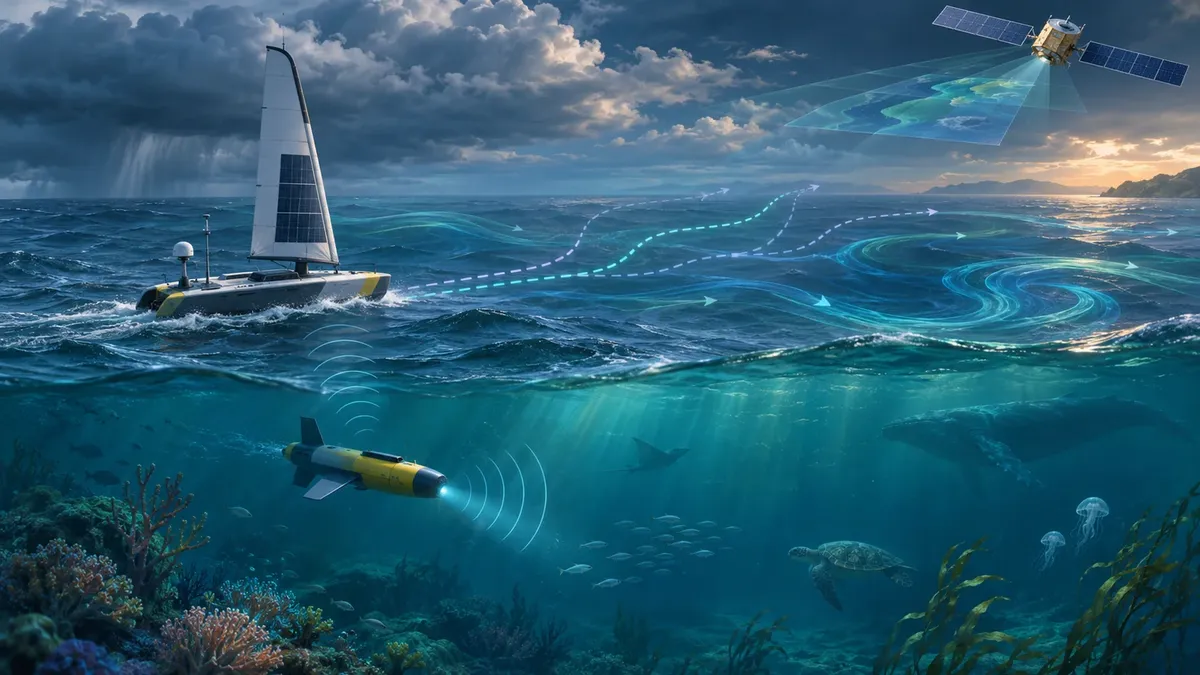
Ocean robots must make decisions with sparse observations, changing conditions and limited or intermittent communications. A review explores whether AI “world models” could help them anticipate what comes next—and why promising ideas are not yet proof of reliable ocean autonomy.
An ocean robot may have to choose a route while currents shift and visibility falls, with only limited communication with shore. To act safely, it needs more than a snapshot of what its sensors see: it needs some way to anticipate how the situation might change. That is the problem examined in a review of “world models” for ocean engineering.
A world model, in this context, is an internal representation of the environment that predicts how it may evolve and can inform forecasting, planning or control. The authors draw an important boundary: a system that only recognises an image or sound is not, by itself, a world model. For practical robotic use, prediction must account for time—and, when decisions affect what happens next, for actions or interventions.
From sensing to prediction
Many existing robotic systems are designed to respond to current observations, for example by following waypoints. The review argues that marine settings make prediction particularly valuable. Measurements are sparse and come from different sources; environmental conditions and vehicle behaviour can change; and underwater or satellite communications may be costly, low-bandwidth or intermittent. A robot operating far from shore may need to make decisions onboard rather than rely on continuous human guidance.
The paper surveys several approaches, including generative models that reconstruct or produce observations and Joint-Embedding Predictive Architectures, or JEPAs. Instead of reproducing every pixel or other sensor detail, a JEPA predicts a compact representation of the data. The idea is to focus on information useful for anticipating change, rather than spending effort recreating details that may not matter to a decision.
But a compact representation is not automatically useful for control. The review compares approaches by what they predict, how they model change over time, whether they include actions, how predictions connect to a planner, and whether the model can adapt after deployment. That distinction helps separate a promising learning technique from a complete system that can guide a vessel.
What has been shown—and what has not
One example the authors examine is AdaJEPA, which adapts its predictive model during model predictive control (MPC). At each replanning step, the system uses its current model to plan, acts, records the resulting transition, updates selected model parameters from recent observations and plans again. The review reports that AdaJEPA was evaluated on the simulated PushT and PointMaze tasks under visual, geometric, dynamics and layout shifts. The reported adaptation overhead was 0.01–0.03 seconds per step on an NVIDIA H200.
Those tests offer evidence for adaptive latent planning in those settings, not evidence that the approach is ready for marine missions. The review says the experiments were simulated, short-horizon and based on pretrained models. They did not test marine sensors, lengthy ocean deployments or ecological processes. Water turbidity, wave-driven motion and sensor fouling are examples of marine shifts that would need dedicated evaluation.
The broader synthesis reaches a similar conclusion: most reviewed models are trained offline and remain fixed during evaluation. Direct evidence for long-duration marine deployment, online recalibration and adaptation to combined sensor and dynamics changes remains limited. Results from driving or terrestrial robotics can suggest design choices, the authors argue, but should not be counted as validation at sea.
Biodiversity monitoring is a further step away. In principle, a predictive model could combine satellite data, acoustic recordings, imagery, environmental measurements and eDNA sampling, then help a robot decide where another measurement would be most useful. But the review finds no demonstrated, unified world model for marine biodiversity at ecosystem scale. It describes digital twins and ecosystem forecasting as prospective applications, not established capabilities. Adaptive observation—choosing useful, safe and energy-aware sampling actions—is presented as a more realistic near-term goal.
The unresolved safety and evidence questions
Adapting to new conditions could help a model cope with change, but it could also learn from a faulty sensor reading or an unusual event that should not be ignored. The authors identify uncertainty calibration, safe adaptation, embedded computing and marine-specific benchmarks as priorities. They call for safeguards such as uncertainty-gated updates, rejecting corrupted transitions and rolling back harmful changes, alongside independent safety supervision.
The review says it searched Scopus, Web of Science and arXiv for work from 2019 to 2026, and included 36 studies after screening. It also drew on secondary sources such as technical blogs and community-curated repositories. As a review, it synthesises other work rather than reporting a new ocean-robot experiment. Its conclusions depend on the search scope, the evidence available and how consistently different fields use the term “world model.” The authors themselves warn that the field is changing quickly and that preprint findings may change after peer review.
The practical message is cautious: predictive AI could help marine robots plan and collect better observations, but ocean-ready systems will require evidence under real marine conditions. The review’s proposed path is to combine predictive models with physical knowledge and guarded adaptation, then validate them progressively in simulation and field missions.
- marine robotics
- world models
- JEPA
- ocean engineering
- adaptive sampling
- biodiversity monitoring
- digital twins
Related reading
Automatically matched by shared topic keywords. These links do not imply that the sources agree or establish a consensus.
Why one action may not teach an AI how actions work
Source published
Shared keywords: world models
A safety shield for image-based robot parking
Source published
Shared keywords: world models
Can robot planners think in point clouds?
Source published
Shared keywords: world models
How LeHami changes AI’s imagined futures
Source published
Shared keywords: world models
A smoother way for robot AI to imagine what actions do
Source published
Shared keywords: world models