TRANSMISSION // 2611.28971v1
When an AI’s Wrong Answer Hasn’t Settled
Source published
A study of recurrent reasoning models finds that wrong answers often change when computation continues—but the result is limited to tested tasks and models.
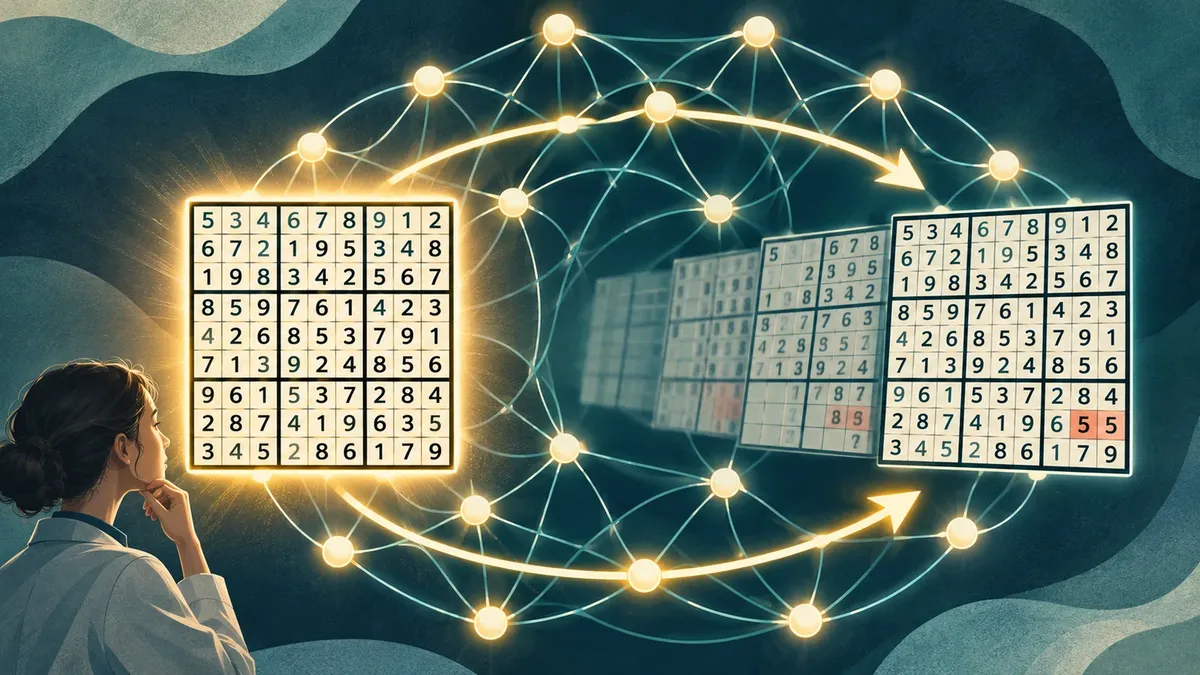
A model can stop computing without its answer being stable. Researchers tested whether extending a recurrent reasoner’s computation would preserve correct and incorrect answers alike, finding that wrong answers changed more often in the settings they examined.
When does a model’s answer become settled?
Some AI systems solve a problem by repeatedly updating an internal state. They run these updates for a set amount of time, then report an answer. But reaching the end of that budget does not necessarily mean the computation has converged on a stable result. A wrong answer might be a lasting state—or a temporary one that would change if the model kept going.
In this preprint, Jiucheng Zang, Congkai Peng and Yankai Wei investigate that distinction. Their main question is whether correct and incorrect answers from a recurrent reasoner persist at similar rates when the system gets another stretch of computation.
Continuing the recurrence
The authors’ primary test used a trained Hierarchical Reasoning Model, or HRM, with 27 million parameters, evaluated on the difficult Sudoku-Extreme task. They took answers at the end of the model’s usual inference budget and ran the recurrence for one more budget. They compared this continuation with an unperturbed control, allowing them to assess whether answers persisted without treating added noise as the explanation.
The researchers also tested perturbations at different scales relative to the model’s final update. According to the abstract, changing that scale—from 0.05 to 20 times the terminal-update scale—barely changed the persistence rates. The authors interpret this as evidence that their main measurement reflects continued recurrence rather than sensitivity to noise.
Correct answers persisted more often
Among 512 solved endpoints, 0.95 retained their answer after the extra inference budget. Wrong answers were less persistent: 0.42 of 170 near-miss answers kept the same answer, while 0.18 of all 512 wrong endpoints did so.
These figures describe the tested model and setup, not a general law about AI. They suggest that, within this finite extra run, an incorrect output was often not a settled endpoint. But a changed answer is not necessarily a corrected answer; the abstract does not say that every change improved the result.
The authors report that the ordering—solved answers persisting more often than wrong ones—also appeared in five other settings: a second random seed, another recurrent model called TRM, Maze, a GRAM-guided TRM, and N-Queens. However, a fixed one-half persistence threshold did not hold across those settings. Nor did certain additional patterns seen in HRM, involving endpoint spectra and fast-versus-slow predictability. The authors therefore caution against treating those patterns as universal ways to diagnose model behavior.
What should extra computation be used for?
The abstract also compares ways to spend additional compute on Sudoku-Extreme. A previously studied approach, perturb-and-reselect, adds frozen noise and chooses among resulting answers. In the reported comparison, this produced a 4.8 percentage-point accuracy gain, with 197 answers gained and two lost. Extending computation to a matched depth produced a 5.6-point gain, while Sudoku symmetry augmentation produced a 34.6-point gain.
These are results for the reported experiments, not a guarantee that the same strategy will be best elsewhere. Still, they complicate the idea that noise-based answer selection is the most useful way to spend a limited compute budget: in this comparison, other approaches performed better.
Limits and open questions
The evidence has important boundaries. The authors say the conclusions are limited to finite computation horizons and one primary HRM checkpoint. The experiments do not establish what would happen if recurrence continued indefinitely, and they do not rule out the possibility that a model eventually settles into an attractor. Results across several additional settings broaden the evidence, but they do not make every measured diagnostic universal.
This article is based on the paper’s abstract, not a full-text review. Details needed to assess the experimental design more fully—such as the exact evaluation procedures and uncertainty estimates—are therefore not available here. The paper is an arXiv preprint, which may not have undergone peer review. Its findings are best read as evidence about the specific models, tasks and finite inference budgets studied, rather than as a broad claim about how all reasoning systems behave.
- recurrent reasoning
- artificial intelligence
- Sudoku
- inference-time computation
- AI evaluation
Reviewed cross-references
These connections were reviewed by a model, not independently fact-checked by a human. Similarity does not imply agreement; consult the original papers and the evidence below.
Why Recurrent AI Models Still Struggle With Longer Tasks
Shared method: Both studies examine recurrent computation by running shared model updates beyond the training or stopping range: Zang et al. test whether HRM answers persist after an extra inference budget, while Jung et al. vary recurrent computation at test time in synthetic state tracking. The models, tasks and outcomes differ, so this is a methodological connection, not evidence that their findings generalize to each other.
Model review: · openai-codex/gpt-6-luna
Evidence and provenance
Selected excerpts, not complete papers. PDF extraction can omit figures or damage equations, tables and reading order; sources may be preprints.
2611.28971v1 — Original paper
Excerpt reference:
static/papers/2611.28971v1.md:13-36
Basis: Paper text
Source SHA-256:cc38ee1c16d737d1d701e0344f58f02201aa3902259b5fccf4f3ba773c0126132611.29171v1 — Original paper
Excerpt reference:
static/papers/2611.29171v1.md:13-68
Basis: Paper text
Source SHA-256:67e3cd3f59892e4e587f7cb1b8e08b0c319e0a33dea5633814725cb49eacd5b72611.29171v1 — Original paper
Excerpt reference:
static/papers/2611.29171v1.md:131-199
Basis: Paper text
Source SHA-256:67e3cd3f59892e4e587f7cb1b8e08b0c319e0a33dea5633814725cb49eacd5b7
Related reading
Automatically matched by shared topic keywords. These links do not imply that the sources agree or establish a consensus.
Can a network reason by pushing back against broken rules?
Source published
Shared keywords: artificial intelligence
When AI agents fix a system but misdiagnose the fault
Source published
Shared keywords: ai evaluation, artificial intelligence
GUI Agent Failures Cluster in Tested Tasks
Source published
Shared keywords: ai evaluation, artificial intelligence
Why GUI agents can be right—and still fail
Source published
Shared keywords: ai evaluation, artificial intelligence
AI Can Fix a Simulated System Without Finding What Broke It
Source published
Shared keywords: ai evaluation, artificial intelligence