TRANSMISSION // 2611.28970v1
How Data Agents Organize Analytical Work
Source published
A comparison of the ten highest-ranked KDD Cup submissions identifies patterns in how data agents allocate computation, structure evidence and reuse artifacts—and questions for future testing.
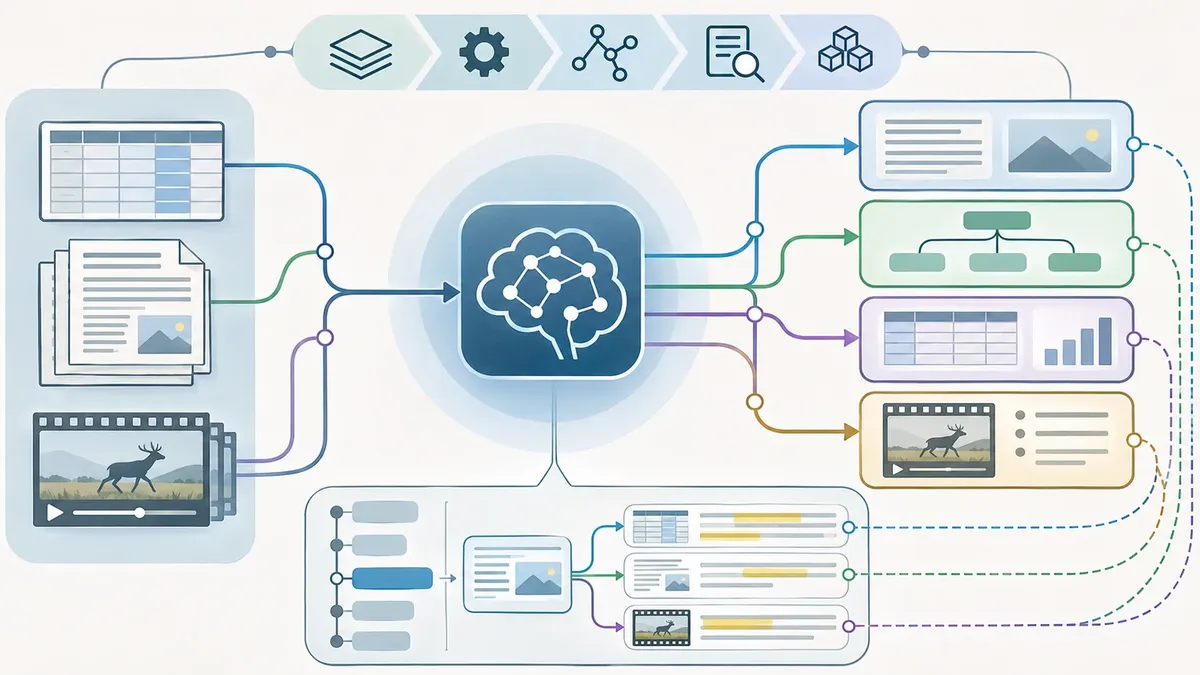
Data agents interpret analytical requests, work with data and tools, and deliver results within resource limits. Researchers examined final code submissions from the ten highest-ranked teams in the KDD Cup 2026 competition. Their comparison identifies recurring design choices, but does not establish whether those choices improve performance.
How do data agents organize analysis?
A data agent uses AI to interpret an analytical request, access data and tools, and carry out a computational workflow. It must decide what evidence to use, how to check candidate results and when to stop—all within limits such as elapsed time and model calls.
To examine how these systems are built, the researchers analyzed the final code submissions of the ten highest-ranked teams in the KDD Cup 2026 Data Agents for Complex Data Analysis competition. The competition’s DataSpace benchmark pairs analytical questions with workspaces containing different kinds of material, including structured data, documents and videos. Agents are required to return complete tabular results for deterministic evaluation. The researchers compared teams’ code, configurations and prompts, using stated criteria when a design choice was ambiguous.
They grouped the systems’ design choices into three interacting layers. Orchestration controls the workflow: how work is scheduled, resources are allocated, and the system decides to retry, stop or submit a candidate. Functions interpret the task, construct evidence, compute candidate answers and assess results. Working state preserves artifacts and runtime information, such as specifications, evidence, candidate versions and assessment reports, for use in later steps.
This is a comparison of existing submissions, not a controlled experiment. It identifies patterns in what teams implemented; it does not establish that those patterns caused their competition rankings.
Three recurring patterns
Allocate computation in response to progress. With a fixed budget, extra refinement can leave too few resources to finish. Four of the ten submissions combine stage budgets with bounded repair. Examples include estimating whether another pass is affordable and limiting attempts. The researchers argue that systems should let observed progress guide further computation while preserving enough budget to complete the task. Their comparison does not establish that a particular scheduling policy works best.
Represent evidence so it can support computation and assessment. Seven submissions combine structured evidence with checks on content or coverage. Organizing extracted material can help an agent compute from it and inspect whether relevant material is missing, but checks do not guarantee completeness.
For the highest-ranked submission, the paper analyzes 33 tasks with nonempty reference sets. Mean per-task recall of reference tables was 89.39%. Five tasks omitted a table listed in the reference; in two cases, that table received no positive votes across five rounds. The paper notes that unselected tables remained accessible through tools, allowing source selections to be revisited. These observations show why agreement or a coverage check should not automatically be treated as proof that all relevant evidence was included.
Reuse artifacts while preserving provenance. Six submissions retain prepared evidence across attempts, and four of these also preserve provenance. Reusing prepared evidence can avoid repeating work. But candidate answers that draw on the same evidence may inherit the same error. Their agreement is not necessarily independent confirmation; understanding it requires tracing their shared evidence dependencies.
What remains to be tested
The authors propose that future systems use recorded evidence dependencies and assessment results to decide whether to spend more computation or revisit a source. If shared evidence appears faulty, dependency records could help identify which results need recomputing while leaving unaffected work intact. They also propose controlled comparisons that hold the model, task set and total budget fixed while varying orchestration and evidence sharing. Introducing known errors into extracted tables could test whether systems locate and repair them. These are research proposals, not outcomes demonstrated by the submission comparison.
The study examines ten high-ranking submissions from one competition. Given that scope, its observations alone cannot establish how common these design patterns are in other settings or whether they generalize to other tasks. The authors report that they helped organize the competition, with several serving as chairs, and say they were authorized under its rules to analyze the submissions. That disclosed context is relevant when considering how the study was conducted.
The supplied manuscript has a journal-style header and states a 2026 copyright, but its received and accepted dates are placeholders. The available text does not resolve its publication status. More broadly, the paper offers a framework and observations about a set of competition systems, not controlled evidence that any particular design reliably improves accuracy. Its practical point is that reusing evidence also reuses its dependencies: assessing candidate answers means looking at where their evidence came from, not only whether the answers agree.
- data agents
- AI systems
- data analysis
- evidence provenance
- KDD Cup 2026
- large language models
Related reading
Automatically matched by shared topic keywords. These links do not imply that the sources agree or establish a consensus.
Can an AI council help researchers make sense of qualitative data?
Source published
Shared keywords: evidence provenance, large language models
A Safety Check Before AI Changes Live Infrastructure
Source published
Shared keywords: evidence provenance
Testing NoeVera’s evidence loop for LLM serving
Source published
Shared keywords: evidence provenance
How MAASAI coordinates astronomy analysis
Source published
Shared keywords: large language models
Finding surprising shopping patterns without abandoning statistics
Source published
Shared keywords: large language models