TRANSMISSION // 2611.28945v1
A physics-based watchdog for quantum key links
Source published
Q-TRACE checks whether a quantum-key receiver’s detailed detection patterns fit an honest, lossy-link model, rather than relying on error rate alone.
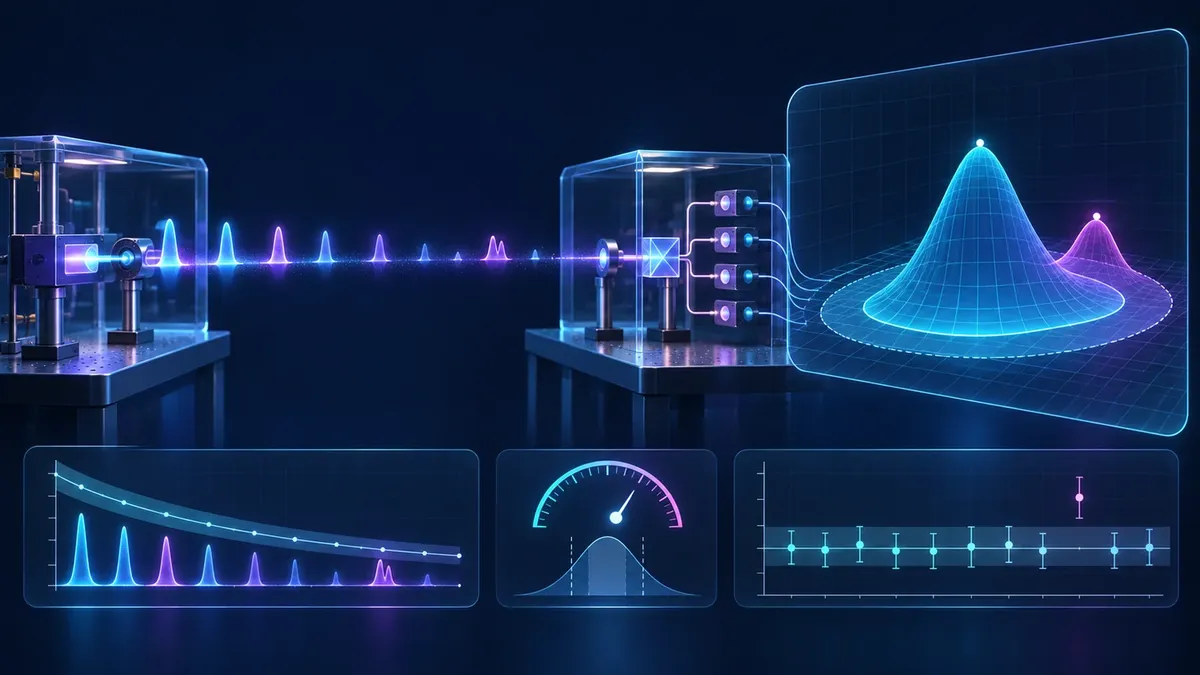
Quantum key distribution can be undermined by devices that behave differently from the assumptions in their security proofs. A new proposed monitor looks for those mismatches in receiver data, while accounting for ordinary signal loss. Its results are promising, but the tests also show how much detection depends on a carefully matched reference.
Quantum key distribution (QKD) uses quantum states to help two parties establish a shared secret key. But the security of a practical system depends not only on quantum theory: its actual devices must also behave within the assumptions used by the security proof. An attacker may exploit a device flaw while keeping the quantum bit error rate (QBER)—the fraction of measured bits that disagree—low enough to escape a simple alarm.
In a preprint, Sumit Tapas Chongder proposes Q-TRACE, a monitor for decoy-state BB84, a widely used form of QKD. The central question is whether a monitor can spot attacks without being trained on examples of each attack, while avoiding alarms just because normal channel loss has changed.
Testing what an honest link can produce
Q-TRACE builds a physical model of the receiver’s possible outcomes when the link is operating honestly. It considers the intensity and basis of each pulse, which detector clicks, whether both detectors click, and whether neither clicks. The collection of statistics that an honest receiver could produce at different levels of channel loss is called the “honest-device manifold.” In plain terms, it is a map of the receiver patterns compatible with an honest link, even when the signal is weakened.
The monitor first estimates device parameters from commissioning data collected when the link is presumed attack-free. For each later window of data, it adjusts for the best-fitting channel transmittance, so a change in loss by itself is not treated as evidence of an attack. It then checks for inconsistencies in the full pattern of detection outcomes and in how pulse settings were allocated. These checks include broad residual tests and tests aimed at deviations suggested by the receiver’s physics. The design uses no attack data.
The paper also defines a detectability measure: how far an attack’s receiver statistics are from the closest honest explanation. This gives a theoretical limit on how quickly any monitor using the same telemetry can detect an attack. Crucially, some attacks leave no detectable trace in those data. The authors show this for a Trojan-horse probe whose back-reflected light is filtered before reaching the receiver: in that case, the receiver statistics match the honest ones, so no monitor based on those statistics can identify the probe.
Simulation results and a hardware test
In a simulated, count-level twin of a QKD link, the authors deliberately included effects—such as intensity jitter and device drift—that were not represented in the monitor’s main physical model. Across five held-out random seeds, and at a per-window false-alarm rate of 0.001, Q-TRACE detected 63.6% of links with known attack families, 28.0% with attack families not used in its development, and 65.3% with composite attacks. The strongest comparison methods reached 51.2%, 6.7%, and 42.3%, respectively. These figures describe this particular benchmark, attack mix and threshold; they are not universal detection rates.
The authors also tested 33 parallel BB84 links on IBM’s ibm_marrakesh superconducting-qubit processor. The eavesdroppers were implemented as operations coupling a data qubit to an ancilla qubit, rather than as attacks on an optical-fibre QKD system. The experiment highlights a practical issue: when the commissioning reference was collected under different operating conditions, every type of monitor tested raised alarms on most honest link-epochs. With a condition-matched reference, Q-TRACE detected the weakest tested probe in 14 of 14 attacked link-epochs, with no alarms in 66 honest ones. That result is encouraging, but the condition-matched analysis was devised after the original reference failed, and the authors call for a prospective follow-up.
What the results do—and do not—show
The proposal’s main strength is that it tests a detailed physical expectation rather than looking only for familiar attack signatures or a rise in QBER. In the simulations, it could also distinguish ordinary loss changes from other departures from the model. The detectability framework makes a useful point: a missed alarm may reflect a weak monitor, or an attack that is intrinsically hard—or impossible—to see in the available data.
There are important limits. Simulation findings depend on the chosen model and parameter ranges, and the tested attacks were not designed adaptively to evade Q-TRACE. The theoretical delay bound assumes a stationary honest link; real drift can make detection slower. False-alarm control was calibrated empirically, rather than guaranteed exactly. The hardware study used one processor and a single run, with a limited number of link-epochs per probe, and it does not establish performance on deployed optical links. Q-TRACE is presented as a complement to security proofs and hardware countermeasures, not a replacement for either.
The work is a single-author arXiv preprint, not evidence of independent peer review. Its reported results and limitations should therefore be treated as preliminary. The author says the code and data are available in a public repository, which may help others check and extend the analysis.
- quantum key distribution
- Q-TRACE
- BB84
- quantum cybersecurity
- attack detection
- QBER
- preprint
Related reading
Automatically matched by shared topic keywords. These links do not imply that the sources agree or establish a consensus.
Can quantum key distribution stay secure when devices remember?
Source published
Shared keywords: quantum key distribution
Quantum packets take two routing hops without rewriting their address
Source published
Shared keywords: quantum key distribution
Before quantum keys, Sweden’s fiber links need a checkup
Source published
Shared keywords: quantum key distribution
Modeling the wait for fresh quantum keys in drone-based computing
Source published
Shared keywords: quantum key distribution
When near-classical correlations can still support quantum key guarantees
Source published
Shared keywords: quantum key distribution