TRANSMISSION // 2611.28873v1
A shared action vocabulary for robots—and humans
Source published
A new action tokenizer turns movements from robots, simulations and human hands into short sequences a policy can generate and execute step by step. Tests show promise across simulated tasks and one real robot, with important limits.
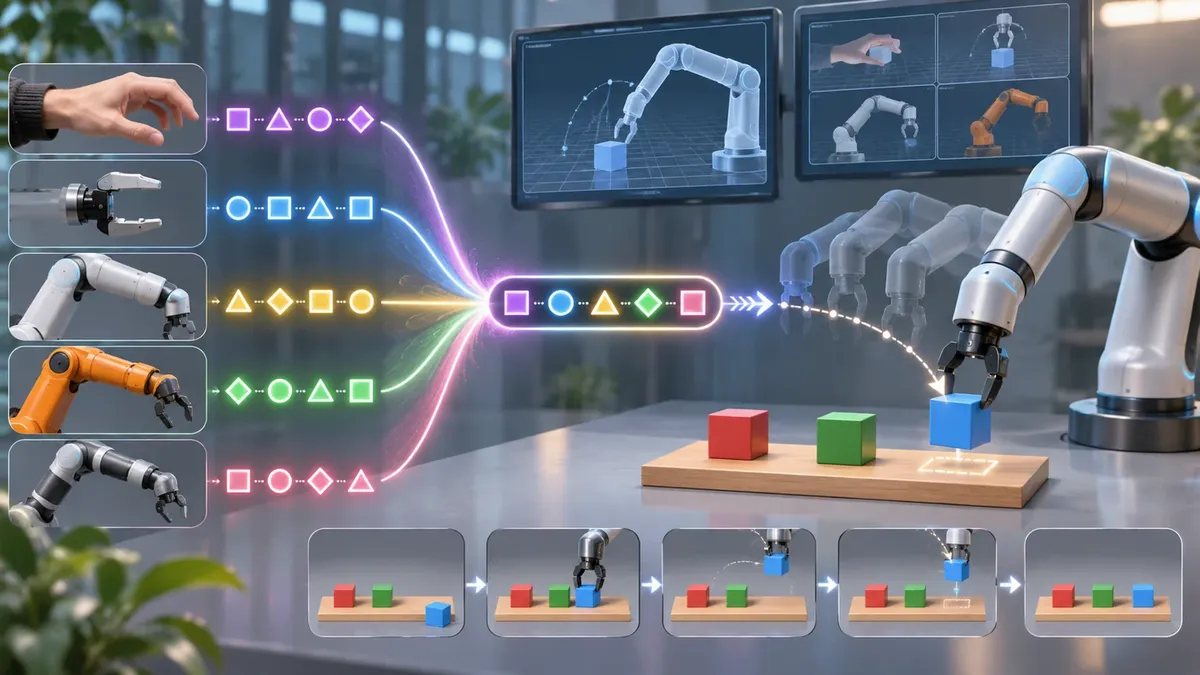
Robots come in different shapes, with different controls. A research team proposes a way to represent their movements—and human hand motions—as a shared stream of tokens. The results suggest this can help robot-learning systems, but do not yet establish a universal solution.
A robot policy can be trained to predict actions much as a language model predicts words: one token at a time. But unlike words, actions differ across machines. A robot arm, a handheld gripper and a human hand do not have the same joints or control ranges. How can one policy learn from all of them, including robots it has not encountered before?
Ahad Jawaid, Alexander Swerdlow and Yu Xiang introduce the Neural Action Tokenizer (NAT), designed to compress action sequences into short, ordered token streams. Their preprint reports training on a corpus of about 49,000 hours of movement data from robots, handheld grippers, simulations and human hands.
Making actions streamable
Many robot-learning systems predict a short sequence, or “chunk,” of future movements. A conventional tokenizer may need the whole chunk before it can translate tokens back into actions. NAT’s decoder is causal: each part of the output depends only on tokens already produced. This lets the robot begin carrying out the earlier movements while the policy generates the rest.
The researchers built NAT from an encoder, a quantizer that converts internal representations into discrete codes, and a decoder. The encoder and decoder process the sequence in time order; multiple quantization stages capture information at different temporal scales. The team trained the tokenizer to reconstruct the original actions, then froze it while training policies to predict its tokens.
This streaming design also allows a policy to keep the actions already underway as a fixed prefix when producing the next chunk. In the authors’ tests, this real-time chunking reduced abrupt changes between chunks. It is a technical way to make handoffs between predicted movements smoother, not a guarantee that a robot will move safely in every setting.
What the tests found
On four simulation benchmarks, a policy using NAT had the highest average success among the compared tokenizers, including FAST and other neural approaches. The ranking was not uniform across tasks: FAST led on Meta-World, while another tokenizer led on RoboMimic. The authors also report that NAT performed well when tested on robot embodiments excluded from tokenizer training.
The team then trained vision-language-action models (VLAs)—systems that connect images and instructions to robot movements—using NAT tokens or the FAST+ tokenizer. After fine-tuning across four simulated benchmarks, the NAT model had higher mean success in the reported setup. The difference varied by benchmark, and the intervals overlapped on Meta-World. On a Trossen AI Solo robot, the NAT model succeeded in 55% of trials across four tasks, compared with 35% for FAST+. Each task had only 10 trials; NAT did worse on the grape-placement task, illustrating that its advantage was not consistent across tasks.
NAT’s first actions were available sooner than the full action chunk in the authors’ latency tests. The paper also compares token-based control with a flow-matching action head, which generates actions through a different process. The flow head performed better on some benchmarks; on LIBERO, the reported success intervals for the two approaches overlapped. These comparisons are not a blanket demonstration that token-based control is faster or better in all systems: latency depends on the model and test setup, and the flow-head training recipe differed in additional ways.
One striking result concerns training data. A NAT trained only on human hand motion performed close to one trained on all data sources in the reported tests. This suggests robot data may not be essential for learning a useful action representation in these experiments. It does not show that human movement alone is enough to train a capable robot policy: the policy training and real-robot fine-tuning involved robot data.
A promising result, not a universal answer
The study covers four simulation benchmarks and a small real-robot evaluation, not every robot, task or operating environment. NAT uses a fixed number of tokens per action chunk, and the authors identify variable-length chunks and scaling tokenizer and policy training data together as open questions. Performance also depended on the benchmark and setup, while some flow-head results remained stronger.
This work is an arXiv preprint, so its claims should be treated as provisional rather than as independently validated conclusions. The results support NAT as a promising shared, streamable action representation—not proof that one vocabulary can reliably control any robot. Further testing across more hardware, tasks and conditions will be needed to establish how broadly it transfers.
- robot learning
- action tokenization
- Neural Action Tokenizer
- robotics
- vision-language-action models
- human motion data
Reviewed cross-references
These connections were reviewed by a model, not independently fact-checked by a human. Similarity does not imply agreement; consult the original papers and the evidence below.
H2RB preprint explores how human demonstrations can teach robots new tasks
Supporting evidence: Both studies report a role for human-motion data in robot learning: NAT finds its tokenizer trained only on human hand motion performs close to tokenizers trained on robot data, while H2RB reports improved real-world transfer using human demonstrations alongside robot demonstrations. These are complementary, not directly comparable results: NAT evaluates action representations, whereas H2RB evaluates task transfer with a pretrained VLA and embodiment-specific decoders.
Model review: · openai-codex/gpt-6-luna
Evidence and provenance
Selected excerpts, not complete papers. PDF extraction can omit figures or damage equations, tables and reading order; sources may be preprints.
2611.28873v1 — Original paper
Excerpt reference:
static/papers/2611.28873v1.md:70-138
Basis: Paper text
Source SHA-256:2103e2e877fa4a9d74b925acfcb4d3965ffc29ba826b31a8a5eff606d20998142611.04391v1 — Original paper
Excerpt reference:
static/papers/2611.04391v1.md:15-38
Basis: Paper text
Source SHA-256:d366d081c470701b6c50255190b80755e249492c18d757b16fdc2e8f3ac5a026
Related reading
Automatically matched by shared topic keywords. These links do not imply that the sources agree or establish a consensus.
Can a general AI model control a robot arm?
Source published
Shared keywords: robot learning, vision language action models
How to combine robot skills without making them clash
Source published
Shared keywords: robot learning, vision language action models
A critic helps robot policies learn from logged experience
Source published
Shared keywords: robot learning, vision language action models
Teaching Robot AI to Focus on Motion, Not Scenery
Source published
Shared keywords: robot learning, vision language action models
A robot plan that knows what remains—and when to consult a demonstration
Source published
Shared keywords: robot learning, vision language action models