TRANSMISSION // 2611.28847v1
A fixed recipe extends quantum error-correcting codes
Source published
A mathematical construction reuses a code’s structure to generate larger quantum LDPC codes without screening candidates at each size. Exhaustive searches certify several distance results, while the proposed long-term trend remains conjectural.
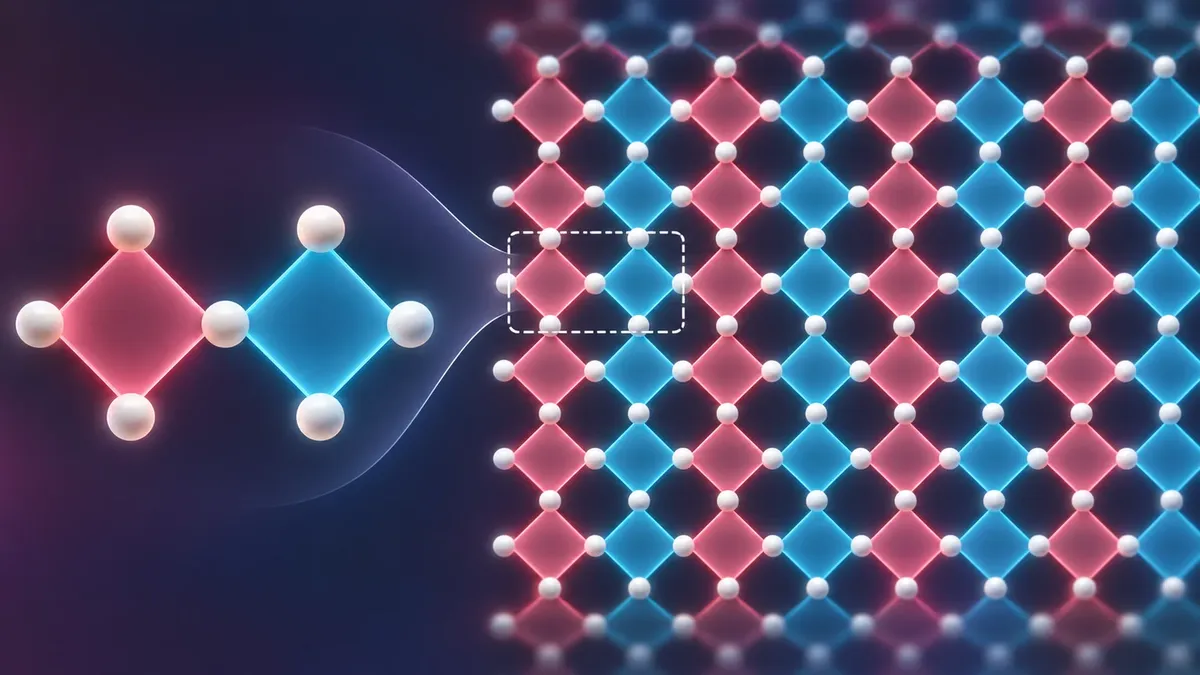
Can a good quantum error-correcting code be enlarged by a fixed recipe, rather than rediscovered through a search at every size? Kenta Kasai’s preprint describes a way to do that for a family of sparse-check codes—and reports verified distance gains in several examples.
Quantum computers are vulnerable to errors, so useful machines need error-correcting codes that spread information across many physical qubits and use checks to detect faults. Quantum low-density parity-check (LDPC) codes are designed so each check involves only a limited number of qubits, and each qubit participates in only a limited number of checks. A central challenge is to make codes that are both sparse and hard to disrupt: their distance is the weight of the smallest error that acts like a logical operation without being detected by the checks.
Kenta Kasai’s preprint asks whether a code’s construction can be extended to larger sizes without searching through new candidates at each size. The proposed method starts with a code built using permutation matrices and a pair-partition structure. It extracts fixed integer parameters and a rule for arranging the matrices. At another size, that rule generates new parity-check matrices while preserving the required relationship between the X and Z checks, which makes them commute. It also preserves the checks’ row and column weights.
The matrix blocks are either circulant permutation matrices (CPMs), which shift entries in a regular cycle, or affine permutation matrices (APMs), which use modular arithmetic to permute positions. A pair partition groups contributions so that they cancel in the conditions needed for the two kinds of checks to commute. In the paper’s procedure, the fixed parameters carry information from an original code into the larger construction.
The important distinction is between generating a code and proving it has a particular distance. The recipe can produce a code at an allowed size without screening candidates by their distance. But the recipe does not guarantee that distance will improve. The authors therefore verify distances separately: exhaustive searches, with symmetry reductions and pruning, seek to rule out lighter logical operators, while explicit logical operators establish matching upper bounds where exact distances are reported. The paper says it audited completion of the partitioned search space and provides construction data, matrices, operators and audit materials. It also notes that independently reproducing an exclusion requires rerunning the saved implementation on the recorded inputs and search ranges; an audit summary alone is not a reproduction.
Among the reported examples, an APM-based code with 3,072 physical qubits encodes 772 logical qubits and has distance 32. Its X- and Z-check matrices each have column weight 3 and check weight 8. The paper reports an original code in the same family with distance 26, so this example shows a verified increase under the chosen extension rule. A CPM-based family with check weight 10 reaches a reported distance lower bound of at least 34 at 1,270 physical qubits, encoding 260 logical qubits; both check matrices have column weight 4. The “at least” matters: the paper reports a verified interval from 34 to 70 for that code, not an exact distance. Other displayed examples do not all improve monotonically as size changes.
The authors conjecture that the main APM construction has a finite structural upper bound on distance and that its distance improves toward that bound as size increases. They do not establish the bound or its attainability, and they explicitly do not assume monotonic growth. The paper also says that improving distance at the same length would require changing the generation data. These results are therefore examples of a promising construction strategy, not a general guarantee that every extension will improve a code.
There are further practical limits. The construction preserves sparse-check weights, but the paper does not demonstrate performance on quantum hardware or establish an error-correction threshold under realistic noise. The distance computations are substantial, and the authors identify more efficient certification methods and runtime comparisons as future work. The article describes a mathematical method and finite examples; it does not show that the codes are ready for deployment.
This is version 1 of an arXiv preprint, not evidence here of peer review. Its claims should be read with that status in mind. The paper provides public data and audit materials, but full independent reproduction of the exhaustive exclusions requires carrying out the saved computations. Its most solid contribution is narrower than the conjectured long-term trend: a fixed, explicit rule can extend particular quantum LDPC constructions, and exhaustive searches support the stated distance results for the examples reported.
- quantum error correction
- quantum LDPC codes
- code distance
- pair-partition construction
- permutation matrices
- quantum computing
Related reading
Automatically matched by shared topic keywords. These links do not imply that the sources agree or establish a consensus.
A proposed shortcut to addressable quantum gates
Source published
Shared keywords: quantum computing, quantum error correction, quantum ldpc codes
GeneCS Targets Leaner Quantum Code Surgery
Source published
Shared keywords: quantum error correction, quantum ldpc codes
Why trapped-ion error correction may need cooling built into the schedule
Source published
Shared keywords: quantum error correction
A smarter search for leaner quantum graph states
Source published
Shared keywords: quantum computing, quantum error correction
Magic-state factories tailored to quantum algorithms
Source published
Shared keywords: quantum computing, quantum error correction