TRANSMISSION // 2611.28820v1
Can AI link construction defects to the right BIM component?
Source published
A proposed AI system combines site images, 3D scans and BIM attributes to link defects with building components. Its tests use synthetic data, so field performance remains uncertain.
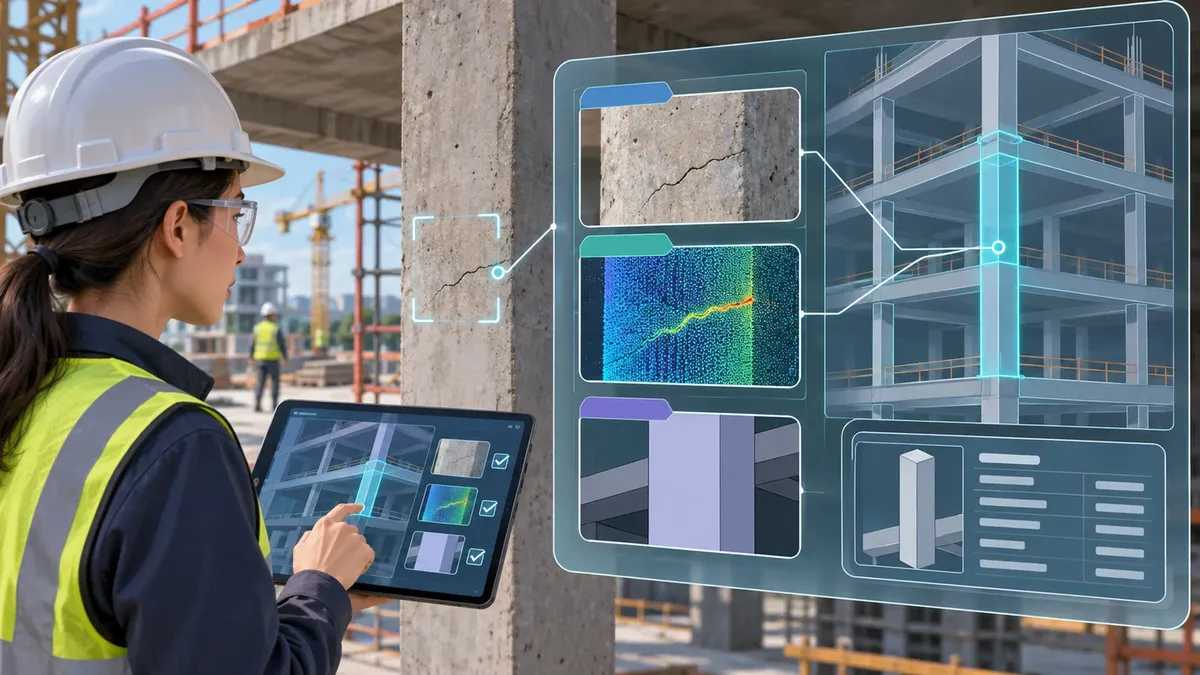
A crack or missing sleeve is useful to a construction team only if it can be connected to the right part of the building. A preprint proposes combining photos, 3D point clouds and design-model information to help make that link—but its evaluation is synthetic, not a test on real construction sites.
On a construction site, spotting a defect is only part of the job. A crack, a misaligned support or a missing sleeve also needs to be tied to the correct building component. That link can matter for locating the problem, checking it against design intent and sending it for review. But similar components may repeat across a site, while equipment, shadows or incomplete scans obscure the evidence.
A preprint by Na Yu proposes an AI system to connect site observations with components in a building information model, or BIM—a digital record of a building’s parts and their properties. The central question is not simply whether a model can recognize damage. It is whether it can associate that evidence with the right component, while indicating how reliable the match appears to be.
Combining photos, scans and design context
The proposed system builds an inspection “window” around a candidate component. It brings together a cropped site image, a local 3D point-cloud patch, BIM attributes such as component type and material, and information about construction stage and evidence quality. The latter includes factors such as image occlusion, point-cloud sparsity and registration error—the mismatch that can occur when aligning a scan with the digital model.
Its point-cloud branch uses PointNeXt to learn local shape and geometric differences between what was built and what the BIM model describes. An adapter adds design attributes to that geometric representation. The idea is that the same apparent deviation may mean different things depending on the component and its role. A fusion stage combines image, geometry, design context and source reliability, then produces a proposed component link, defect category and probability, confidence, evidence judged most important, and a recommended review action.
That output is framed as support for inspection, not an automatic verdict. For example, a weak match might prompt a clearer photograph or a check of the scan alignment rather than an issue being closed or assigned without review.
What the reported tests suggest
The authors evaluated the approach on a synthetic, multisource BIM inspection dataset. It contains 18,000 component-level inspection windows across four broad component groups and five defect categories. The evaluation was designed to include challenges such as occlusion, sparse point clouds, registration errors, repeated layouts and arrangements not seen in training.
According to the paper, the proposed model improved component-association accuracy, defect recall and confidence calibration compared with image-only, point-only, simple-fusion and adapter-free alternatives. The paper also describes ablation tests: removing images weakened recognition of surface damage, removing point-cloud evidence weakened detection of geometric deviations and missing parts, and removing BIM attributes made component association harder. These results support the proposed design within the reported test setup; they do not establish how well it would work on a live project.
The authors identify small, partly hidden and repeated components as difficult cases. They also describe possible false alarms from temporary stains and artificial gaps in sparse scans. These are practical reasons to keep uncertainty visible and retain human confirmation.
Why the evidence is preliminary
The key limitation is the evaluation data: it is synthetic. The paper explicitly calls the dataset a controlled benchmark rather than proof of field readiness and says that testing with real construction-site data remains future work. Synthetic scenes can help researchers vary conditions systematically, but they cannot by themselves show whether a model will cope with the full range of materials, site practices, camera views, changing designs and scan quality encountered in practice.
The paper’s abstract and conclusion report improvements, but the available text does not provide numerical scores for the main model comparisons. That makes it difficult to judge the size of the gains or how much they vary across defect and component types. Results from the synthetic benchmark should therefore be read as an early indication, not a measured promise of site performance.
This work is a preprint, and the source does not establish that it has been peer reviewed. Its claims and methods may change as the work is scrutinized or extended. The authors themselves call for staged field validation, richer BIM attributes, project-specific tolerance rules and expert confirmation—especially when confidence is low.
The broader idea is straightforward: an inspection tool may be more useful when it explains which component it thinks is affected and what evidence supports that choice. Whether this particular system can do so reliably on real projects remains an open question.
- BIM
- construction inspection
- PointNeXt
- point clouds
- defect detection
- artificial intelligence
Reviewed cross-references
These connections were reviewed by a model, not independently fact-checked by a human. Similarity does not imply agreement; consult the original papers and the evidence below.
Why 3D reconstruction needs more than a close fit
Supporting evidence: Both papers suggest that geometric evidence alone is insufficient for engineering interpretation: the BIM defect-association study reports that removing BIM attributes makes component recognition harder, while S2Bench reports a gap between scan coverage and semantic accuracy. The tasks differ—defect association versus scene reconstruction—and the former uses a synthetic dataset, so this is a limited connection, not a direct performance comparison.
Model review: · openai-codex/gpt-6-luna
Evidence and provenance
Selected excerpts, not complete papers. PDF extraction can omit figures or damage equations, tables and reading order; sources may be preprints.
2611.28820v1 — Original paper
Excerpt reference:
static/papers/2611.28820v1.md:115-166
Basis: Paper text
Source SHA-256:e1f888ad49b437c72c371b5d7d7bb1a8c45b8f7dc952beb8a11e7a6ba7e17dfe2611.28820v1 — Original paper
Excerpt reference:
static/papers/2611.28820v1.md:388-450
Basis: Paper text
Source SHA-256:e1f888ad49b437c72c371b5d7d7bb1a8c45b8f7dc952beb8a11e7a6ba7e17dfe2611.28197v1 — Original paper
Excerpt reference:
static/papers/2611.28197v1.md:101-176
Basis: Paper text
Source SHA-256:76446043de9e610f6feb55260e542e28af0ec95d3b14deec0ae7ebebf8ba2769
HighwayVerse Tests AI Across the Inspection Chain
Supporting evidence: The BIM defect-association paper treats component linking and review as distinct from detecting a defect, while HighwayVerse finds that initial anomaly judgments can exceed performance across later diagnostic and maintenance stages. Together they support evaluating inspection beyond initial detection; the studies use different infrastructure settings, methods, and datasets, so they do not establish comparable accuracy.
Model review: · openai-codex/gpt-6-luna
Evidence and provenance
Selected excerpts, not complete papers. PDF extraction can omit figures or damage equations, tables and reading order; sources may be preprints.
2611.28820v1 — Original paper
Excerpt reference:
static/papers/2611.28820v1.md:13-58
Basis: Paper text
Source SHA-256:e1f888ad49b437c72c371b5d7d7bb1a8c45b8f7dc952beb8a11e7a6ba7e17dfe2611.28800v1 — Original paper
Excerpt reference:
static/papers/2611.28800v1.md:200-276
Basis: Paper text
Source SHA-256:549de6f45c6f96e2a568abcbd9ef876e48fbea40702b3c793960cdd9dcc3e54b
Related reading
Automatically matched by shared topic keywords. These links do not imply that the sources agree or establish a consensus.
Why 3D reconstruction needs more than a close fit
Source published
Shared keywords: artificial intelligence
How microscopy corrections can become reusable tools
Source published
Shared keywords: artificial intelligence
Can robot planners think in point clouds?
Source published
Shared keywords: point clouds
FIND helps LiDAR detectors adapt by separating stable shapes from changing sensor patterns
Source published
Shared keywords: point clouds
PruneGround narrows the search for objects in 3D scenes
Source published
Shared keywords: point clouds