TRANSMISSION // 2611.28819v1
When AI Learns from Math’s Lean Translations
Source published
A benchmark study found that training a model on paired research-paper passages and Lean code improved proof completion and agreement with project statements. The results are limited to one setup.
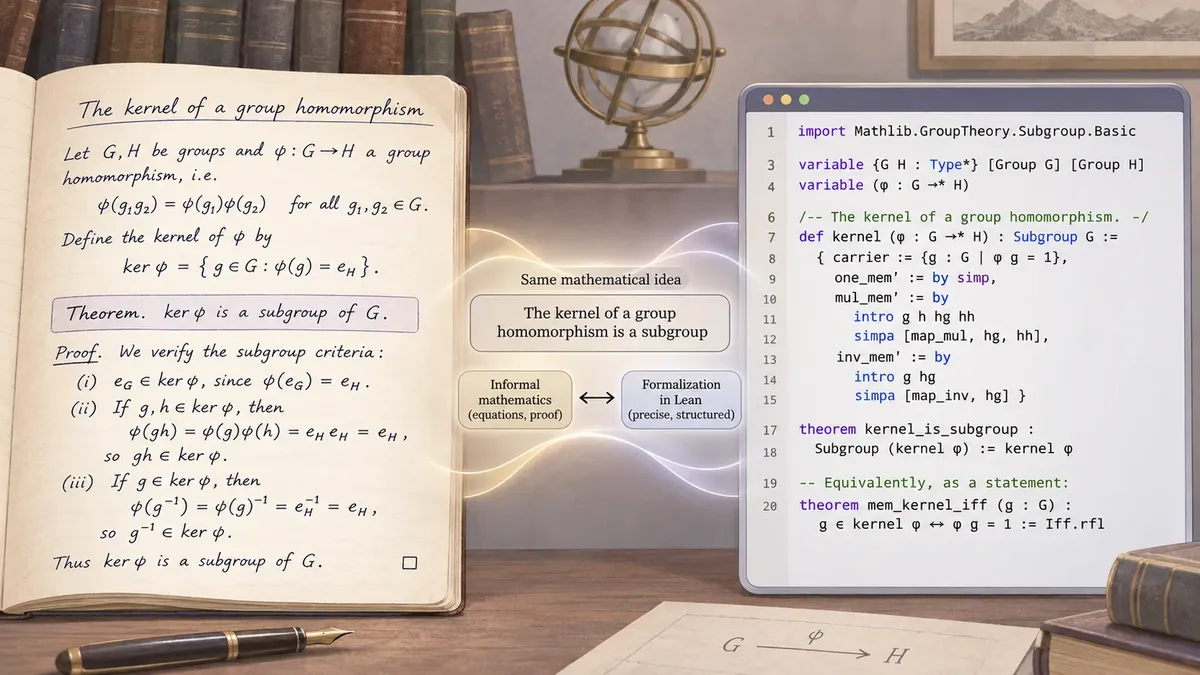
Turning research mathematics into Lean code is not word-for-word translation: libraries and formal-system requirements can lead to different definitions, hypotheses or proofs. A study tested whether examples of those differences help a model write code inside existing research projects.
A Lean formalization can differ from the paper it represents. It may state an assumption explicitly, use a project’s definition, or divide an argument into smaller pieces. So a model’s code can compile without matching the declaration used in the project—or even the mathematical content a reader takes from the paper. Those are distinct questions, and this study evaluates them separately.
The researchers asked whether training on examples pairing informal mathematical sources with Lean declarations would help a model write code inside large research projects. The aim was not just to translate isolated sentences: new code must fit the definitions and conventions already in a project.
Building a benchmark from research projects
The team began with 832 public Lean repositories devoted to research-level mathematics. After auditing them, the researchers retained 171 projects and recorded differences between sources and formalizations. The collection included changes such as altered hypotheses, definitions and proof strategies. The authors expanded these records into paired examples for training and evaluation.
For testing, they held out repositories from fine-tuning. The final benchmark contained 645 tasks from 27 projects. A task asked a model to write a definition, state a theorem, or prove a supplied statement. The prompt provided the project file up to the target declaration and source material, which could include a paraphrase, excerpt and informal argument. Long file prefixes could be shortened; the model was not necessarily given the full paper or full project.
The researchers fine-tuned Qwen3.8-27B with a small LoRA adapter. It learned to produce project declarations from examples centered on source–formalization differences. The comparison included the untuned model and five other models, among them a prover developed specifically for Lean; this was not a controlled comparison of otherwise identical model designs. Models generated one answer per task using greedy decoding, without compiler feedback during generation.
The team checked whether code compiled. For proof tasks, a proof had to compile without a placeholder. For definitions and theorem statements, language-model judges assessed both whether the candidate matched the paper’s content and whether it matched the project’s own declaration. The latter measure, “gold agreement,” was the main measure of agreement with the project formalization. It is not a direct measure of authorial intent, nor does it establish that the project’s version is the only faithful formalization.
Gains on the benchmark, with substantial room to improve
The fine-tuned model’s complete-proof rate rose from 11.2% to 20.4%. Among theorem statements, the share in gold agreement increased from 30.4% to 39.2%. These results apply to the tested benchmark and setup. Even after fine-tuning, most proof tasks were not completed and most theorem statements did not meet the gold-agreement threshold.
Agreement with the paper’s content did not meaningfully improve, while agreement with the project’s declaration did. The authors interpret this pattern as evidence that the adapter learned to reproduce declarations like those in the projects, rather than becoming better at restating the paper. The fine-tuned model also compiled theorem statements slightly less often than the base model, a reminder that compilation and agreement measure different things.
The researchers tested two alternatives. A separate adapter trained to predict categories of differences, without seeing Lean code, did not improve the main measures. Supplying predicted or correct difference labels in prompts also brought no consistent benefit. In this experiment, training directly on paired source material and project declarations worked better than training to name or describe the differences.
What remains uncertain
The benchmark covered 395 declarations from 27 held-out projects, and the authors report wide uncertainty for some task types. Two language-model judges evaluated semantic agreement. On gold-agreement decisions, they agreed 94.0% of the time (κ = 0.84), their overall rates were nearly identical, and the model ranking did not change. This supports consistency between those two judges on this measure; it is not a substitute for human review of every judgment.
The authors also note that the test used one answer per task and no compiler feedback, unlike search-based or agentic workflows. The projects were excluded from fine-tuning, but because they are public, possible exposure during pretraining cannot be ruled out. Only one base model was fine-tuned. And the experiment does not isolate whether selecting examples specifically from places where formalizations depart from sources is important: it lacked a matched training control using ordinary declarations from the same projects.
The paper was presented as a NeurIPS 2026 workshop paper and is available as an arXiv preprint; workshop presentation is not evidence here of broader peer-review consensus. The findings offer a benchmark-specific result, not a general measure of AI’s ability to formalize research mathematics. They suggest that examples of how source material is rendered in a real project can help a model reproduce that project’s Lean declarations, while leaving open how well the approach transfers elsewhere.
- Lean
- formal mathematics
- AI formalization
- theorem proving
- semantic agreement
- research software
Reviewed cross-references
These connections were reviewed by a model, not independently fact-checked by a human. Similarity does not imply agreement; consult the original papers and the evidence below.
FARMS links formal mathematics to computational skills
Supporting evidence: Both studies treat compilation as insufficient by itself to establish semantic fidelity: the origin paper separately scores agreement with a project’s formal statement, while FARMS describes semantic review in addition to compilation. This supports only the bounded point that both workflows use checks beyond compilation; their tasks and evaluation procedures differ, so outcomes are not directly comparable. The evidence comes from selected excerpts of preprints.
Model review: · openai-codex/gpt-6-luna
Evidence and provenance
Selected excerpts, not complete papers. PDF extraction can omit figures or damage equations, tables and reading order; sources may be preprints.
2611.28819v1 — Original paper
Excerpt reference:
static/papers/2611.28819v1.md:172-225
Basis: Paper text
Source SHA-256:b08c32ddcf12641b91c12eceafab29b39e791a7cda268ed71347f404eaa8fd2b2610.40560v1 — Original paper
Excerpt reference:
static/papers/2610.40560v1.md:161-222
Basis: Paper text
Source SHA-256:ff1381f822e28aaa485d83ef7b1dcd7aa39722fee8d90881f37f99c026806229
Related reading
Automatically matched by shared topic keywords. These links do not imply that the sources agree or establish a consensus.
An AI agent tries to formalize a topology textbook, one checked proof at a time
Source published
Shared keywords: formal mathematics, theorem proving
What AI-Written Lean Libraries Look Like
Source published
Shared keywords: formal mathematics
FARMS links formal mathematics to computational skills
Source published
Shared keywords: formal mathematics