TRANSMISSION // 2611.28818v1
Reassessing Kepler’s Habitable-Zone Planets
Source published
A study reanalyses transit data for 187 confirmed and candidate planets in or near the habitable zone, updating their estimated properties and conducting statistical validation to inform follow-up observations.
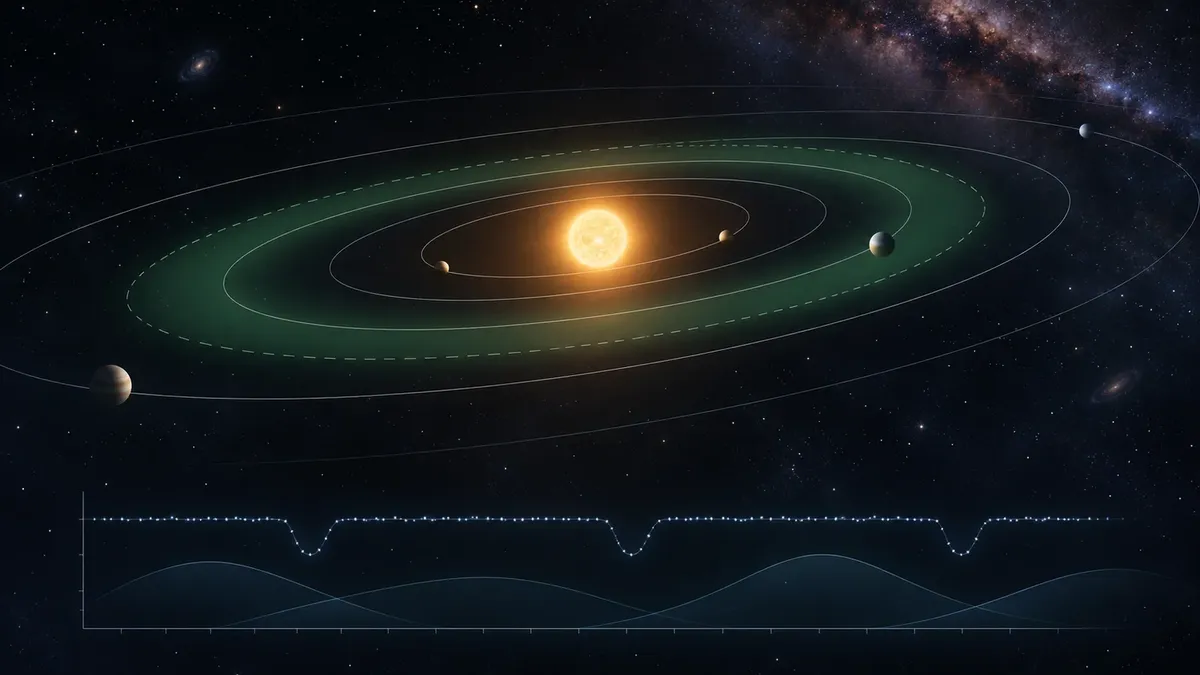
Where are Kepler’s confirmed and candidate planets that lie in or near the habitable zone, and how well are their properties known? A new analysis uses updated stellar measurements to reassess 187 targets and identify observations that could sharpen estimates—without determining whether any world is actually habitable.
The habitable zone is an astronomical way of grouping planets by their location relative to a star. Being in or near this zone does not establish that a planet has a suitable climate, liquid water or life. The study examined 187 confirmed and candidate planets identified by Kepler in this orbital category around Sun-like stars.
Led by Md Abdullah Al Zaman, the team set out to address uncertainties in the properties of these systems and in whether candidate signals represent planets. The authors note that demographic studies of habitable-zone planets are limited by both the size of the available sample and uncertainties in system parameters. Follow-up work on already known targets may improve the information available while larger samples await future surveys.
A uniform analysis of Kepler data
The researchers carried out a homogeneous analysis of transit light curves—the records of changes in a star’s brightness as observed by Kepler. They incorporated updated stellar parameters derived from Gaia’s third data release, Gaia DR3, and report a uniform set of estimated planetary radii, instellation fluxes and orbital ephemerides for the targets.
Instellation flux refers to the stellar energy received by a planet. An orbital ephemeris is information about a planet’s orbit used to predict its transit timing. The study presents these parameters as a resource for prioritizing and scheduling follow-up observations. The abstract does not describe the analysis in enough detail to assess how each quantity was derived or how it changed for individual targets.
The authors also report conducting a statistical validation effort for all targets. The abstract does not explain the validation procedure or provide outcomes for specific candidates. So this account cannot say how many candidates were judged likely to be planets, or how secure any individual planet’s status is.
A possible route to better radius estimates
The abstract highlights systems with orbital periods longer than 300 days as particularly worthwhile targets for transit follow-up. The authors estimate that a single transit observed with a facility such as the 6-m James Webb Space Telescope or the planned 3-m Lazuli space telescope could provide about twice tighter precision on planet radii than four years of Kepler photometry.
That is the authors’ stated estimate for the proposed observations, not a result independently assessed here. The abstract does not give details needed to determine how broadly it applies across targets or observing circumstances. It also does not report specific revised radii or explain how much the estimates changed. Those questions require examination of the full paper and its results.
What this analysis can tell us
The study’s reported contribution is a consistent analysis of 187 confirmed and candidate planets in or near the habitable zone, updated using Gaia DR3-derived stellar parameters, alongside statistical validation efforts. The resulting radii, instellation fluxes and ephemerides are intended to support follow-up and improve understanding of planets in this regime.
These measurements and validation efforts do not establish that any planet is habitable. The work, as summarized in the abstract, concerns planetary parameters and the assessment of targets—not direct evidence about their atmospheres, surface conditions or biology.
This article is based on the abstract available for arXiv:2611.28818v1, not an examination of the full paper. The abstract supports the broad methods and findings described here, but does not provide the detail needed to assess the validation procedure, individual results or the authors’ precision estimate. The source record identifies the work as an arXiv item; the material reviewed here does not establish its peer-review status. Treat the reported catalogue and follow-up estimate as research findings to examine in context, rather than a definitive verdict on the planets or their habitability.
- Kepler
- exoplanets
- habitable zone
- Gaia DR3
- transit light curves
- planetary parameters
- statistical validation
Related reading
Automatically matched by shared topic keywords. These links do not imply that the sources agree or establish a consensus.
A new climate model checks the boundaries of the habitable zone
Source published
Shared keywords: habitable zone
Finding surprising shopping patterns without abandoning statistics
Source published
Shared keywords: statistical validation
Four open clusters mapped on Milky Way orbits
Source published
Shared keywords: gaia dr3
Stellar Accelerations and Jerks Could Help Gaia Find Hidden Black Holes
Source published
Shared keywords: gaia dr3
A close galactic encounter could bend the Large Magellanic Cloud’s bar
Source published
Shared keywords: gaia dr3