TRANSMISSION // 2611.28800v1
HighwayVerse Tests AI Across the Inspection Chain
Source published
HighwayVerse evaluates multimodal AI on highway inspections, from spotting anomalies to selecting maintenance. Models’ scores fell across the chained tasks; a retrieval method improved results in the benchmark.
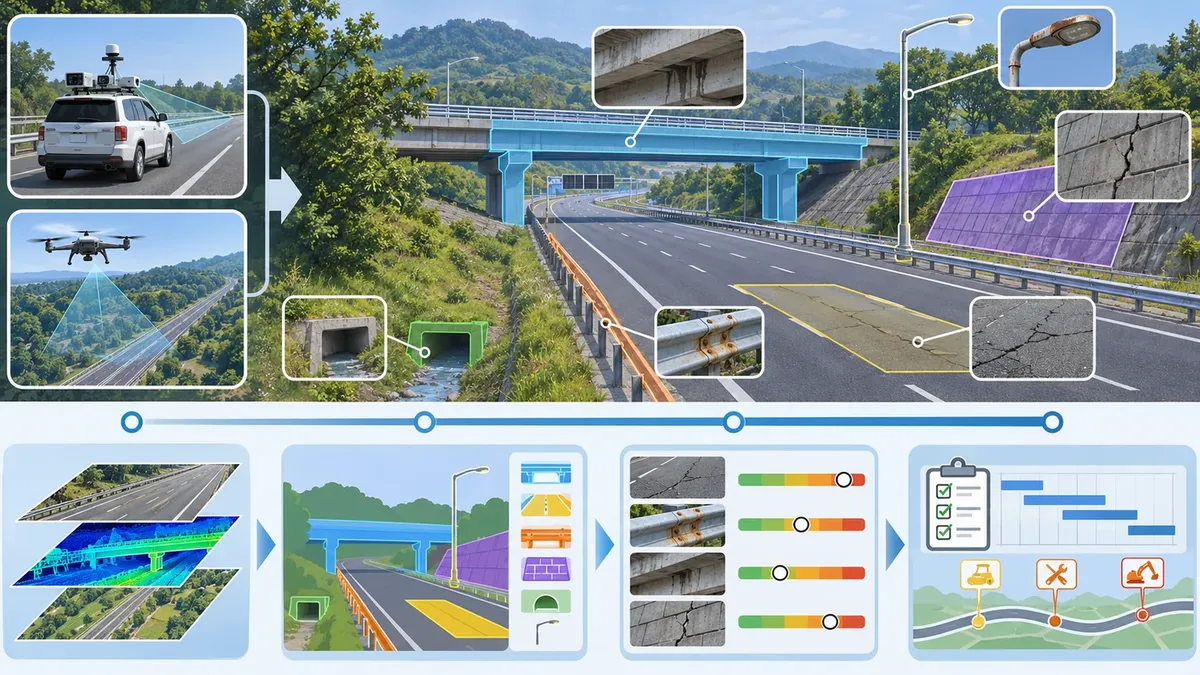
Spotting a possible highway defect is only one part of an inspection. A useful assessment also requires identifying the anomaly, describing its condition and choosing a maintenance response. HighwayVerse tests multimodal AI models across those connected steps using ground-level and aerial inspection images.
Imagine an inspection image showing a possible defect. An inspector would need to establish whether something is wrong, identify what it is, assess relevant details and decide what response fits. HighwayVerse is a benchmark designed to test whether multimodal large language models (MLLMs)—systems that process images and text together—can answer questions across that sequence, rather than only handle isolated visual tasks.
The researchers call the sequence the Highway Infrastructure Inspection Progression Chain, or HIIP-Chain. It has four stages: anomaly detection, anomaly recognition, condition analysis and maintenance resolution. Condition analysis consists of three parallel questions about the anomaly’s location, visible features and risk. The stages are connected: the benchmark’s overall score does not credit a maintenance answer unless the model has also passed specified earlier diagnostic steps.
Inspection records from two viewpoints
HighwayVerse contains 14,143 real-world inspection records collected during six months of routine expressway and highway inspections. Of these, 7,680 are ground-level records spanning 100 anomaly categories, and 6,463 are UAV images spanning 17 categories. These are viewpoint-specific category lists, not a single set of 117 distinct categories. Ground images capture close-up details; UAV images cover wider road corridors, slopes and roadside surroundings.
Each record has six multiple-choice questions across the four stages. Together, the records provide 84,858 question-and-answer pairs. Ten domain-trained annotators spent 400 hours reviewing the questions and answers. The authors report an initial record-level pass rate of 82.3%; uncertain records received additional manual review before inclusion. The category distribution is long-tailed: some anomaly types have many records, while others are rare.
The team evaluated 12 MLLMs: eight open-source and four closed-source models. For the main evaluation, models received images and answer options, but not inspectors’ field metadata or ground-truth annotations. The researchers scored individual questions and introduced an overall chained measure called Final. A model receives credit for maintenance resolution only if it correctly detects the anomaly, identifies its category, answers at least one of the three condition-analysis questions, and selects the correct maintenance option.
This scoring rule is intended to distinguish an isolated correct answer from success that follows the benchmark’s diagnostic prerequisites. For example, a model could correctly guess that an anomaly is present but fail to identify its type. In that case, even a correct maintenance answer would not count toward Final. This describes how the scoring works; it is not a report that the study observed models making a particular kind of recommendation after misdiagnosis.
Scores fall along the chain
Across the evaluated models, accuracy was relatively high on the initial question of whether an anomaly was present, but substantially lower on the chained Final measure. One example reported by the authors is InternVL3.5-8B: on UAV images, it scored 72.48% for anomaly detection and 25.96% for Final. The gap shows that performance on the first question did not reliably extend through the later requirements in this benchmark. The scores measure answers to the benchmark; they do not directly establish what a model internally understands.
The paper also introduces LaneRAG, a retrieval method that supplies relevant labeled reference images alongside the inspection question. It organizes examples in a hierarchy and retrieves references at different levels. The MLLM’s parameters are not updated, although the retrieval system uses offline-trained routers. The authors report an average 2.33% improvement in Overall Final across the evaluated models. They also report larger average gains for open-source than closed-source models. These results describe the tested setup; they do not establish that LaneRAG will improve every model or work equally well in operational inspections.
Limits of the benchmark
HighwayVerse covers more than pavement damage, including infrastructure such as guardrails, glare screens and drainage systems. Its chained scoring makes the order of inspection questions explicit. But it is a benchmark evaluation, not a field trial demonstrating that AI can safely direct highway maintenance. The questions are multiple-choice, and the ground and UAV datasets differ in viewpoint and category composition. Some categories have few records, which the authors note can limit the stability of category-level results. The paper leaves open-ended inspection reporting for future work.
The authors say the dataset, benchmark and code will be publicly released; the supplied paper text does not establish that they are already available. This article is based on an arXiv preprint, which may not have been peer reviewed. Its findings should therefore be read as reported benchmark results, not as evidence of real-world deployment or validated maintenance decisions.
- HighwayVerse
- multimodal AI
- highway inspection
- infrastructure anomalies
- LaneRAG
- AI benchmark
Reviewed cross-references
These connections were reviewed by a model, not independently fact-checked by a human. Similarity does not imply agreement; consult the original papers and the evidence below.
A lab AI benchmark finds a gap between seeing a procedure and locating where to act
Supporting evidence: Both benchmark studies report a gap between comparatively coarse initial or procedural judgments and more demanding downstream decisions: HighwayVerse finds MLLMs’ chained highway-inspection scores fall well below anomaly-detection accuracy, while BEAKER finds models can follow coarse video procedures yet struggle with action grounding and mid-length step ordering. This is a bounded parallel, not a direct comparison: the domains, tasks, models, and evaluation measures differ, and BEAKER is an offline, single-turn benchmark rather than a test of closed-loop execution.
Model review: · openai-codex/gpt-6-luna
Evidence and provenance
Selected excerpts, not complete papers. PDF extraction can omit figures or damage equations, tables and reading order; sources may be preprints.
2611.28800v1 — Original paper
Excerpt reference:
static/papers/2611.28800v1.md:200-276
Basis: Paper text
Source SHA-256:549de6f45c6f96e2a568abcbd9ef876e48fbea40702b3c793960cdd9dcc3e54b2611.28800v1 — Original paper
Excerpt reference:
static/papers/2611.28800v1.md:343-418
Basis: Paper text
Source SHA-256:549de6f45c6f96e2a568abcbd9ef876e48fbea40702b3c793960cdd9dcc3e54b2611.06911v1 — Original paper
Excerpt reference:
static/papers/2611.06911v1.md:106-157
Basis: Paper text
Source SHA-256:ab7d81704d93dec61524a415d4d6c06cc626bf0a9187f1cae3cdfb07ca80f1fa2611.06911v1 — Original paper
Excerpt reference:
static/papers/2611.06911v1.md:1214-1271
Basis: Paper text
Source SHA-256:ab7d81704d93dec61524a415d4d6c06cc626bf0a9187f1cae3cdfb07ca80f1fa
Related reading
Automatically matched by shared topic keywords. These links do not imply that the sources agree or establish a consensus.
Can AI recognize a building across photos and plans?
Source published
Shared keywords: ai benchmark, multimodal ai
How MVAgent coordinates AI to understand multiple videos
Source published
Shared keywords: multimodal ai
When AI Rebuilds a Document, Looking Right Is Not the Same as Being Right
Source published
Shared keywords: multimodal ai
What a visual AI benchmark reveals about confidence
Source published
Shared keywords: multimodal ai
Giving Wearable AI a Measurable 3D View
Source published
Shared keywords: ai benchmark