TRANSMISSION // 2611.28732v1
Can a Robot Learn a New Task by Watching One Video?
Source published
Entangle trains a robot to use a human demonstration video as a task guide. Tests show promise on unseen tasks, but the evidence remains limited.
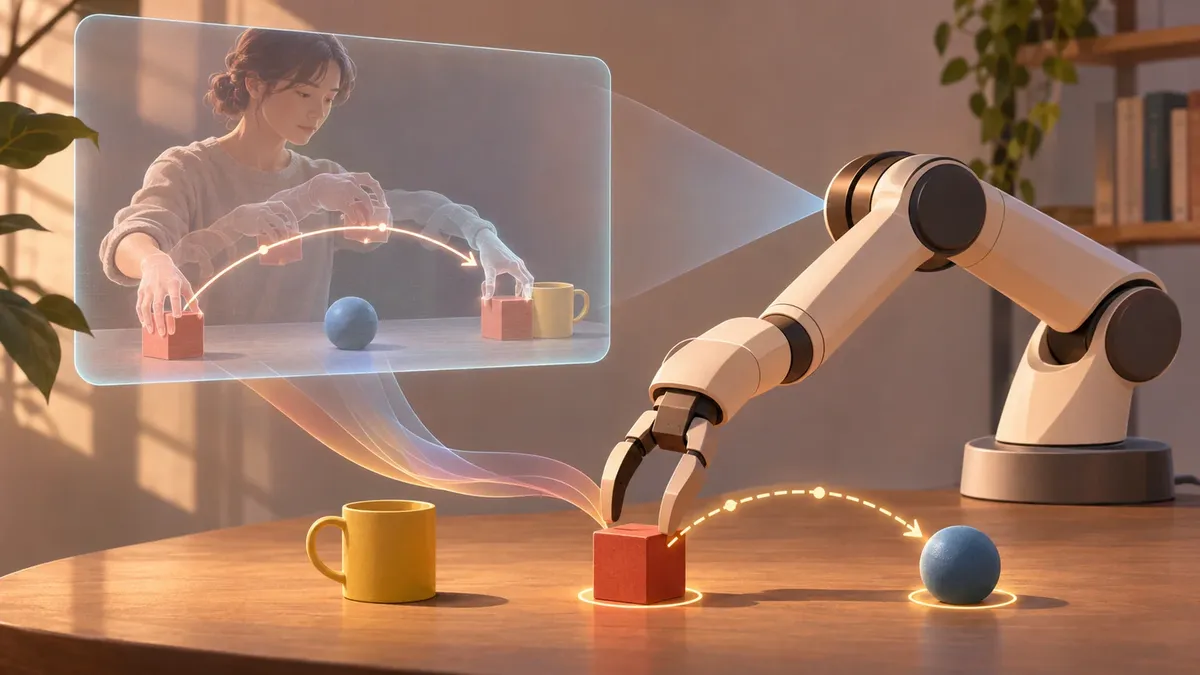
A video can show more than what a person wants done: it can show the order, path and manner of doing it. Entangle is a robot-learning system designed to use that detail while keeping its model weights fixed during a new task.
A spoken instruction such as “put the blocks in order” may leave out which block goes where or what path to take. A short video can make those details visible. Entangle, a world-action model described in an arXiv preprint, asks whether a robot can use one human video to carry out an unfamiliar manipulation task—without updating its model parameters for that task.
The challenge is getting a robot to follow the specific procedure shown, not merely recognize the general goal. If training examples pair a human video and a robot run only because they share a task label, their motions may differ in timing and path. And when several ways to complete a task are acceptable, a robot may learn to identify the task from the objects or starting scene rather than track the demonstration’s sequence.
Building paired examples
Entangle takes a human demonstration and the robot’s current camera observations as input. It predicts both what the robot’s surroundings will look like next and a sequence of executable actions. During deployment, it keeps the same video as context, executes part of its prediction, observes the result and plans again.
The researchers assembled 21,269 paired episodes: about 5,300 real pairs and about 16,000 synthetic pairs, according to the paper. For real pairs, people reenacted robot trajectories in the same workspace, trying to match the camera viewpoint and movement timing. For synthetic pairs, a video-generation pipeline replaced the robot’s visible arms with human hands while using the original robot video as a motion reference. A vision-language model screened generated clips for visual quality and agreement with the source trajectory. That screening is a quality-control step, not proof that every accepted clip is perfectly aligned.
The model learns to predict future video and actions together. Its training also includes a contrastive objective: it favors the robot action trajectory paired with a particular video over other trajectories for the same task. In plain terms, this is meant to discourage the robot from settling for “a way to do this task” when the video shows a particular way. Training uses video windows of different lengths. On the real robot, the system shortens its action execution when its internal attention to the reference appears weak, then replans from fresh observations. The authors describe this shortening rule as a heuristic, not a calibrated measure of confidence.
What the tests found
On a physical Astribot S1 robot, the authors tested six tasks they say were absent from the model’s pretraining and continued-training data. These included stacking blocks in a specified order, tracing letters with a computer mouse, wringing a towel and moving an object through a required opening. Without task-specific fine-tuning, Entangle earned an average score of 83.5 out of 100 across the six tasks, using graded task rubrics and 10 trials per task and configuration.
In the RoboTwin simulator, the model was adapted to the simulator using 43 training tasks and evaluated on seven held-out tasks. Its average success rate was 69.52%, compared with 46.95% for Zero-WAM under the paper’s reported protocol. This is a benchmark result, not evidence that the robot can handle arbitrary household tasks.
The authors also tested changes to layouts and objects, despite training on scene-aligned pairs. They report examples including using a banana to sweep a block into a box, and transferring a wiping interaction from a picture frame to a stand. These cross-context results are qualitative demonstrations; the paper says broader quantitative evaluation is needed. They should not be read as a measured success rate across a wide range of substitutions.
Ablations—tests that remove or alter parts of the system—support the importance of the design choices in these experiments. On the real robot, removing strict video-to-robot pairing, the contrastive objective, mixed-length windows or adaptive replanning each reduced the average score. That shows these components mattered in the tested setup; it does not establish that the same recipe will help every robot or task.
What remains uncertain
This is a preprint, so its findings have not necessarily been peer reviewed. The physical-robot evaluation uses one robot embodiment, and the synthetic data depends on generated videos faithfully preserving motion and interaction. The authors call for more reliable data generation, tests across robot types and stronger evaluation of context transfer. Simulator results also depend on the benchmark’s task definitions and success checks; passing a simulated test is not the same as safe, reliable performance in an uncontrolled home.
Entangle’s central idea is practical: let people specify not only a goal but a procedure by showing it. The reported results suggest that closely matched training videos and robot actions can help a model attend to that procedure. Whether this approach scales beyond the tested robots, tasks and scenes remains an open question.
- robotics
- robot learning
- human video
- in-context learning
- world-action models
- robot manipulation
Reviewed cross-references
These connections were reviewed by a model, not independently fact-checked by a human. Similarity does not imply agreement; consult the original papers and the evidence below.
A robot's-eye view, generated from outside video
Supporting evidence: Both papers report benefits from generated visual data for robot learning: Entangle pairs robot trajectories with temporally matched, generated human demonstrations, while AuroraWorld synthesizes egocentric observations for policy training. Their results support the bounded possibility that generated video data can aid manipulation policies, but the generated inputs, training roles, benchmarks and evaluations differ, so they do not establish a directly comparable effect.
Model review: · openai-codex/gpt-6-luna
Evidence and provenance
Selected excerpts, not complete papers. PDF extraction can omit figures or damage equations, tables and reading order; sources may be preprints.
2611.28732v1 — Original paper
Excerpt reference:
static/papers/2611.28732v1.md:206-278
Basis: Paper text
Source SHA-256:e44af2e81021a7eb6e6ee9d2e22f158d5c07ae4f7be2fdf5193da10264118b002611.28732v1 — Original paper
Excerpt reference:
static/papers/2611.28732v1.md:83-131
Basis: Paper text
Source SHA-256:e44af2e81021a7eb6e6ee9d2e22f158d5c07ae4f7be2fdf5193da10264118b002611.00177v1 — Original paper
Excerpt reference:
static/papers/2611.00177v1.md:902-1021
Basis: Paper text
Source SHA-256:51fa1c602592723ce01037eb0349bc8a528b48be281a4916ec37096c8fc249ae
A robot plan that knows what remains—and when to consult a demonstration
Supporting evidence: Both papers report robot policies using human demonstrations as context to guide manipulation. Entangle conditions a world-action model directly on one human video and reports results on unseen tasks; JEPA-ICL uses progress-aligned plans to retrieve relevant demonstration stages and reports gains in its own simulation evaluations. This supports the limited proposition that demonstration context can guide execution, not that either method’s mechanism or performance transfers to the other’s settings.
Model review: · openai-codex/gpt-6-luna
Evidence and provenance
Selected excerpts, not complete papers. PDF extraction can omit figures or damage equations, tables and reading order; sources may be preprints.
2611.28732v1 — Original paper
Excerpt reference:
static/papers/2611.28732v1.md:83-131
Basis: Paper text
Source SHA-256:e44af2e81021a7eb6e6ee9d2e22f158d5c07ae4f7be2fdf5193da10264118b002611.28732v1 — Original paper
Excerpt reference:
static/papers/2611.28732v1.md:550-613
Basis: Paper text
Source SHA-256:e44af2e81021a7eb6e6ee9d2e22f158d5c07ae4f7be2fdf5193da10264118b002611.30516v1 — Original paper
Excerpt reference:
static/papers/2611.30516v1.md:82-172
Basis: Paper text
Source SHA-256:addb8cbc619029faa27aa9504299bdaeb9f10bc3987343bf3d4bd044d93d8adb2611.30516v1 — Original paper
Excerpt reference:
static/papers/2611.30516v1.md:636-707
Basis: Paper text
Source SHA-256:addb8cbc619029faa27aa9504299bdaeb9f10bc3987343bf3d4bd044d93d8adb
Related reading
Automatically matched by shared topic keywords. These links do not imply that the sources agree or establish a consensus.
A robot plan that knows what remains—and when to consult a demonstration
Source published
Shared keywords: in context learning, robot learning, robot manipulation
Teaching a robot model to predict what its actions will change
Source published
Shared keywords: robot learning, robot manipulation, world action models
Can a general AI model control a robot arm?
Source published
Shared keywords: robot learning, robot manipulation
Teaching Robot AI to Focus on Motion, Not Scenery
Source published
Shared keywords: robot learning, robot manipulation
How MAWAM imagines teamwork for robots
Source published
Shared keywords: robot manipulation, world action models