TRANSMISSION // 2611.28726v1
Why seeing a puzzle isn’t the same as planning it
Source published
In a railway-puzzle benchmark, models often struggled to build layouts that worked. Tests of one model found that reading boards and predicting movement were much stronger than planning or repairing a complete layout.
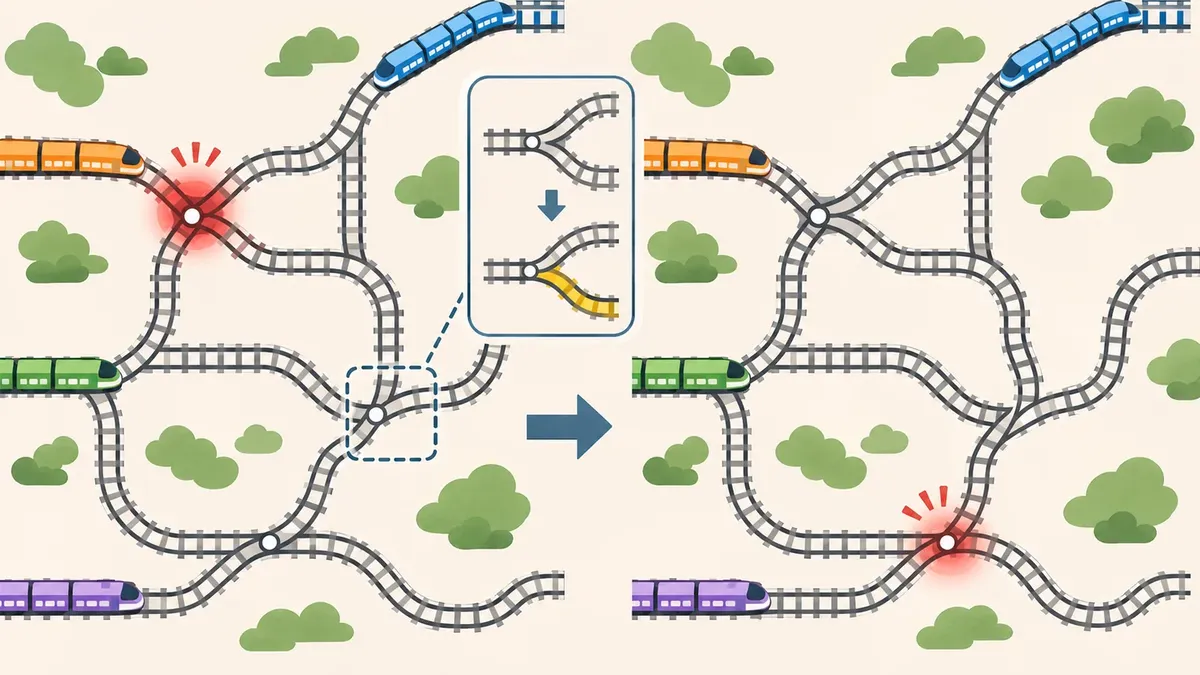
Planning in a changing visual world takes more than recognizing what is there: a model must anticipate how moving parts interact, follow the rules and produce a plan that works as a whole. Railbound-Bench tests those abilities—and whether models can use feedback to recover when a plan fails.
A railway puzzle with a moving target
A railway layout can look sensible and still fail once the cars start moving. One track may send a car toward its station but block another, trigger a collision or disrupt delivery order. That makes railway puzzles a useful test of a specific question: can a multimodal AI model read a visual scene, anticipate what will happen and combine those predictions into a plan that works? If the plan fails, can it use the evidence to repair it?
In Seeing Is Not Planning, Siyuan Li and colleagues introduce Railbound-Bench, a collection of railway puzzles judged by a simulator. A model sees a board and its rules, adds track pieces within a budget, then submits one complete layout. The simulator moves all cars at once and checks whether the layout meets the rules. After a failure, the model can try again, up to five answers total. Unlike an interactive game, the model cannot change its plan while the cars are moving.
The benchmark includes 200 newly designed, difficult puzzles and a separate set of 1,000 puzzles spanning a wider range of difficulty. The authors also use 180 puzzles from the larger set for controlled tests of one model, GPT-6.1 Terra. These tests examine board reading, movement prediction, rule knowledge, plan construction and repair. A search solver checks layouts and estimates puzzle difficulty; it does not create the models’ answers.
Strong at reading; weaker at combining
On the 200-puzzle main set, the top model, GPT-6.1 Sol, solved 59.5% within five answers. The next model solved 39.5%, while the other seven solved at most 10%. Results were higher on the broader set: GPT-6.1 Sol solved 90.9% of its 1,000 puzzles within five answers. The sets differ in difficulty, so these scores describe performance on particular benchmark collections, not a universal measure of planning ability.
The controlled tests of GPT-6.1 Terra help explain why reading the board is not enough. On the 180-puzzle panel, it copied 97.2% of boards exactly. Given a correct layout as text, it predicted all four requested future states in 91.3% of cases. Yet only 22.8% of its first layouts worked. Providing an exact text description of the board raised first-attempt success to 24.3%, a change the study could not clearly distinguish from zero.
The gap appears when a model must choose tracks that work together. Cars may share rails, approach from opposite directions or affect one another’s timing through stations and switches. Across puzzles with similar search-solver effort, greater route interaction was associated with lower success. This is an association in the benchmark analysis, not proof that route interaction alone causes failure. Models also failed in different ways: some struggled with derailments or invalid answers, while stronger performers more often encountered conflicts between cars or delivery order.
Repairing a fault may leave the plan broken
Feedback helped GPT-6.1 Terra address the immediate failure in the controlled panel, but that did not reliably produce a working layout. Visual feedback removed the reported fault in 175 of 417 first revisions. Only 43 of those revisions solved the puzzle; 132 removed the observed fault but failed somewhere else. A local change could shift a conflict rather than resolve the whole layout.
The authors also compared feedback with generating fresh attempts at an equal budget of 40,000 tokens per puzzle. Success was 39.1% with visual feedback and 40.6% with fresh retries. The estimated difference was uncertain, so the study does not establish that either approach is superior at that budget.
The results distinguish several abilities: recognizing a board, predicting how a given layout runs, constructing a successful layout and repairing the whole plan. A system meant to plan in changing environments may need to check a candidate plan against its combined effects before committing, rather than relying only on local corrections after failure.
What the evidence can—and cannot—show
Railbound-Bench uses simulator-checked tests, and the authors have released the puzzles, simulator, solver and evaluation code. But its conclusions are bounded by its design. The controlled diagnostics use one model; other models may have different strengths and weaknesses. The puzzles come from one game-inspired domain, and the simulator differs from the original game in two rules. The study did not measure human performance, and its difficulty labels reflect one solver’s search effort—not how hard puzzles are for people or AI models.
The paper is an arXiv preprint, so its findings should be treated as research claims rather than settled conclusions. The results show a gap within this benchmark, not that AI models cannot plan in every visual or real-world setting. Whether the same pattern holds in settings such as robotics or traffic management remains an open question.
- multimodal AI
- spatiotemporal planning
- plan repair
- Railbound-Bench
- visual reasoning
- AI benchmarks
Reviewed cross-references
These connections were reviewed by a model, not independently fact-checked by a human. Similarity does not imply agreement; consult the original papers and the evidence below.
DualWorldBench tests whether AI agents can turn delivery goals into workable plans
Supporting evidence: Both studies report a gap between local visual or task understanding and producing a globally feasible plan: in Railbound-Bench, GPT-6.1 Terra copied boards accurately and predicted provided layouts well but often failed to construct a working one; DualWorldBench reports that perception and topology understanding do not necessarily yield constrained, feasible delivery plans. This supports that bounded observation across these benchmarks, not a direct performance comparison: the tasks, models, and evaluation measures differ.
Model review: · openai-codex/gpt-6-luna
Evidence and provenance
Selected excerpts, not complete papers. PDF extraction can omit figures or damage equations, tables and reading order; sources may be preprints.
2611.28726v1 — Original paper
Excerpt reference:
static/papers/2611.28726v1.md:197-265
Basis: Paper text
Source SHA-256:41cb6c0b9ce743b727a8dd8c3ddf02c5555e223cebdb3f3cccbc781904b6aa2a2611.04228v1 — Original paper
Excerpt reference:
static/papers/2611.04228v1.md:110-156
Basis: Paper text
Source SHA-256:b83b30bd8727e10989e8112e495c7d07421814a201e4d8cd49cac4b9da485060
Related reading
Automatically matched by shared topic keywords. These links do not imply that the sources agree or establish a consensus.
A second look may help AI connect images and questions
Source published
Shared keywords: ai benchmarks, multimodal ai, visual reasoning
What a visual AI benchmark reveals about confidence
Source published
Shared keywords: ai benchmarks, multimodal ai, visual reasoning
Can AI Models Think in Pictures, Not Just Words?
Source published
Shared keywords: multimodal ai, visual reasoning
MMCOMET gives commonsense knowledge a visual anchor
Source published
Shared keywords: multimodal ai, visual reasoning
AI can read an image yet struggle to reason about it
Source published
Shared keywords: multimodal ai, visual reasoning