TRANSMISSION // 2611.28671v1
Why the computing setup can change an AI team’s score
Source published
MASSYS tests how multi-agent AI workflows perform across serving systems and workload pressure, measuring answer quality alongside delivery and runtime.
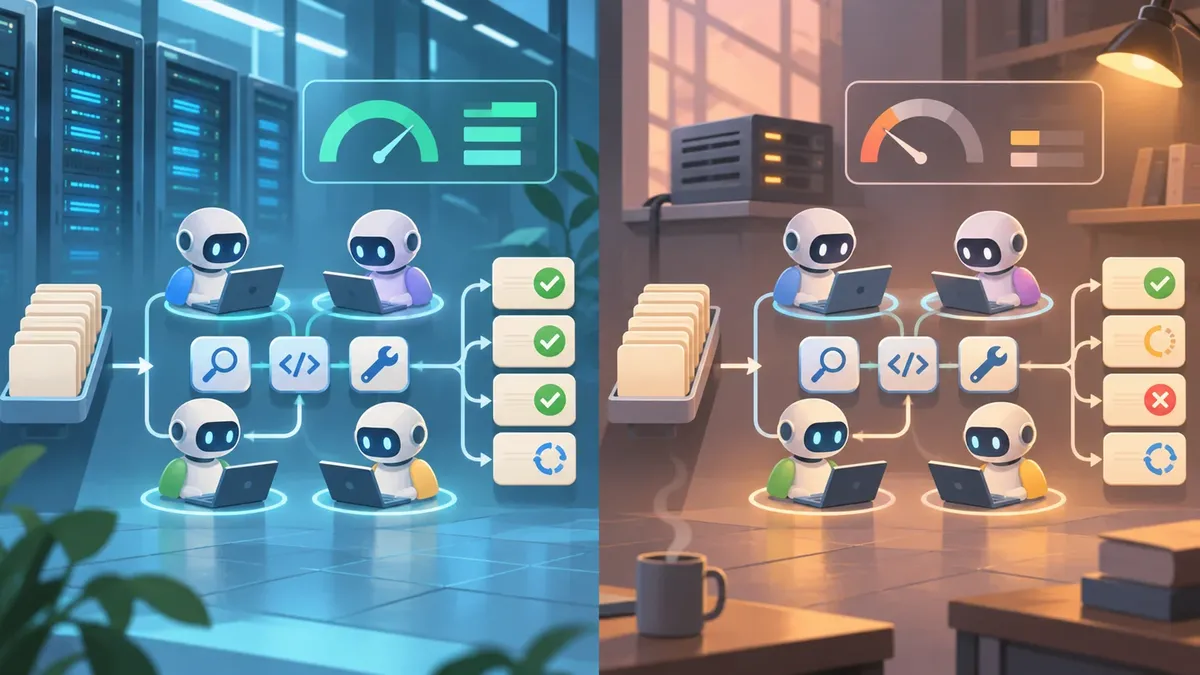
An AI workflow can look fast in one computing setup and struggle in another. A preprint introducing MASSYS argues that evaluations should measure not only the quality of completed answers, but also whether jobs finish under specified operating conditions.
The benchmark is part of the system
When several AI agents work together, one might plan, another search or write code, and a third check the result. Their performance depends on more than models and prompts: it can also depend on the software and hardware serving them, the workload arriving at the same time, and how requests are queued or timed out.
That raises a practical question: if the agents and tasks stay the same, can changing the computing setup change which workflow seems fastest—and how often useful results arrive? A preprint by Haoyuan Zheng and colleagues introduces MASSYS, a benchmark designed to examine that dependence. Its central point is that a benchmark result describes a system operating under particular conditions, not a workflow in isolation.
Holding work steady, varying the setup
MASSYS runs the same task-and-workflow combinations across serving setups and load levels. Its five task families cover software repair, research synthesis, financial analysis, interactive control, and diagram generation. Candidate workflows include different ways of organizing agents, such as chains and star-shaped arrangements.
The benchmark records both task outcomes and service behavior: whether a job finishes, whether it produces a usable result, how long it takes, and what traces show about tool calls, queue waits, resource pressure, and failures. This distinction matters: a job that never delivers an answer is not useful merely because completed jobs score well.
The paper combines broad benchmark sweeps with a separate controlled diagnostic. That diagnostic used five fixed workflows processing the same synthetic telemetry context, with the model and workflow definitions held constant while serving constraints changed. It was not a test of the heterogeneous benchmark tasks or the PlanAgent-generated candidates used in the main sweeps. Under a cache-constrained condition, Star’s mean-latency ranking fell from first to fourth, while Chain rose from fourth to first. This illustrates how a speed ranking can depend on serving conditions.
Load can mean fewer delivered answers
Across the broader tests, higher offered load was associated with longer runtime tails and increased timeout pressure. Effects varied among serving setups and task families; the authors do not identify one backend as best on every measure. A system may be relatively fast among jobs that finish while completing fewer jobs overall.
That difference affects measured quality. “Evaluated-only” quality describes jobs that produced outputs and received scores. “Effective” quality in the paper also accounts for jobs that failed to deliver: unsuccessful or unevaluated submissions count as zero. In some task families, the scores of surviving outputs changed less than effective quality as load increased. In other words, completed answers could remain competitive even as fewer submitted jobs yielded usable results.
The authors audited 3,255 submissions from the original benchmark runs. Of 492 jobs without valid scores, 490 were classified as skipped following execution failure or deadline termination; two encountered evaluation failures after successful execution. In these runs, missing scores were overwhelmingly associated with delivery problems. That does not establish the cause of every failure, or imply that missing answers in other benchmarks have the same explanation.
Traces also point beyond model generation: queueing, tool execution, and orchestration overhead can contribute to runtime, with their relative importance changing under load. The benchmark therefore measures the execution path, including tools and coordination, as part of system performance.
What the results can—and cannot—show
MASSYS is a measurement framework, not a universal ranking of agent designs. Its results depend on the tasks, workflow candidates, serving cells, hardware, and scoring methods included. The study covers five task families and a finite set of serving setups; it does not capture every real deployment, particularly long-running enterprise work, human-in-the-loop tasks, or safety-critical settings.
The traces provide evidence about possible failure modes but do not always isolate root causes when problems interact. Some task scores rely on judge models, which may introduce evaluator bias; other tasks use benchmark-specific checks. Additional workload seeds provide evidence about variability, but the results still apply to the tested configurations rather than establishing a universal ordering of systems.
This work is an arXiv preprint, so its claims should be treated as provisional, not as peer-reviewed conclusions. The paper links code and trace data, which may support inspection and reproduction, but independent replication and broader testing are needed to assess generality. The practical takeaway is specific: evaluations of multi-agent AI should report operating conditions, successful delivery per submission, and evidence about where execution breaks down—not only the quality or speed of outputs that completed.
- multi-agent AI
- AI benchmarks
- LLM serving
- latency
- AI systems evaluation
- MASSYS
Reviewed cross-references
These connections were reviewed by a model, not independently fact-checked by a human. Similarity does not imply agreement; consult the original papers and the evidence below.
Why AI agents need a different approach to saving GPU power
Supporting evidence: Both studies indicate that memory and context conditions can shape agent-serving performance: MASSys reports latency-rank changes under KV-cache pressure and longer runtime tails under load, while KAIROS reports that growing context and reduced GPU frequency can trigger memory thrashing. These are complementary, not directly comparable tests: MASSys evaluates multi-agent benchmark workflows across serving conditions, whereas KAIROS studies power control for agentic serving on its evaluated setups.
Model review: · openai-codex/gpt-6-luna
Evidence and provenance
Selected excerpts, not complete papers. PDF extraction can omit figures or damage equations, tables and reading order; sources may be preprints.
2611.28671v1 — Original paper
Excerpt reference:
static/papers/2611.28671v1.md:15-72
Basis: Paper text
Source SHA-256:1df800c9623818e43bda46aa38de2a383d112f2f5d0e96c422e6b26a1be9b3512611.28671v1 — Original paper
Excerpt reference:
static/papers/2611.28671v1.md:1391-1442
Basis: Paper text
Source SHA-256:1df800c9623818e43bda46aa38de2a383d112f2f5d0e96c422e6b26a1be9b3512604.16682v2 — Original paper
Excerpt reference:
static/papers/2604.16682v2.md:107-162
Basis: Paper text
Source SHA-256:e57e0dc5c45979fab4aac1cb92293a643ed60fb8438ca2fa5db76b2fec5527532604.16682v2 — Original paper
Excerpt reference:
static/papers/2604.16682v2.md:468-555
Basis: Paper text
Source SHA-256:e57e0dc5c45979fab4aac1cb92293a643ed60fb8438ca2fa5db76b2fec552753
Related reading
Automatically matched by shared topic keywords. These links do not imply that the sources agree or establish a consensus.
ServerBench tests whether coding agents can build better LLM serving systems
Source published
Shared keywords: llm serving
Keeping the right conversation in memory could make AI chatbots faster
Source published
Shared keywords: llm serving
AMD’s InferaSim predicts which LLM serving setups are worth testing
Source published
Shared keywords: llm serving
ForeSpark schedules both AI guesses and checks
Source published
Shared keywords: llm serving
Testing NoeVera’s evidence loop for LLM serving
Source published
Shared keywords: llm serving