TRANSMISSION // 2611.28618v1
Can Visual AI Learn from Four Histories?
Source published
A preprint reports that four selected interaction histories improved visual-agent performance on several simulated benchmark panels, while noting limits in scope and evaluation.
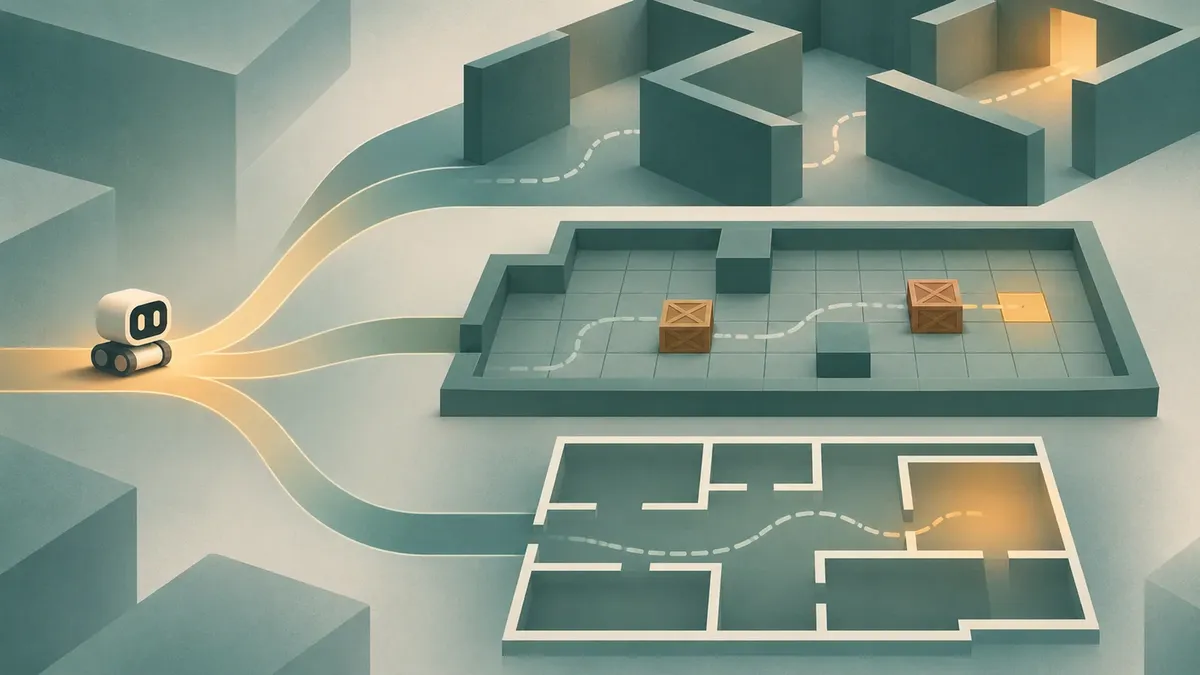
Training an AI agent through interaction can be costly. This study tests whether a smaller visual agent can learn from a few selected histories or from fresh interaction on a limited set of tasks—and how well those approaches perform on the paper’s benchmark evaluations.
The question: how much experience helps?
Visual agents use images and feedback to make decisions over multiple steps. An action changes what they see next, so training on recorded sequences may not prepare an agent for every situation it encounters. In this arXiv preprint, Siyu Zhou and colleagues compare learning from a small set of recorded histories with learning through fresh interaction on a restricted set of tasks. They ask whether either approach supports transfer on specified navigation, puzzle and mapping evaluations.
The authors compare two forms of on-policy distillation (OPD), in which a smaller student learns using a stronger teacher. In fixed-history replay, the student generates new responses at old visual decision points, and the teacher scores those responses. The student’s new actions are not carried out, so this training stage produces no fresh environment observations. In online OPD, the student acts in persistent environments and training uses teacher supervision under the online protocol. The paper describes asynchronous interaction, including up to one update of policy lag; this is not simply replay’s fixed-prefix procedure applied to newly generated responses.
How histories are selected and tested
The experiments use simulated visual navigation, Sokoban puzzles and SpatialGym mapping. The team begins with trajectories from an unadapted student. An annotation process builds a skill–context inventory and labels opportunities across training trajectories; that process can use complete trajectories and outcomes. Separately, visual-decision descriptions are restricted to information available before the response at each turn. A selector prioritizes coverage of different skill–context combinations, then similarity between ordered sequences of described decisions.
These annotations guide which trajectories are selected, but they are not added to the student’s or distillation teacher’s prompts. The models receive the original visual histories. In replay, those histories include earlier responses, while the newly generated actions are not executed.
The researchers adapt Qwen3.5-4B and Qwen3.5-9B students using a frozen Qwen3.5-27B teacher. Comparisons include online OPD, supervised fine-tuning (SFT) on teacher responses, and different history or task budgets. Navigation and Sokoban are measured by success rate; SpatialGym uses a composite mapping score. Main results are reported at update 100 and average four evaluation repeats per task.
Results on the reported panels
On the original standard Navigation panel, replay with four selected trajectories raised the 4B student’s success rate from 49.17% to 82.08%. On Sokoban, it rose from 60.16% to 85.55%. The authors calculate that these gains recover 91.86% and 90.28% of the measured initial-student-to-teacher gaps on those panels. Those ratios describe these particular scores; they do not show that the student generally matches the teacher.
Four-history replay also improved the 4B student’s SpatialGym scores on held-out single-room and two-room evaluations. However, the four held-out rooms were also used for monitoring, so they are not an untouched test set. On a separate Navigation panel, replay increased success from 45.83% to 76.67%. This is 91.36% of the same-task online method’s measured gain, calculated from point estimates. It is not evidence that replay and online training are statistically equivalent.
Online training on a single task also produced gains on several tested evaluations. Results depend on the task and measure: for example, online OPD scored higher than four-history replay on two-room mapping. Across the five 4B panels in the main table, replay OPD scored higher on the two Navigation panels; online OPD scored higher on Sokoban and both SpatialGym panels. SFT also improved performance, but its results varied by panel and method.
What remains uncertain
The evidence covers a limited set of simulated environments, models and evaluation panels. The authors say core results include single training runs and panels inspected during development. Additional Navigation training repetitions provide some evidence beyond a single run, but several supplementary aggregates—including the independent Navigation results—are collaborator-reported; the paper says their raw training logs and per-episode records were not locally audited. Reported uncertainty intervals condition on fixed trained models and the inspected evaluation panel. They do not capture variation from training, data collection, annotation or selection. With only four SpatialGym held-out rooms, the authors caution that population-level uncertainty is difficult to estimate.
“Four trajectories” refers to the selected histories, not the full cost of creating the training data. Candidate trajectories still have to be collected and annotated. Reported token counts omit costs such as collection, annotation and evaluation, and the paper does not provide end-to-end GPU-hour or API-cost accounting. The experiments also do not establish why the selection method helps: similarity between text descriptions does not itself prove that relevant visual states are covered. The authors explicitly note that the selection procedure does not provide a guarantee of performance.
This is an arXiv preprint, not a peer-reviewed publication. Its findings suggest that compact histories can be useful on the specified benchmark panels, but the reported evidence does not establish broad transfer to varied or real-world settings.
- visual AI agents
- on-policy distillation
- knowledge distillation
- trajectory selection
- simulated environments
- AI training
Related reading
Automatically matched by shared topic keywords. These links do not imply that the sources agree or establish a consensus.
Why language-model students can struggle to learn from teachers
Source published
Shared keywords: ai training, knowledge distillation, on policy distillation
Teaching Small Vision Models What to Notice
Source published
Shared keywords: ai training, knowledge distillation, on policy distillation
Can a checklist help an AI model learn from a text-only teacher?
Source published
Shared keywords: ai training, knowledge distillation
A Two-Way View of Teaching Language Models
Source published
Shared keywords: knowledge distillation, on policy distillation
Can recurrent models learn more from stronger AI teachers?
Source published
Shared keywords: knowledge distillation, on policy distillation