TRANSMISSION // 2611.28603v1
Can recurrent models learn more from stronger AI teachers?
Source published
A preprint tests whether changing a student language model’s computation helps it benefit from larger teachers. Recurrence showed promising results, especially on math tasks, but the evidence is limited.
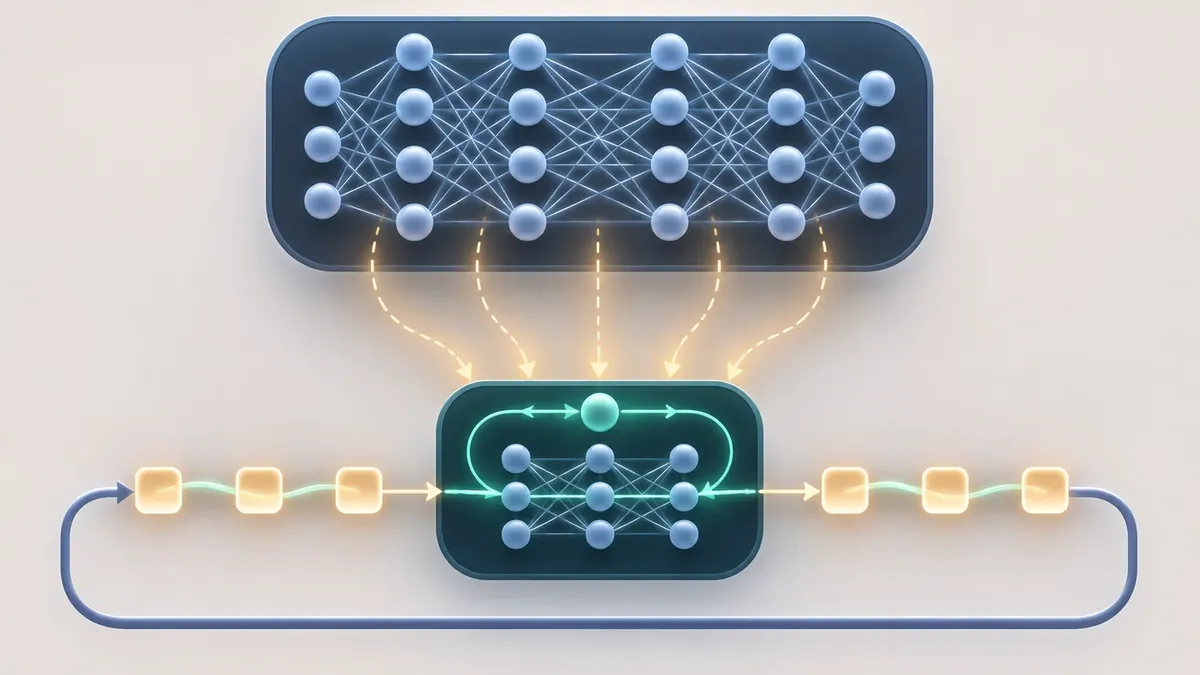
Knowledge distillation lets a smaller language model learn from a larger one. But a stronger teacher does not automatically produce a better student. This study asks whether changing how the student computes—rather than simply enlarging it—can help close that gap.
The problem with a stronger teacher
In knowledge distillation, a “teacher” model guides a smaller “student,” often by showing it which next words are likely in a given context. The hope is that a smaller model can acquire useful capabilities without the cost of running the larger one. Yet a student may not benefit from every improvement in its teacher. This paper investigates one possible reason: the student’s way of processing information may limit what it can learn.
The authors compare three approaches while keeping the student’s main model size roughly fixed. A vanilla model processes each token in the usual way. A looped model repeatedly applies the same network to a token, reusing its weights. A recurrent model carries a representation from the previous token into the current token’s computation. The researchers describe both alternatives as ways to change the student’s computation graph, not simply add a larger set of independently trained layers. Their idea that this gives students more “effective capacity” is a hypothesis; the experiments do not directly measure that capacity or establish it as the cause of the results.
Tests across training settings
The paper reports three sets of experiments. First, the researchers trained models from scratch on FineWeb-Edu, a text dataset, and distilled knowledge from teachers ranging from about 0.8 billion to 3.9 billion parameters. Students had an approximately 0.4-billion-parameter backbone. They measured held-out language-model performance using bits per byte, where lower is better.
Second, they tested mathematical post-training on GSM8K and MATH500, using both teacher-forced distillation and on-policy distillation. In the latter, the teacher also evaluates sequences generated by the student itself. Finally, they started with a pretrained Qwen2.5 model and fine-tuned it into looped or recurrent forms while distilling from a teacher in the same training run. This last test asks whether the change can be made without repeating pretraining.
What the study found
In the from-scratch language-modeling experiment, vanilla students improved with distillation but showed a small reversal at the largest teacher size: their best reported result came with intermediate-sized teachers. Looped students also showed this pattern. Recurrent students’ results improved overall as teachers grew larger, then levelled off; the reversal seen in the other configurations was not observed. The paper reports that recurrence added about 3% to the model’s parameter count in this setup and had decoding latency around 1.1 times that of the vanilla model. Those are measured results for this particular configuration, not a general guarantee of similar costs elsewhere.
The mathematical experiments also favored recurrence in several comparisons. With on-policy distillation from the authors’ own pretraining runs, recurrent students’ accuracy rose across the teacher-size sweep on MATH500, while vanilla students levelled off between the two largest teachers. On GSM8K, recurrent accuracy increased overall, but the gains over the largest-teacher interval were modest. The authors note that much of the recurrent model’s GSM8K advantage was already present in its no-teacher comparison, so higher scores alone do not show that recurrence specifically made the model learn more from its teacher.
In the Qwen2.5 experiment, recurrent models had the highest reported scores on both math benchmarks for each teacher size tested. But this combines architectural conversion and teacher supervision: recurrence also improved the no-teacher fine-tuning result. The paper therefore does not establish that all of the advantage comes from better distillation.
What remains uncertain
These are promising results, not a settled recipe. The experiments use one main model family, a relatively small student backbone, and a narrow set of evaluations: language modeling and two English-language math benchmarks. Teacher size and teacher training-token budget changed together in the from-scratch sweep, so the study cannot attribute the pattern to parameter count alone. The authors also report one run per configuration, without multiple training seeds or confidence intervals. Small differences—and even some larger-teacher trends—should therefore be read descriptively rather than as statistically established effects.
The comparison does not hold training computation equal across architectures. Looping and recurrence require extra training work, and the reported decoding latency does not establish equal prompt-processing cost or total deployment efficiency. The authors also report no additional decontamination check against the math evaluation sets. Finally, strong math or language-model scores do not establish safety or performance on other tasks.
The paper is an arXiv preprint, a research manuscript that may not have undergone peer review. Its findings suggest that student architecture can matter alongside teacher strength, and that recurrent computation is worth testing further. They do not yet show that recurrence will help across model families, tasks, or deployment settings.
- knowledge distillation
- recurrent computation
- large language models
- on-policy distillation
- mathematical reasoning
Reviewed cross-references
These connections were reviewed by a model, not independently fact-checked by a human. Similarity does not imply agreement; consult the original papers and the evidence below.
Can a checklist help an AI model learn from a text-only teacher?
Shared method: Both study on-policy distillation using student-generated rollouts and teacher-derived supervision. The methods differ: the source paper’s mathematical post-training uses teacher-forced or on-policy distillation with recurrent students, while ROPD uses text-only teacher responses to construct rollout-conditioned rubrics; their reported outcomes are from different setups and should not be compared directly.
Model review: · openai-codex/gpt-6-luna
Evidence and provenance
Selected excerpts, not complete papers. PDF extraction can omit figures or damage equations, tables and reading order; sources may be preprints.
2611.28603v1 — Original paper
Excerpt reference:
static/papers/2611.28603v1.md:80-147
Basis: Paper text
Source SHA-256:61782c05142522d6fe2378a46e0d596bf01b001237880e857f55461f98a96afc2611.28603v1 — Original paper
Excerpt reference:
static/papers/2611.28603v1.md:148-215
Basis: Paper text
Source SHA-256:61782c05142522d6fe2378a46e0d596bf01b001237880e857f55461f98a96afc2605.07396v2 — Original paper
Excerpt reference:
static/papers/2605.07396v2.md:176-218
Basis: Paper text
Source SHA-256:bf708c48c84a8979eab23d54edf7ac34b231029555df0c5df1013d00b2fe1ad92605.07396v2 — Original paper
Excerpt reference:
static/papers/2605.07396v2.md:219-373
Basis: Paper text
Source SHA-256:bf708c48c84a8979eab23d54edf7ac34b231029555df0c5df1013d00b2fe1ad9
Can Visual AI Learn from Four Histories?
Shared method: Both use on-policy distillation in which the student generates responses that receive teacher supervision. The visual-agent study also evaluates replay at fixed histories, unlike the recurrent-model paper’s mathematical post-training; the tasks, feedback setups, and reported outcomes differ, so this connection is methodological rather than evidence of comparable performance.
Model review: · openai-codex/gpt-6-luna
Evidence and provenance
Selected excerpts, not complete papers. PDF extraction can omit figures or damage equations, tables and reading order; sources may be preprints.
2611.28603v1 — Original paper
Excerpt reference:
static/papers/2611.28603v1.md:80-147
Basis: Paper text
Source SHA-256:61782c05142522d6fe2378a46e0d596bf01b001237880e857f55461f98a96afc2611.28603v1 — Original paper
Excerpt reference:
static/papers/2611.28603v1.md:1039-1110
Basis: Paper text
Source SHA-256:61782c05142522d6fe2378a46e0d596bf01b001237880e857f55461f98a96afc2611.28618v1 — Original paper
Excerpt reference:
static/papers/2611.28618v1.md:188-263
Basis: Paper text
Source SHA-256:41198696f2c32cca796bc87e940ed8b704f8d8f0c8ddbd58ff29fbb80b279bf42611.28618v1 — Original paper
Excerpt reference:
static/papers/2611.28618v1.md:264-422
Basis: Paper text
Source SHA-256:41198696f2c32cca796bc87e940ed8b704f8d8f0c8ddbd58ff29fbb80b279bf4
Related reading
Automatically matched by shared topic keywords. These links do not imply that the sources agree or establish a consensus.
Can a checklist help an AI model learn from a text-only teacher?
Source published
Shared keywords: knowledge distillation, large language models, mathematical reasoning
A Two-Way View of Teaching Language Models
Source published
Shared keywords: knowledge distillation, mathematical reasoning, on policy distillation
Why language-model students can struggle to learn from teachers
Source published
Shared keywords: knowledge distillation, on policy distillation
Teaching Small Vision Models What to Notice
Source published
Shared keywords: knowledge distillation, on policy distillation
Visual Backdoors Can Emerge Suddenly in Distillation
Source published
Shared keywords: knowledge distillation, on policy distillation