TRANSMISSION // 2611.28585v1
A faster handoff between robot policies
Source published
AsyncMixVLA prepares a recovery policy while a robot completes actions already underway. In simulated LIBERO-Long tasks, it improved success after disturbances and reduced the median handoff wait exposed to control.
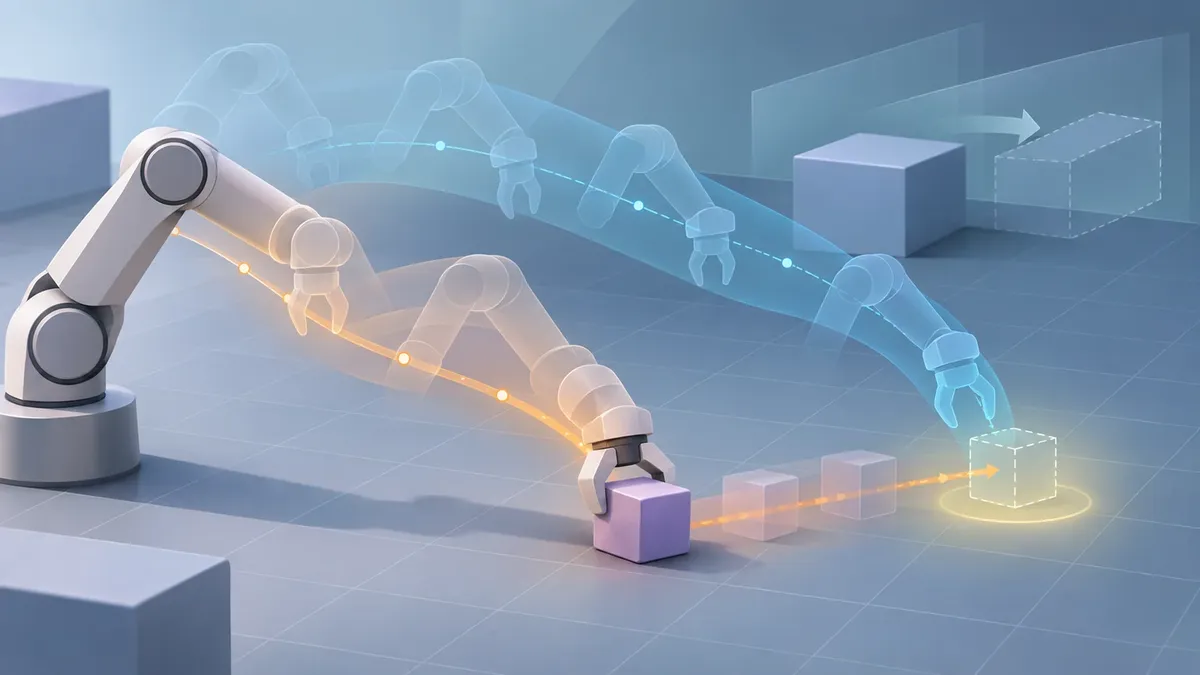
When an object moves during a robot’s task, actions planned from an earlier image may no longer suit the scene. AsyncMixVLA explores whether switching to another policy can help—and how to prepare that policy while the robot is still moving.
A robot following an instruction can encounter a changed scene: for example, an object may shift while the robot is reaching for it. Actions planned from an earlier camera image may then be less useful. One possible response is to switch to another vision-language-action (VLA) policy—a model that uses images and instructions to choose robot actions. But the new policy takes time to run, and advice based on an outdated view may not fit the scene when control passes to it.
AsyncMixVLA, proposed by Tamoghno Das and colleagues, is a framework for switching between two separately trained policies. VLA-Adapter is the lightweight default; OpenVLA-OFT is the higher-compute recovery policy. A learned trigger uses rescue and harm scores to decide whether to escalate. These scores guide the switching decision; they do not guarantee that the system can reliably predict whether a particular task will succeed or fail. The framework allows at most one switch per episode.
After a switch is accepted, the robot completes the remaining actions in its already-generated VLA-Adapter action chunk. These committed actions form a bridge while the system prepares the incoming policy and obtains its response asynchronously. The robot moves during the bridge, so the framework estimates the state it is expected to reach and adjusts the incoming policy’s context. For visual alignment, a separately trained predictor is designed to make OpenVLA-OFT’s actions under the predicted context resemble its actions under the actual post-bridge context. The incoming policy’s backbone, language conditioning, proprioceptive pathway, and action head stay frozen; the alignment predictor itself is trained.
The researchers tested AsyncMixVLA in LIBERO-Long, a simulated benchmark with ten long-horizon tasks. The main evaluation included 238 episodes: 120 without disturbances and 118 feasible matched episodes with a disturbance. In the disturbed episodes, a task-relevant movable object was displaced by five centimetres over five control steps. Comparisons included each policy used alone, synchronous switching, and asynchronous switching without takeover-context alignment.
AsyncMixVLA succeeded in 91 of the 118 disturbed episodes, or 77.1%, compared with 69.5% for VLA-Adapter alone. Across all 238 episodes, it achieved 84.9% success, versus 84.5% for synchronous switching. The authors describe these overall results as comparable, not as evidence of a meaningful success advantage over synchronous switching. All methods achieved 92.5% on the clean episodes.
The clearest measured difference was the wait exposed to the robot’s control loop after the committed actions ended. Across 109 handoffs, median exposed handoff latency was 0.1 milliseconds for AsyncMixVLA and 226.5 milliseconds for synchronous switching. This is the residual wait, not the time OpenVLA-OFT takes to compute: asynchronous preparation can overlap with the bridge, but the reported median does not show how much computation was hidden. A residual wait can remain if the incoming response is late.
The latency figures also have a tail: AsyncMixVLA’s 95th-percentile exposed wait was 224.5 milliseconds, slightly higher than the 200.1 milliseconds for naive asynchronous switching. That simpler asynchronous method had lower latency at the 95th percentile, while AsyncMixVLA had higher task success in the reported comparison. Timing tests used one NVIDIA RTX 3090, with both policy services sharing the GPU allocation, so results may vary with hardware and workload.
The researchers also tested 289 episodes across three perturbation types not used for development: object rotation, target displacement, and post-grasp slip. Without retraining or recalibration, AsyncMixVLA reached 75.1% success overall, compared with 71.3% for VLA-Adapter and 69.2% for OpenVLA-OFT. The strongest constituent policy varied by disturbance: OpenVLA-OFT did best on rotation, while VLA-Adapter outperformed it on target displacement. These results suggest different strengths across the tested conditions, not guaranteed performance in every unfamiliar setting.
The evidence has limits. The tasks were simulated, not demonstrations on a physical robot. The main disturbance test used a specific object displacement, and the evaluation covered two policies, a fixed task set, and at most one handoff per episode. Benchmark success rates do not establish how the approach will work in real-world environments.
The work is an arXiv preprint, so it should be read as a research report rather than peer-reviewed validation. Within that scope, AsyncMixVLA explores a practical systems approach: let a robot continue actions already underway while preparing another policy for the state it is expected to inherit.
- robotics
- vision-language-action models
- robot policy switching
- asynchronous inference
- robot recovery
- LIBERO-Long
Reviewed cross-references
These connections were reviewed by a model, not independently fact-checked by a human. Similarity does not imply agreement; consult the original papers and the evidence below.
Teaching robot policies to anticipate their next move
Shared method: Both methods use actions already committed for execution to anticipate the context at an asynchronous handoff: AsyncMixVLA aligns an incoming policy to the expected takeover state, while JEPA-Tuner predicts future policy guidance for the next chunk. They apply this principle to different settings—switching between policies versus replanning within a policy—and the excerpts do not establish comparative performance.
Model review: · openai-codex/gpt-6-luna
Evidence and provenance
Selected excerpts, not complete papers. PDF extraction can omit figures or damage equations, tables and reading order; sources may be preprints.
2611.28585v1 — Original paper
Excerpt reference:
static/papers/2611.28585v1.md:68-190
Basis: Paper text
Source SHA-256:4018318f64b6fda67eafe7282b2db462b6fcffaba69cc2651a50e6d3695126ec2611.29096v1 — Original paper
Excerpt reference:
static/papers/2611.29096v1.md:77-128
Basis: Paper text
Source SHA-256:3fe2963ae17176851aa4c236645dda04dd30260e7758db6d62247a27cc65321e
Related reading
Automatically matched by shared topic keywords. These links do not imply that the sources agree or establish a consensus.
Teaching robot policies to anticipate their next move
Source published
Shared keywords: asynchronous inference, vision language action models
A Robot Memory System That Keeps the Lesson, Not Every Detail
Source published
Shared keywords: vision language action models
Teaching Robot AI to Focus on Motion, Not Scenery
Source published
Shared keywords: vision language action models
Teaching robot policies to handle stale observations
Source published
Shared keywords: asynchronous inference
How a robot can learn from its own attempts
Source published
Shared keywords: vision language action models