TRANSMISSION // 2611.28574v1
When an AI agent must remember before it knows what matters
Source published
EvoViM lets multimodal AI agents revise visual-memory programs using experience from interactive tasks. In tests across six benchmarks, the approach outscored a strong baseline on average, but results come from simulated environments and varied by task.
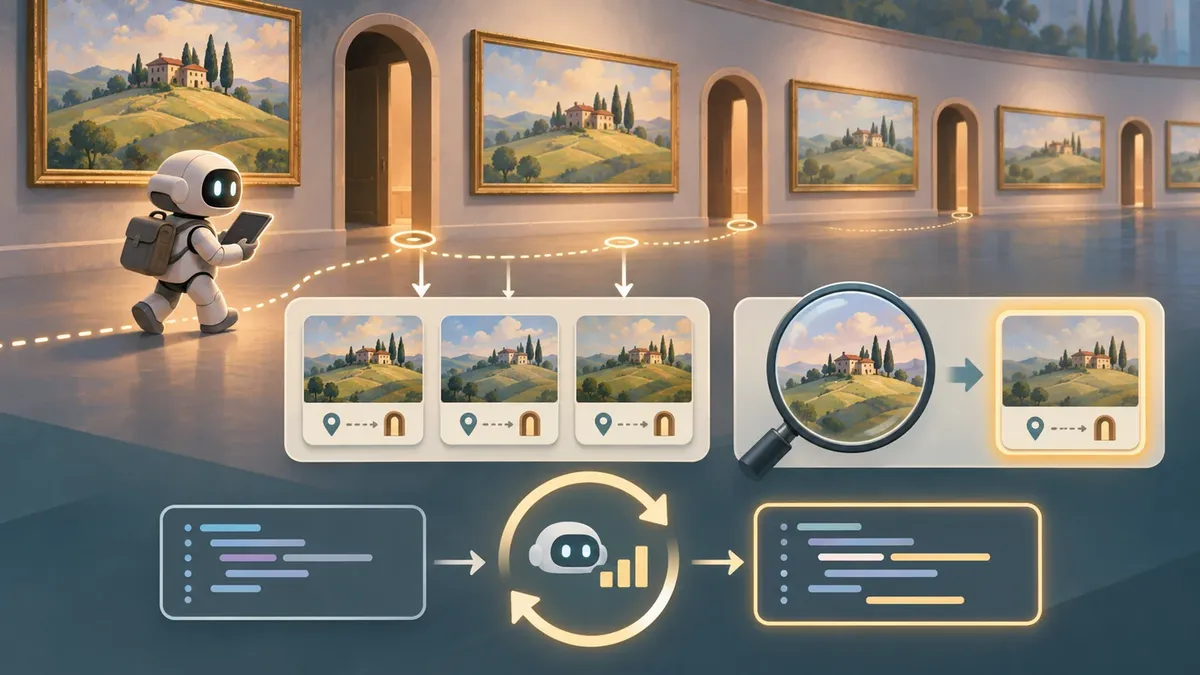
A familiar challenge for people is remembering details before knowing whether they will matter. EvoViM studies the same problem for AI agents: can they explore a visual environment, keep useful evidence, and answer questions revealed only afterward?
An agent exploring a gallery may be asked later where a particular painting was hanging—even if no one told it to pay attention to paintings. That is the challenge studied in EvoViM, a research framework for AI systems that must explore first and receive questions later. The central problem is not simply storing observations. It is deciding what to preserve, how to find it again, and how to use it when the question finally arrives.
Many agent memory systems rely on written notes. But a short description may blur the difference between two similar images. Keeping every image avoids that particular loss, yet does not ensure the agent can match a later image to the right place or make a correct decision. EvoViM’s authors propose that an agent should learn not only what to remember, but also how to work with visual evidence.
A revisable visual program
EvoViM uses a frozen multimodal language model: the underlying model’s weights do not change. Instead, the model revises a Python-based program that supplies memory operations and image-processing tools. The program can retain frames, crops or visual features, compare pixels, connect images with locations, and present selected evidence to the model. It can also offer guidance for choosing actions in some tasks.
The system improves this program between rounds of interaction. It examines recorded development episodes—including observations, memory snapshots, tool results and outcomes—and tries to trace failures to the operation that lost or mishandled evidence. It may then change how observations are stored or matched. It also updates notes and analysis scripts intended to make later revisions build on earlier tests rather than repeat unsuccessful changes.
Candidates are checked and tested on the same two development seeds as their parent. A candidate is retained if its average development score improves; ties have additional efficiency conditions. The final program is then evaluated on separate held-out seeds, with episode memory reset between tasks. This separation offers a test of whether revisions transfer beyond the episodes used to make them, though it does not establish broad real-world generality.
The researchers tested three multimodal models on six tasks: visual matching, spatial recall and sequential decision-making. Three tasks used deferred questions. For example, an agent might explore a maze containing posters and later be shown a re-photographed poster and asked where it appeared. Other tasks included matching cards, identifying previously visited product pages, Tetris and Pac-Man. The comparison included fixed text and visual memories, as well as AutoMem, a baseline that evolves text-based memory.
Better average scores, with important exceptions
Across the six tasks, EvoViM’s average score was 31.3 to 47.6 points higher than AutoMem’s for the tested models, and the reported paired-bootstrap confidence intervals for those average improvements excluded zero. EvoViM had the highest average for each model. However, it did not lead every ability group for every model: GPT-6.1 Sol’s sequential decision-making average was an exception.
The results suggest why visual evidence and task-specific operations matter. Text descriptions could fail to distinguish similar patterns, while an image archive alone often could not connect a match to a location or decide whether an image was unseen. EvoViM’s programs sometimes learned to associate saved views with doors or walls, or to compare visual details directly. Programs written in one pass from initial instructions, without interaction experience, generally performed substantially worse than evolved programs.
The gains were not uniform. On Poster Maze, exploration routes affected which posters were clearly observed; in some episodes, limited coverage left little evidence to answer later questions. Some programs still mishandled unseen-image “lures” or made poor decisions despite retrieving useful evidence. On sequential tasks, results varied across models. The authors’ failure analysis also attributes remaining losses to stages including observation, decision-making and execution, not just memory.
What the study does—and does not—show
These experiments support a focused conclusion: on the tested benchmarks, revising visual-memory and decision-support programs from interaction experience can improve average performance over the comparison systems. They do not show that an agent can reliably remember everything in an open-ended, real-world setting, or that the same program will work across unrelated environments. The tasks are interactive benchmark environments, the final programs are developed separately for each task and model, and held-out results still vary by task and episode. The paper also reports cases where development performance did not transfer as well, particularly when exploration paths changed.
The authors say they have not evaluated audio and identify combining visual and auditory evidence in embodied environments as future work. The manuscript is an arXiv preprint, so its claims should be read as research findings rather than established consensus; a preprint is not, by itself, evidence of peer review. The paper reports that code and data are available from the project website, which could help others examine and reproduce the work.
EvoViM’s broader idea is that useful memory is more than an archive: it includes rules for collecting, comparing and applying evidence. The benchmark results make that idea promising, while leaving open how reliably it will carry over to noisier, less predictable settings.
- AI agents
- visual memory
- multimodal AI
- deferred queries
- self-evolving systems
- benchmark evaluation
Reviewed cross-references
These connections were reviewed by a model, not independently fact-checked by a human. Similarity does not imply agreement; consult the original papers and the evidence below.
Teaching AI agents to train other language models
Supporting evidence: Both studies report better benchmark performance after agents use experience from training or interaction: EvoViM’s evolved visual programs outperform programs written once from initial instructions, while RSI-Dojo models fine-tuned on filtered post-training trajectories outperform their base models. This supports only the bounded observation that experience-based adaptation improved results in these evaluations; the tasks, adaptation procedures, and outcomes differ, so the results are not directly comparable.
Model review: · openai-codex/gpt-6-luna
Evidence and provenance
Selected excerpts, not complete papers. PDF extraction can omit figures or damage equations, tables and reading order; sources may be preprints.
2611.28574v1 — Original paper
Excerpt reference:
static/papers/2611.28574v1.md:81-207
Basis: Paper text
Source SHA-256:9e728c198a1ba0e34b5eb5ac9c2a351570ceda4fadf01b3c7c930a730270cb2a2611.28574v1 — Original paper
Excerpt reference:
static/papers/2611.28574v1.md:670-749
Basis: Paper text
Source SHA-256:9e728c198a1ba0e34b5eb5ac9c2a351570ceda4fadf01b3c7c930a730270cb2a2611.03698v1 — Original paper
Excerpt reference:
static/papers/2611.03698v1.md:64-123
Basis: Paper text
Source SHA-256:9fa44499a91269878010c4430da018c8f234e05666e21454f98cf836144a8d5f
Related reading
Automatically matched by shared topic keywords. These links do not imply that the sources agree or establish a consensus.
How MVAgent coordinates AI to understand multiple videos
Source published
Shared keywords: ai agents, benchmark evaluation, multimodal ai
When AI Uses a Tool, Did the Tool Actually Help?
Source published
Shared keywords: ai agents, benchmark evaluation, multimodal ai
Can AI scripting agents learn from their own EDA mistakes?
Source published
Shared keywords: ai agents, self evolving systems
Do AI models really combine evidence across images?
Source published
Shared keywords: benchmark evaluation, multimodal ai
Giving AI Agents the Right Roles in Program Evolution
Source published
Shared keywords: ai agents, benchmark evaluation