TRANSMISSION // 2611.28558v1
Teaching Visual AI When to Call a Tool
Source published
AOVO trains image-answering models to focus on questions where visual tools can supply useful evidence, rather than rewarding tool calls themselves.
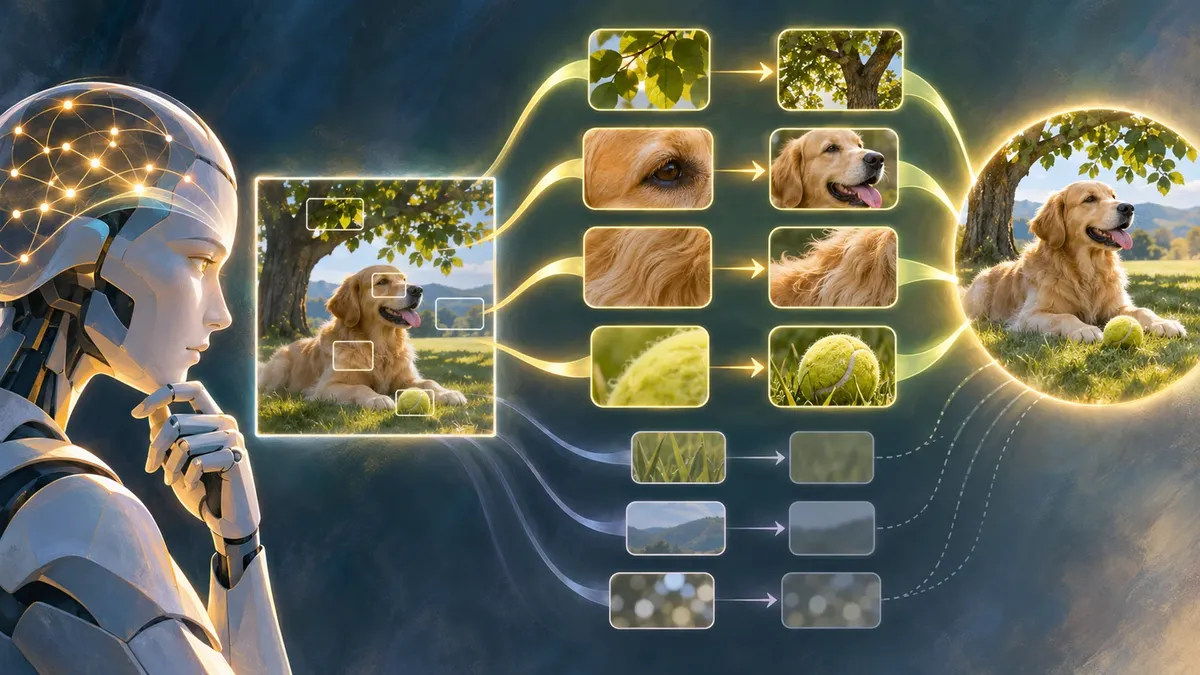
An AI can call an image tool and still fail to use what it sees. A new preprint proposes identifying which questions are helped by extra visual evidence, then adjusting training so those examples provide more useful learning signals.
The problem: knowing when to look
Multimodal AI models can use tools such as optical character recognition (OCR), chart readers, or image cropping to inspect visual details. But making a call is not the same as benefiting from it. A tool may reveal text the model missed, return unhelpful evidence, or leave the answer unchanged. Training methods that reward calls can create incentives to call too often or too rarely, without reliably teaching when another observation will help.
A paper by Jin Cui and colleagues proposes AOVO, a training framework that changes which questions the model practices on rather than adding a tool-call bonus. The motivating distinction is between failures caused by missing visual evidence and failures that extra evidence is unlikely to fix because the obstacle lies elsewhere, such as reasoning.
Probing the model’s own attempts
The researchers start from a model’s reasoning state: a point before its first tool call or final answer. From that state, they probe each available visual expert, sampling continuations both with and without the expert’s observation. The comparison estimates whether observations change answer success, while repeated continuations help account for the model’s own variability. It is an operational counterfactual procedure within the study, not definitive proof that an observation caused an outcome in every individual case.
The paper uses specific rules to assign categories. A question is “Repairable” if at least one expert raises the estimated success rate by a threshold. It is “Harmful” if no expert meets that repair criterion and the expert selected by the policy lowers success by the threshold. Questions are also classified as “Saturated” when attempts are already reliably successful, “Hard” when they remain largely unsuccessful across conditions, or “Reasoning-dominated” when outcomes vary but are mostly unaffected by observations.
These labels guide both initial training and later sampling. For supervised fine-tuning, Repairable examples use a tool call and an observation followed by a correct continuation; the researchers verify and, where needed, revise the post-observation continuation. Harmful and Saturated cases retain correct tool-free continuations. Hard and Reasoning-dominated cases receive teacher-corrected tool-free supervision. During reinforcement learning, Saturated examples are excluded, while Policy-Adaptive Data Sampling (PADS) periodically adjusts the mix among the other categories using recent estimates of observation effects.
The model is optimized for final-answer correctness, without a separate reward for making a tool call. In the reported setup, the tools are an OCR system, a chart parser, and an object detector used with cropping. PADS’s counterfactual probing adds a reported 3.5–3.8% rollout compute in that setup—a training cost, not a measure of inference-time tool use.
What the study reports
The authors train AOVO using Qwen2.5-VL-7B and evaluate it across 13 benchmarks: document and text perception, including DocVQA and OCRBench; high-resolution perception through HR-Bench at 4K and 8K; visual mathematics, including MathVision, MathVista, and MathVerse; and broader multimodal tests such as GQA, MMBench, and MME. The benchmark list also includes InfographicVQA, V*, and POPE.
The paper reports improvements over vanilla GRPO, a reinforcement-learning baseline trained on the same data, across its accuracy-based results. The table reports MME as a total score rather than accuracy, so it should not be read as the same kind of measurement as the accuracy columns. The authors describe particularly strong results on some text-heavy perception tasks. They also note exceptions among tool-use comparisons: Mini-o3 and ZwZ lead on V*, while the strongest explicit tool-use models remain ahead on MathVision and MathVerse. These are benchmark results, not evidence that AOVO will outperform other systems on every task.
The authors’ analyses suggest that the training-data mix matters: removing or overemphasizing categories could lead to excessive or insufficient calling, or calls that do not help. They report that adaptive sampling maintained useful training signals as the model changed. This evidence comes from the study’s particular models, tools, data, and experimental setup.
What remains uncertain
AOVO’s trained model is Qwen2.5-VL-7B, although the paper also compares it with other open-source and proprietary models. The results therefore do not establish how the method would perform when training different models, using different tools, or facing real-world images and tasks. The authors say that disentangling visual-grounding gains from reasoning gains remains beyond their causal analysis; they attribute the observed improvements primarily to better visual grounding.
The source is an arXiv preprint. The supplied source does not establish its peer-review status, and the results should be understood as claims reported by the authors rather than independent confirmation. Replication and evaluation in other settings would help clarify how broadly the approach works. The central proposal is a useful reframing: train on examples where observations can provide informative signals, then test whether that helps the model decide when looking is worthwhile.
- multimodal AI
- visual tool use
- reinforcement learning
- AOVO
- adaptive data sampling
- visual reasoning
Reviewed cross-references
These connections were reviewed by a model, not independently fact-checked by a human. Similarity does not imply agreement; consult the original papers and the evidence below.
Teaching 3D AI to Check the Evidence It Uses
Shared method: Both papers use counterfactual evidence interventions in reinforcement-learning training: AOVO compares continuations with and without expert observations to identify questions whose outcomes are observation-sensitive, while CARE-3D masks returned 3D evidence to estimate its contribution to answer likelihood. These are related attribution strategies, not the same procedure; AOVO classifies questions, whereas CARE assigns evidence-sensitive credit to grounding interactions.
Model review: · openai-codex/gpt-6-luna
Evidence and provenance
Selected excerpts, not complete papers. PDF extraction can omit figures or damage equations, tables and reading order; sources may be preprints.
2611.28558v1 — Original paper
Excerpt reference:
static/papers/2611.28558v1.md:79-122
Basis: Paper text
Source SHA-256:d37e01047838662f283912178e5a052d269658cdc70a66c0c49444f31cc6d1182611.29969v1 — Original paper
Excerpt reference:
static/papers/2611.29969v1.md:507-581
Basis: Paper text
Source SHA-256:94db5f03b5165e205a34ef43a3571b517c9a6f95f2e0f1f4b6657a453a8debe7
Teaching AI Sudoku one difficulty step at a time
Shared method: Both approaches adapt which examples are sampled during reinforcement-learning training as the policy changes. AOVO periodically reallocates sampling using estimated observation effects, whereas AdaC-GRPO selects difficulty groups using online accuracy to target a competence window. The shared feature is adaptive sampling; their selection signals and task settings differ.
Model review: · openai-codex/gpt-6-luna
Evidence and provenance
Selected excerpts, not complete papers. PDF extraction can omit figures or damage equations, tables and reading order; sources may be preprints.
2611.28558v1 — Original paper
Excerpt reference:
static/papers/2611.28558v1.md:123-179
Basis: Paper text
Source SHA-256:d37e01047838662f283912178e5a052d269658cdc70a66c0c49444f31cc6d1182610.13184v2 — Original paper
Excerpt reference:
static/papers/2610.13184v2.md:223-304
Basis: Paper text
Source SHA-256:d5a826ac91527be85c4f378592568a6827417af9644727d3c29f9364557e1058
Related reading
Automatically matched by shared topic keywords. These links do not imply that the sources agree or establish a consensus.
AI can read an image yet struggle to reason about it
Source published
Shared keywords: multimodal ai, reinforcement learning, visual reasoning
Teaching AI Sudoku one difficulty step at a time
Source published
Shared keywords: multimodal ai, reinforcement learning, visual reasoning
Can AI Models Think in Pictures, Not Just Words?
Source published
Shared keywords: multimodal ai, visual reasoning
Teaching Small Vision Models What to Notice
Source published
Shared keywords: multimodal ai, visual reasoning
AVIS Lets Vision-Language Models Spend Effort Where It May Help
Source published
Shared keywords: multimodal ai