TRANSMISSION // 2611.28517v1
When should a digital twin be trusted—and what should it change?
Source published
Simulations suggest that tracking how forecast errors spread can help detect unreliable predictions in some agent networks. For choosing network edits, predicted collective outcomes may matter more than how closely a twin tracks a trajectory.
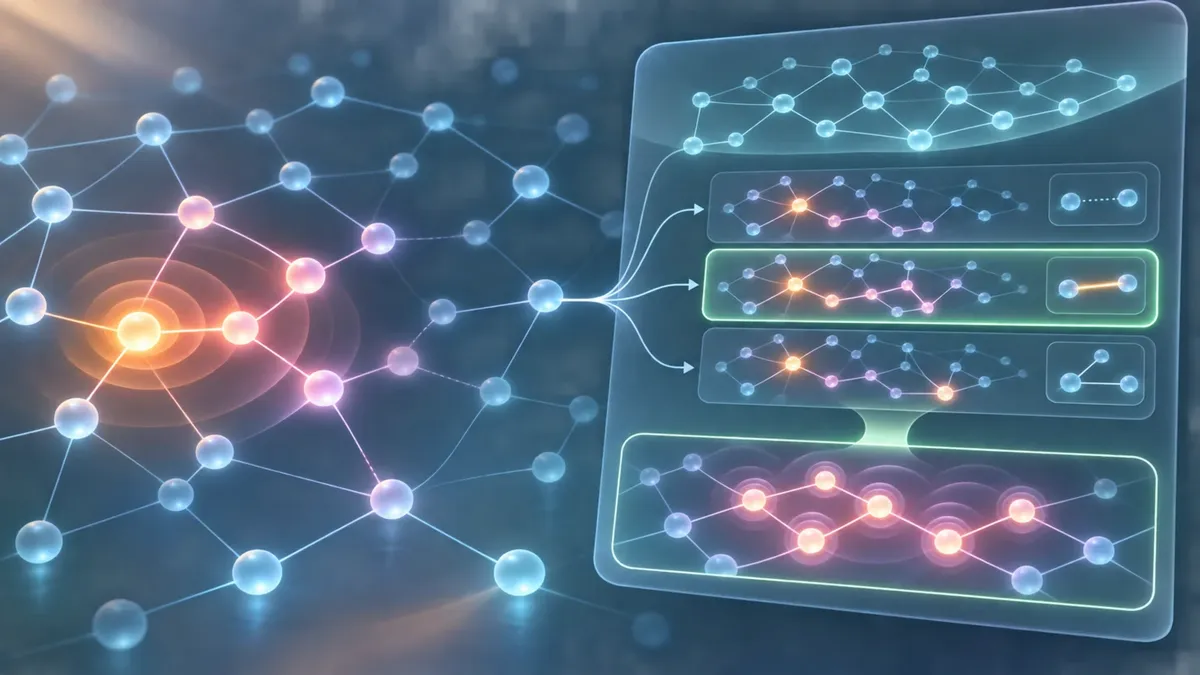
A digital twin can forecast how a network of interacting agents will behave—and test changes before they are made. But a forecast can become unreliable as errors spread, and a prediction that closely follows one possible outcome may not identify the most useful intervention. A new simulation study explores both problems.
A digital twin is a model of a real or simulated system, used to forecast what might happen and explore possible changes. For a network of interacting agents, predicting one agent at a time may not be enough: an error in one prediction can affect connected agents, while changing a connection can alter the network’s collective behavior.
A study by Truc Nguyen Thi Le and Phuoc Nguyen T. H. asks two related questions: Can information about how forecast errors spread help identify unreliable forecasts? And can a learned digital twin select network changes that improve a collective outcome, even when its predictions are imperfect?
The authors propose a framework called PAV-Twin. Its monitoring component combines recent prediction errors and disagreement among several models with estimates of how small changes in one step could influence later steps. Those estimates come from Jacobians—a mathematical description of how a model’s output responds to changes in its input. The planner takes a different approach: it simulates candidate network edits and ranks them by the collective outcome the twin predicts.
The team tested the methods in simulations of networks with 8 to 64 agents. The simulated systems included consensus dynamics, coupled oscillators and a coupled-map lattice. The researchers trained models on some network structures and tested them on familiar structures at larger sizes, as well as on larger networks with held-out topologies. For intervention planning, they compared choices based on predicted collective outcomes with choices based on how closely the twin tracked trajectories. They measured selected edits against the best outcome available in the simulator’s candidate set.
Forecast warnings depended on the dynamics. On larger oscillator networks, the propagation-aware monitor improved area under the precision–recall curve (AUPRC), a measure of how well a system identifies failures, by 0.13 on familiar topologies and 0.09 on held-out topologies compared with a graph-based baseline without propagation features. In contractive consensus systems, where disturbances tend to decay, gains were small; the reported differences were slightly negative. In a separate comparison, giving the graph baseline the same propagation features narrowed the gap between approaches. That suggests the features may help, but leaves uncertain how much the proposed monitor adds beyond providing those features to another model.
The benefit also varied as the researchers changed the strength of interactions between oscillators. In their tested sweep, the AUPRC gain was negative when agents were uncoupled, peaked around a coupling strength of 1, and declined at stronger coupling. The authors caution that a measure of potential error amplification alone did not reliably indicate where propagation features would improve detection.
For choosing changes, outcomes beat fidelity in some tests. In oscillator simulations, selecting an edit for its predicted synchronization outcome produced lower regret—meaning a smaller gap from the best available choice—than selecting the edit whose trajectory the twin tracked most closely. This difference was especially pronounced with a simplified oscillator model: outcome-based selection had about 89% lower regret than fidelity-based selection, while fidelity-based selection performed worse than random choice. The difference was smaller in consensus; with a simplified twin, fidelity-based selection reached the oracle-level result at the precision reported by the study.
In a separate planning experiment, ensemble model-predictive control recovered about 99% of the improvement available over random selection in oscillators and nearly all of it in consensus. These results describe the tested candidate edits and simulated systems; they do not establish that the method will work equally well in other networks.
There are important limits. The experiments are simulations, not trials in deployed agent networks. The monitoring results concern how well risk scores rank forecasts; deciding when to re-observe a system also depends on whether predicted probabilities are calibrated. The reported comparisons use a small number of random seeds, and the authors say larger replications could better assess uncertainty. Planning tests are bounded by the networks and edit options studied, and some chaotic-system candidate sets offered little room for any planner to improve on random selection.
The paper is an arXiv preprint, so it should be treated as research that has not necessarily undergone peer review. Overall, the simulations support a qualified lesson: modeling error propagation may help flag unreliable forecasts in some network dynamics, while intervention quality should be judged by the collective outcome—not just by how faithfully a twin reproduces a trajectory.
- digital twins
- multi-agent systems
- forecast reliability
- error propagation
- network interventions
- simulation
- artificial intelligence
Related reading
Automatically matched by shared topic keywords. These links do not imply that the sources agree or establish a consensus.
How local mistakes travel through AI teams
Source published
Shared keywords: error propagation, multi agent systems
Failed AI agents often had evidence of their mistakes, a trace study finds
Source published
Shared keywords: error propagation, multi agent systems
Why Clinical AI Needs Statistical Guardrails
Source published
Shared keywords: digital twins
Can One AI Agent Learn From a Whole Team?
Source published
Shared keywords: multi agent systems
How MAWAM helps robot teams act together
Source published
Shared keywords: artificial intelligence, multi agent systems