TRANSMISSION // 2611.28497v1
Why Clinical AI Needs Statistical Guardrails
Source published
Strong model performance does not guarantee sound clinical decisions. A commentary maps statistical risks across four uses of AI in clinical development.
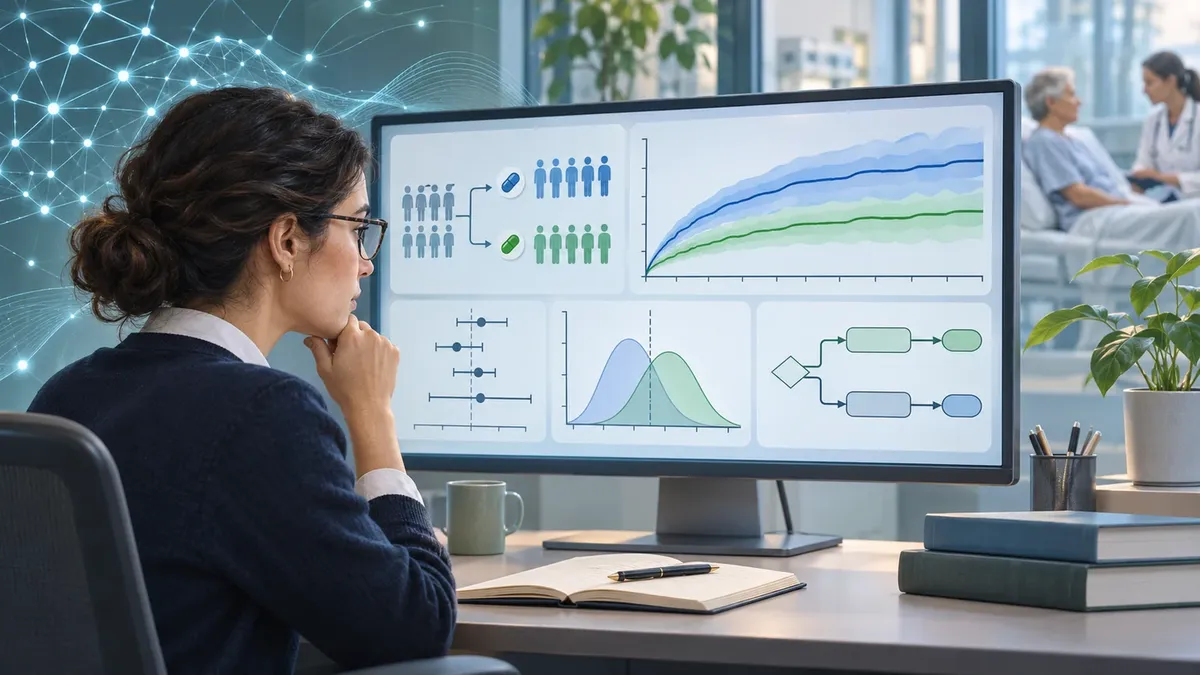
AI can flag unusual trial data, help monitor studies and identify possible treatment subgroups. But a useful prediction is not automatically reliable evidence for a clinical or regulatory decision. A commentary by Siddhesh Kulkarni and colleagues explains why the intended use, assumptions and consequences of acting on an AI output matter as much as its apparent performance.
When a promising signal is not enough
An AI system might spot an unusual pattern in a clinical trial, identify a group of patients with better outcomes, or simulate how a patient’s health could change. Each result may be informative. None, on its own, proves that the data are wrong, that a treatment works better for a particular group, or that a simulated outcome would happen under a different treatment.
That distinction is the central point of a commentary by Siddhesh Kulkarni and colleagues. Rather than reporting a new experiment or trial, the authors offer a statistical perspective on four areas of clinical development: anomaly detection, real-time monitoring and adaptive trials, biomarker-based enrichment, and virtual or digital twins. Their argument is that technical performance must be judged against the decision a model is meant to support.
Four settings, four kinds of risk
In trial monitoring, algorithms can flag atypical patterns at a site or among participants. But an unusual pattern is a prompt to investigate, not proof of faulty data or misconduct. Differences could reflect patient characteristics, measurement practices or chance. Repeatedly searching for unusual signals can also generate false alerts. The authors say assessments should consider not only how many meaningful issues a method detects, but also the burden and consequences of false alarms and whether comparisons across sites are fair.
Real-time monitoring is not the same as an adaptive trial. Monitoring can bring information to researchers sooner; an adaptive design makes planned changes—such as stopping early or changing sample size—based on interim results. If AI contributes to those decisions, the design still needs advance-specified rules and careful evaluation, often through simulation, of error rates, statistical power and treatment-effect estimates. Otherwise, a process that looks responsive could undermine the validity of the trial’s conclusions.
For biomarker-based enrichment, AI can combine data such as genomic, imaging and health-record information to identify patterns associated with outcomes. But a biomarker linked to how patients fare overall is not necessarily one that identifies who benefits more from a particular treatment. The first is prognostic; the second is predictive. Establishing treatment-specific benefit requires suitable comparisons, evaluation of treatment–biomarker interactions, attention to multiple testing and independent validation. The authors frame AI-generated associations as hypotheses until appropriate clinical evidence supports them.
Digital twins raise a related distinction between prediction and causation. A model may generate a plausible future trajectory based on observed data. Estimating what would happen under an alternative treatment is a counterfactual claim, and interpreting a difference as a treatment effect requires defensible causal assumptions. For simulated or hybrid control groups, the authors also identify questions about comparability, missing data and whether results can be transported to the population of interest.
Start with the decision
Across these examples, the authors propose a decision-centered approach: define where and how the model will be used; specify the statistical target and assumptions; assess performance, uncertainty and possible bias; and validate the output with sensitivity analyses suited to the consequences of the decision. For treatment-effect questions, they point to the ICH E9(R1) estimand framework, which helps clarify what effect a trial is trying to estimate and how events during the trial are handled.
This is a conceptual framework, not a newly tested checklist or evidence that any particular AI method improves patient outcomes. The paper is a commentary drawing on cited research, guidance and examples; it does not report original trial data or a systematic review. Its recommendations therefore help organize questions to ask, but do not establish that a specific tool is safe or effective for a particular use. The version supplied is an arXiv preprint, and the source material does not establish peer-review status. The authors’ core point is measured: AI may help clinical development, but valid decisions require evidence that goes beyond a high-performing model or a convincing simulation.
- clinical AI
- machine learning
- clinical trials
- statistical methods
- biomarkers
- digital twins
Reviewed cross-references
These connections were reviewed by a model, not independently fact-checked by a human. Similarity does not imply agreement; consult the original papers and the evidence below.
Can statistical ‘digital twins’ help evaluate job training?
Supporting evidence: The clinical-development commentary says treatment-effect claims from digital twins require a defined estimand and defensible causal assumptions. Chetty and colleagues report that, for workforce-training earnings estimates, their observational estimator’s RMSE was comparable to that of RCT estimates across 37 trials. This is a domain-specific example of benchmarking against experiments, not evidence that the estimator or findings transfer to clinical trials.
Model review: · openai-codex/gpt-6-luna
Evidence and provenance
Selected excerpts, not complete papers. PDF extraction can omit figures or damage equations, tables and reading order; sources may be preprints.
2611.28497v1 — Original paper
Excerpt reference:
static/papers/2611.28497v1.md:312-375
Basis: Paper text
Source SHA-256:ab9b2f36692bcb94fc57b400b30ae0b238b0a89fbdc0b0a34056b70762b5fe922611.03938v1 — Original paper
Excerpt reference:
static/papers/2611.03938v1.md:182-282
Basis: Paper text
Source SHA-256:aec729c2d95a90c33925c41bbaf9e9504bce2e3fc4532cce45861b4a7e8137af2611.03938v1 — Original paper
Excerpt reference:
static/papers/2611.03938v1.md:283-387
Basis: Paper text
Source SHA-256:aec729c2d95a90c33925c41bbaf9e9504bce2e3fc4532cce45861b4a7e8137af
Related reading
Automatically matched by shared topic keywords. These links do not imply that the sources agree or establish a consensus.
Can statistical ‘digital twins’ help evaluate job training?
Source published
Shared keywords: digital twins
Can evidence from one AI help another predict clinical-trial outcomes?
Source published
Shared keywords: clinical trials, machine learning
A model that tracks changing ICU physiology
Source published
Shared keywords: clinical ai, machine learning
How Well Can EEG Models Spot Unfamiliar Seizure Types?
Source published
Shared keywords: clinical ai, machine learning
Why the Same Tuning Algorithm Helped One Throttle Valve but Hurt Another
Source published
Shared keywords: digital twins