TRANSMISSION // 2611.28427v1
Froq tests quantum-side speculation in simulation
Source published
Froq is a proposed way for selected quantum operations to proceed before error decoding finishes. Simulations report shorter quantum-side times, while hardware performance and recovery-related failure rates remain untested.
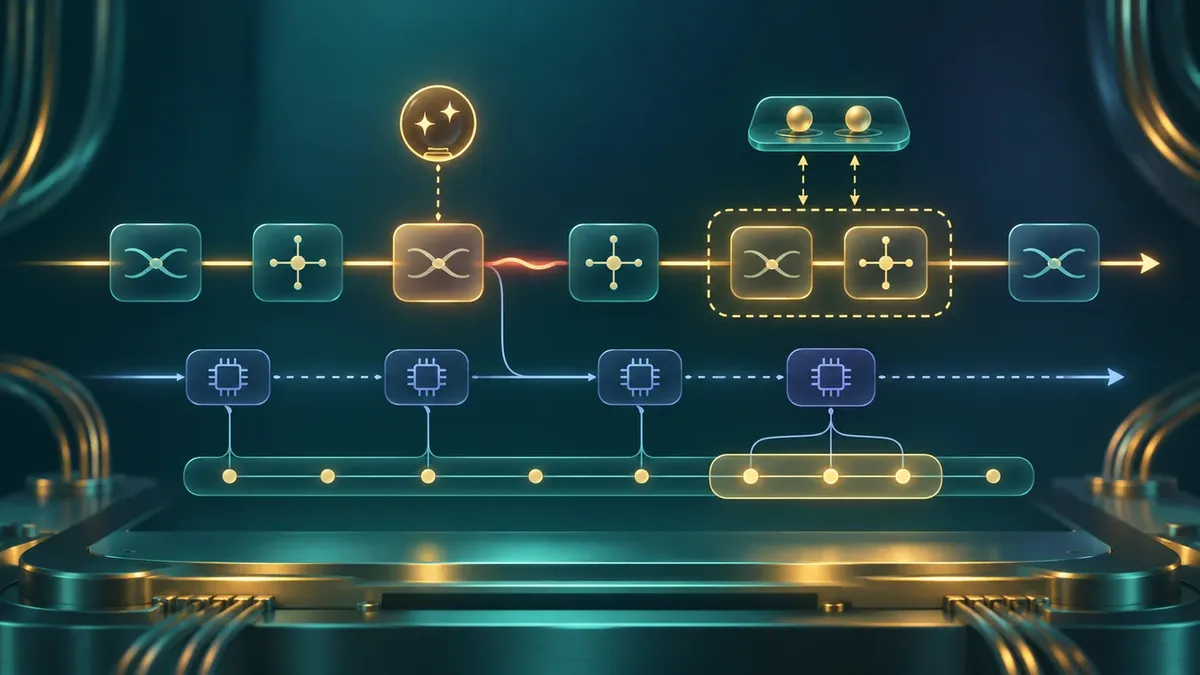
Some feedback-dependent operations in fault-tolerant quantum computing must wait for classical error decoding to finish. Froq proposes letting certain operations run ahead on a prediction, with pre-checked plans to handle the resulting speculative residual if the prediction is wrong.
Why let quantum operations run ahead?
Fault-tolerant quantum computers use error-correcting codes to protect logical information. The system repeatedly measures checks on physical qubits, and classical decoders use those outcomes to infer errors. Some operations depend on a decoding result: for example, a T gate can require a conditional S correction. If that result is not ready, the dependent operation may have to wait.
The paper Froq: Safe Speculative Execution on Live Quantum States for FTQC, by Yicheng Guang and Yueqi Chen, asks whether such operations can proceed using a prediction instead. This extends speculation beyond the classical decoder, which can already guess intermediate decoding results and redo work when a guess is wrong.
A quantum processor cannot simply save a copy of its state and restore it after a mistaken guess. Instead, speculation acts on the live computation. A wrong prediction leaves a residual difference from what would have happened if execution had waited for the confirmed result. That residual can spread through later operations, and affected measurement records may also need correction. Froq is designed to handle particular supported residuals—not to provide general quantum error correction or a rollback mechanism.
Plans for supported recovery
Froq combines an offline compiler with a controller runtime. For each eligible prediction, the compiler traces how its residual could propagate through later operations. At possible stopping points, it prepares and checks a recovery script, and records the options in a “recovery contract.” Execution is not allowed to run beyond the point where recovery has been validated.
Before speculation begins, the runtime reserves the extra qubit workspace that the contract’s recovery scripts might need. This is intended to avoid a deadlock in which recovery cannot proceed because another operation occupies its workspace. The runtime also compares the expected time saved with the expected costs of recovery. It can wait, defer a correction, or apply a predicted correction early; precomputed decision tables help it make these choices during execution.
The implemented recovery library has limits. Froq speculates on conditional S corrections for T gates. In the adders studied, a measurement-conditioned CZ can leave a residual outside that library, so Froq waits for its decoding result instead. The authors say supporting such cases would require a broader recovery library and a more accurate predictor.
What the simulations found
The researchers evaluated Froq in simulation on eight programs across code distances and decoder budgets, reporting 88 configurations. Froq ran on top of SWIPER, a system that speculates within classical decoding; the baseline was SWIPER alone. Both systems shared the modeled program layout and decoder timing, and the simulations included modeled latency for Froq’s controller decisions.
Across all 88 configurations, Froq reduced simulated “quantum-side time”—the time for the quantum processor to finish the program—by 9.81% relative to SWIPER alone. That average includes 38 configurations where the training-time selector chose not to speculate, so the systems behaved identically. Across the 50 configurations where Froq did speculate, the reduction was 16.62%; across the 45 allowing concurrent predictions, it was 18.34%. The peak reported reduction was 31.1% for a five-qubit quantum phase estimation program at code distance 21, under two decoder-budget settings.
Results varied by workload. Quantum phase estimation, Grover search and the quantum Fourier transform accounted for the main reductions. The adders showed little or no benefit in test results; the authors point to their smaller number of T gates and to operations Froq does not speculate on. In one Adder-8 configuration, training favored speculation, but the test runs showed a small slowdown. The findings underscore the role of deciding when to wait rather than run ahead.
What the evidence does—and does not—show
The paper reports two distinct validation results. The compiler’s checks found that 77,295 recovery scripts used in the evaluation passed script checks. Separately, 433,533 recovery regions passed direct comparison on evaluated schedules at code distances 13, 17 and 21. The authors’ correctness claim is exact recovery under ideal instruments for the supported residuals and checked templates; it is not a general guarantee for arbitrary errors or noisy hardware.
The performance evidence is also limited to simulation. The authors did not measure how recovery operations affect logical failure rates under realistic noise. A patch-round estimate suggested lower total exposure in the simulated runs, but comparing reliability at a common logical-failure target would require a failure budget for recovery operations.
Only two controller components were synthesized for an FPGA; timing for other components was derived or estimated. The full controller still needs implementation and testing alongside a real-time decoder. Evaluated programs used at most 95 logical qubits and code distances up to 21. As an arXiv preprint, the paper has not, on the evidence supplied here, been established as peer reviewed. Froq therefore provides a simulation-based case for bounded speculation on selected operations, not a demonstrated hardware speedup or proof of improved reliability.
- fault-tolerant quantum computing
- quantum error correction
- quantum decoding
- speculative execution
- Froq
Related reading
Automatically matched by shared topic keywords. These links do not imply that the sources agree or establish a consensus.
When the Most Likely Error Is Not the Best Correction
Source published
Shared keywords: quantum decoding, quantum error correction
GARI++ splits quantum error correction into a fast first pass and a smaller cleanup
Source published
Shared keywords: quantum decoding, quantum error correction
Small changes to a decoder’s assumptions improve quantum error correction in simulations
Source published
Shared keywords: quantum decoding, quantum error correction
A quantum compiler that keeps error correction in view
Source published
Shared keywords: fault tolerant quantum computing, quantum error correction
GeneCS Targets Leaner Quantum Code Surgery
Source published
Shared keywords: fault tolerant quantum computing, quantum error correction